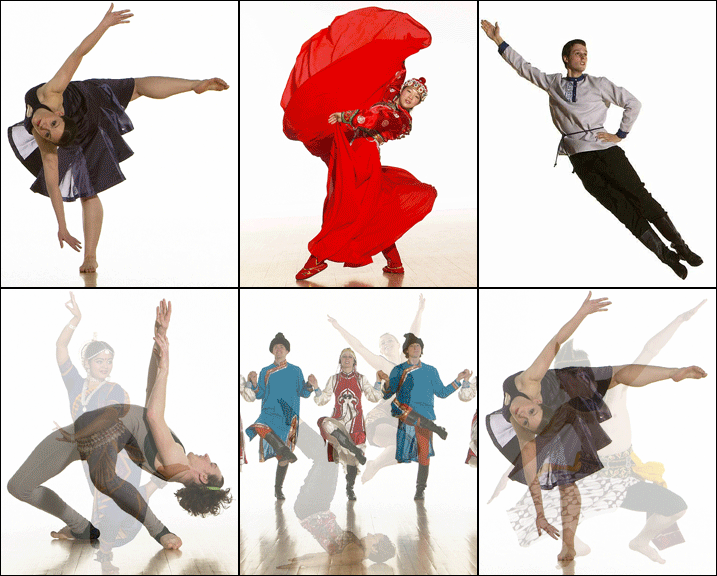
RATIONALE: Training in modern dance technique accentuates and deepens awareness of the body, while acknowledging and exploring established connections between the physical, cognitive, and emotional aspects of the individual. Modern dance technique builds physical, aesthetic and conceptual skills important to the development of a proficient contemporary dancer and assists the student in developing movement clarity, intentionality, and artistry.
CLASS DESCRIPTION: Modern Dance Technique I is geared toward the student with no or limited previous modern dance training. The primary aim of this course is to encourage you to begin the guided exploration and development of an artistic and creative movement practice, via the synthesis of your physical, cognitive and emotional capacities. Throughout this class, you will study principles, movement activities, and language common to a variety of modern dance styles.
The vast majority of the material for this course is learned through your active, physical participation in all class related activities and your out of class practices and explorations.
This modern dance technique class will consist of numerous movement experiences geared to increase coordination, alignment, strength, flexibility, and endurance. Class generally begins with stationary warm-up exercises and progresses to traveling movement patterns that incorporate conceptual elements of dance and build rhythmic, spatial, and dynamic skills. You will also explore the creation of movement material through guided movement exercises. Live musicians accompany this class.
CLASS OBJECTIVES -- during this class you will have the opportunity to learn and perform dance and develop the following dance-related elements:
- Awareness of Your Body: Explore elements of your unique body, its function, actions and ability.
- Alignment: The ability to maintain correct musculoskeletal positioning in movement or stillness.
- Coordination: The ability to efficiently link movement patterning.
- Movement Clarity: The ability to demonstrate accurately and consistently execute intended movements.
- Conditioning: The ability to demonstrate balanced flexibility, strength and endurance.
- Artistry: The ability to integrate technical skills with intuition and personal presence.
- Adaptability: The ability to employ physical and performance skills for a variety of choreographic intentions.
- Analysis: The ability to perceive and discern between successful/effective and unsuccessful/ineffective examples of Alignment, Coordination, Clarity, Conditioning, Artistry and Adaptability in yourself and your peers.
- Discussion: The ability to express your ideas, experiences, and findings of your analysis through oral and written means.
- Creativity: The ability to engage in creative problem solving in individual and group movement activities.
- Dance Vocabulary: Establish a functional language for modern dance description and analysis.
- Historical Perspective: A general understanding of the roots and pioneers of American Modern Dance.
METHODS -- you will:
- Learn and create movement material through guided instruction and intuition in highly and loosely structured settings.
- Consider, apply and deepen physical, cognitive and emotional approaches to artistic movement studies through movement and written practice.
- Engage in consistent and repetitive exploration, refinement and performance of all class related material.
- Receive and process critical feedback from the instructor and other students during class.
- Perceive, assess and provide critical feedback on the work of other students.
- Reflect upon your individual progress through in class discussions, sensory and video observation, and class-related written work.
- See, consider, and discuss live and videotaped modern dance performances.
ACTIVITIES:
- Learn / Remember / Refine Physical Movement Material & Language
- Initial Goals Limerick & Favorite Activity Forum
- View & Respond to The History of Modern Dance Video via Moodle Forum
- Video & Written Self Observation
- Modern Dance Examination
- Performance Attendance / Visual Poetry Impressions
- Learn / Remember / Refine Physical Movement Material & Language: You are expected to work diligently in and outside of class, alone and/or in groups, to cognitively and physically learn, retain, analyze and improve your ability with all the course material (movement, vocabulary, your own individual and group phrases, etc.) given in class. This 'unsupervised' time of experiential movement exploration outside of class will prove to be a positive factor in your growth, confidence, sense of accomplishment, and grade in this class. Your earnest efforts will be rewarded and noticed, by you, your peers, and the instructor, and it will serve you well as we connect movement sequences to develop longer and more complex movement phrases throughout the term.
- Friday Dance Lab: Dittmann Center Studio 2 is reserved each Friday from 12:00pm-3:00pm for any student enrolled in a dance class to physically practice and refine class-related work. I plan to make myself available for some of the dance labs; however, this lab time is primarily designed as a significant opportunity for your self-guided and reciprocal peer learning opportunities. If Friday from 12:00pm-3:00pm does not work with your schedule, as a registered student in this dance class you are able and strongly encouraged to reserve alternate times in the dance studios for class-related work. See the studio sign-up sheets on the bulletin board between studios 2 and 3 to reserve studio space to work on class material.
- Initial Goals Limerick & Favorite Activity via Moodle Forum: You are expected to identify and give a rationale for two initial goals in taking this course. In essence, you should ask yourself, "What are the two primary things I wish to work on most in this course?" "Getting the G.E. credit out of the way," although a reality for some students, is not an acceptable goal to select in successfully completing this assignment.
Include an aspect of your physicality that you consider a strength and another that you believe is a liability.
If you have taken a previous dance course, your goals should address your dance technique and/or performance, including habituated physical/movement patterns, or other aspects relevant to your individual process and this course.
If this is your first formal dance class, your initial goals may address aspects related to other physical activity experiences you've encountered.
Your initial goals will help me to assist your individual process and provide you with more specific feedback, as well as serve as an initial benchmark for your individual journey in this class.
- Submit your initial goals and rationale as a limerick.
Two resources with examples:
- In addition to but separate from your limerick, include your year in school, major(s) and previous dance experience AND favorite activity when you submit this assignment.
- Please follow the Written Assignment Submission Guidelines for this course.
- Be thoughtful and have fun with this assignment.
- Due Monday, 2/14 by 10pm via Moodle.
- Moodle Forum Discussion of The History of Modern Dance Video: As part of this class, you will view the video, The History of Modern Dance. The video includes interviews, archival photographs, and footage of dance rehearsals and performances to explore the history of 20th century dance. It features discussion of topics such as shoeless dancing in ballet, the Graham technique, the contributions of the African and Caribbean movements, the use of technology, the role of academia, and more.
After viewing the video, please discuss the following two questions. In addition to your initial post, you must also respond to at least post by one or more of your classmates.
- What information introduced in the video was interesting and/or new to you and why?
- With which historical dance figure from the video do you have the strongest connection and why?
- How might you use some of the information/material from the video as you begin or continue your journey in this class?
NOTE:
1. Please exhibit an appropriate amount of respect and sensitivity for others when posting your to this forum.
2. Please report any challenges in posting to this forum to me asap.
3. Suggestions for improving this forum as a collaborative learning experience are certainly appreciated.
Due: Friday, 2/11 by 10pm via Moodle.
- Video & Written Self-Observation: Two to three times during the term (near the beginning, middle and end), you will be videoed while performing movement material you have learned and created in relation to this class. The videos will serve as a visual record of your growth and process in this course.
Around mid-term, you will observe video/s of yourself dancing and submit a brief written analysis of your growth and process, successes and challenges, with the class material thus far. The goals for the visual and written self-observation are to encourage and enable you to:
- gain experience performing movement material in small groups and as solo performers.
- develop the ability to perceive your movement process and growth with an 'outside eye' (as objectively as is possible).
- develop the ability to describe, analyze and articulate your ability, including individual strengths and weaknesses, with the course material.
- observe and analyze the ability of your peer dance students.
- deepen your knowledge of class language and movement material by incorporating them into written analysis.
- synthesize your initial goal and instructor/peer feedback with your own awareness of your ability.
- outline a strategic plan for your continued growth and process in this class.
The plan is to have the mid-term course video material online, so you are able to view them from any computer with internet access (be prepared for some limitations).
- **** Due to the organizational logistics and time-consuming nature of the videoing, editing, and uploading processes involved in this activitiy, it is very important that you be in attendance on the video session days.
If you are not present during class for the videotape sessions, to avoid receiving 'no credit' for this assignment, you are responsible for videotaping yourself performing the designated movement material you have learned and created in relation to this class, which involves:
- checking out a digital video camera from Rolvaag and obtaining an appropriate format blank tape for the camera.
- arranging for someone to videotape your performance of the movement.
- reserving studio space to record your performance of the movement.
- viewing the videotape (outside of class) of your performance of the movement.
- Modern Dance Examination: You will take a written examination via Moodle on the modern dance language, movement concepts, and historical information introduced and/or used in relation to this course. Glossaries covering much of the material on the examinations are available on Moodle.
- Modern Dance Performance Attendance and Visual Poetry 'Impressions' Activity: As a member of this class, you are required to attend a minimum of one fully produced modern dance concert by a professional (preferred) or college dance company. Neither a ballet, play, musical, informal showing nor 'works in progress' will count toward this requirement. If you are unsure if a potential dance concert fulfills this requirement, ask me. You are encouraged to attend as many dance events as possible.
- Visual Poetry 'Impressions' Activity
- Within one week after the performance date, you will submit your impressions of the dance performance you attended. Your impressions are to be submitted as a visual or concrete poem, and your poem will be shared with the rest of the class via the corresponding Moodle forum.
- (Visual/Concrete poetry:
the typeface and arrangement of text upon the page can be as important as the words themselves in conveying a message or effect
- Some examples may be found at: http://www.poetryfoundation.org
- Your impressions must include your favorite aspect of the performance, your least favorite aspect, and include a justification for your point of view.
- In addition to but separate from your poem, include your name and the name, date, location of the performance you attended. If you are writing about specific pieces, please include the names of the pieces and the choreographer when you submit this assignment. You may choose to put this information inside the body of your poem or included as additional information.
- Please follow the Written Assignment Submission Guidelines for this course.
- Be thoughtful, creative and have fun with this assignment.
- Due one week after viewing the performance.
Course Guidelines / policies:
Class Etiquette
- Studio Rules:
- No street shoes in the dance studios. Please remove your shoes before entering the dance studio and leave them outside the studio.
- No food or drink other than water (recommended) in a closable, non-glass container.
- No chewing gum or smoking allowed in the studio.
- Cell phones/pagers need to be turned off prior to class.
- Dress Code:
- You will be dancing in bare feet.
- Dance clothes for class should be comfortable without hiding or distorting the lines of the body. Close fitting dance/athletic wear or similar is best. Jeans and similar kinds of pants are not acceptable. Excessively baggy clothing is not acceptable. Gentlemen should consider purchasing a dance belt (artistic athletic supporter). Let me know if you have questions.
- Hair needs to be pulled back from the face and neck
- Long earrings and large or noisy jewelry should not be worn.
- You may consider purchasing kneepads to reduce the potential for irritation when the knees encounter the floor while performing movement combinations with floor work.
- Conduct: You are expected to:
- Be courteous and respectful of the people with whom you are working.
- Have a positive mental attitude.
- Be consistent, self-motivated, and committed to your work.
- Be well prepared for and focused on all tasks you are expected to perform.
- Pay close attention to details and directions (guidance for enhancing your dancing).
- Understand that general directions, while not given to you specifically, may still pertain to you as a member of the class.
- Take constructive criticism and apply it to your work without allowing your personal feelings to interfere with the process.
- Ask questions of the instructor. Beyond this, students should not engage in unnecessary conversation and should give the instructor their full attention at all times.
- Take responsibility to help create a positive atmosphere in the studio classroom.
- Stay engaged. Sitting between combinations is considered poor etiquette as well as being physically detrimental.
- Writing Materials: Bring writing tools to all class meetings: You may need to write down questions, class vocabulary, concepts, and movement material during class.
- Injuries: Due to the experiential and participatory nature of dance classes, it is important that you be able to participate, physically and mentally.
If you have an injury that impedes or prevents you from participating fully in a class, please inform me at the beginning of the class period.
- Tactile Teaching: Tactile (of, having or perceived by the sense of touch) teaching involves hands on correction by the instructor, and is a valuable teaching aide in assisting the student in understanding aspects of proper alignment, placement and movement concepts during class. If any student is uncomfortable with this aspect of the technique class, please let the instructor know immediately.
Absence Policy
- You are expected to be present, on time, appropriately dressed, able and ready to move for every class period. You are expected to plan your personal and curricular schedule of activities to accommodate your full participation in each class period.
- You are expected to meet with classmates to learn and/or review movement material missed as a result of an absence. It is your responsibility to obtain class information and/or handouts missed as a result of an absence.
- You are allowed one absence without effect. Every absence after that lowers your Demonstrated Quality of Effort grade by one grade level (from A to A-, etc.).
- Second or third absences must be made up in other dance technique classes. See Make-up Class Policy /Options below for more information.
- Failing to make up absences beyond the first will result in a grade of F for this course. No other make-ups are allowed.
- The fourth absence is an automatic F for the course.
- If a situation arises in which you must miss class for more than 2 consecutive days, you must immediately inform me and the Dean of Students so that appropriate accommodation may be made. Such accommodation will be made on a case by case basis, with consideration given to your health, well-being, academic integrity and the academic integrity of the Dance program and the College.
- If you are not able to participate during a class period due to illness or injury, but you are well enough to sit and watch class, you can avoid an absence by observing the class and submitting an observation paper.
- Exceptions to the Absence Policy:
- If you must miss class for a College sanctioned event, you will be allowed one additional absence without effect, provided that official notification (email or signed document from faculty/administrative staff supervising the event) is sent to me prior to the day of the class being missed.
- Job Interviews, non-emergency medical appointments, meetings with advisors and the like are not valid exceptions to the absence policy.
Electronic Communication
Information is often sent via email. It is your responsibility to check your email on a regular basis, and to read and promptly respond to all messages related to this class.
Make-up Class Policy / Options
Second or third absences must be made up in other dance technique classes.
You must make-up a missed class by participating in or observing any St. Olaf Dance Department dance technique class.
- You need to obtain the permission of the instructor of the make-up class in advance to make sure you may participate in or observe the class on the day you wish to attend.
- You need to fill out the Make-Up form located near the Companydance bulletin board in the hallway between studios 2 & 3, and obtain the signature of the instructor of the make-up class. Let me know if you have difficulty finding the Make-Up form.
- No make up classes will be permitted during the last two weeks of classes. This is generally an important time of culmination for all dance classes, and the presence of additional students can impede the effectiveness of this process. So, if you know you will have an absence during the term, plan ahead to schedule and attend a make-up class.
Observing Class Policy / Submission Guidelines
If you are not able to participate during a class period due to illness or injury, you may avoid being counted absent for the day by observing the class and submitting an observation paper. This option may be used once, as two observations equal one absence. Below are guidelines to be followed in completing an observation paper.
- Bring pen/paper/laptop with you to the class you plan to observe. You should take detailed notes on the process/progress of the students in class, taking into consideration dance technique, performance and other aspects from class that we are working on and you deem relevant.
- You should reflect upon your individual class process and submit a one-page paper comparing/contrasting your process with that of the other students in class.
- The observation paper must be submitted prior to the beginning of the next class period to avoid receiving an absence for the observed class.
- Please follow the Written Assignment Submission Guidelines for this course.
Open Door Policy
Students may make an appointment with me at anytime during the semester. Email (awr) is likely the most efficient method for making an appointment, but feel free to call my office (3622), home (645-8849) or catch me sometime between classes.
Tardy Policy
- You are expected to be present, on time, appropriately dressed, and ready to move for every class period. If you are not present when roll is called you will be marked tardy. If you are late for class 3 times, you will receive 1 absence (6 times late = 2 absences, etc.). If you arrive late for a class period, please inform me at the end of class, so I can mark you as 'present'.
- If you are 10 minutes late to class, you will not be allowed to participate, but must observe class and complete the corresponding observation paper (see Observation Paper Guidelines below). This is in consideration of the your health, injury prevention, and with respect for your peers in this class. If you must leave class early, please inform me before class begins. You will receive either a tardy or an absence, depending upon how much class is missed. If you choose to leave class without informing me, you will receive an absence for the class.
Written Assignment Submission Guidelines:
- General:
- Unless otherwise specified, all written assignments (except the class journal) should be completed in Microsoft Word, typed, double-spaced and checked for correct grammar and spelling. The electronic assignment file should follow the correct naming scheme specified below.
- Include in your written paper:
- your first and last names.
- the name and section of the course in which you are enrolled.
- the name/title of the assignment.
- Papers should address the requirements of the assignment thoughtfully and concisely, and there is no required number of pages for written assignments.
- Naming Scheme for the Electronic File:
- You are asked to submit your electronic assignment documents with a very specific naming scheme. This process is in place to assist with efficient file management of your assignments.
- Submit all your written assignment files for this class using the following naming scheme:
- your last name-first initial of your first name-assignment name-course number and section.doc (make sure you use the suffix is '.doc' or '.docx' depending upon the version of Microsoft Word you are using).
- For example, I would save my assignment files for Modern I, section Z (dance-111z) with the following names:
- Self-Observation: roberts-a-selfobserve-dance-111z.doc
- Observation Paper: roberts-a-observepaper-dance-111z.doc
- Performance Impressions Haiku: roberts-a-impressions-dance-111z.doc
- Any assignments failing to be follow the correct naming scheme must be correctly resubmitted. This may result in a late assignment, which will result in a 50% reduction in grade.
- Submit your assignments through the St. Olaf College Moodle website/server.
- Late assignments:
- 1 day late will receive only 50% credit.
- 2-3 days late will receive only 25% credit.
- Over 3 days late will receive zero credit
Academic Integrity:
St. Olaf College's Honor System Policy applies to tests, quizzes and examinations, whether in-class, take-home, or on-line.
St. Olaf College's Academic Integrity Policy applies to all other work, including papers, posters, research, internships, lab work, etc.
Disability Services
If you have a documented disability for which accommodations may be required in this class, please contact Connie Ford (ford@stolaf.edu) or Erin Larson (larsonee@stolaf.edu) in the Academic Support Center (507-786-3288) as soon as possible to arrange accommodations. If you have already presented your documentation and/or arranged accommodations through Student Disability Services, you are required to provide me with your accommodation letter within the first two weeks of class. Accommodations will only be provided after the letter is submitted to me and with sufficient lead-time for me to arrange testing or other accommodations.
For more information: http://www.stolaf.edu/services/asc/sds.html.
Assessment:
Grading Systems:
All level 1 movement intensive dance courses are offered P/N (pass/no credit) only. In these courses, grades may be used during the term for evaluation of students, but the grade given is only P or N.
In determining your final grade for this course, the following factors are taken into consideration:
- Assessment definitions in reference to the St. Olaf College Grade and Marking System: While much of the language reflects a focus on language-intensive rather than movement-intensive classes, such as a dance class, there are obvious parallels to the high standards and expectations the dance department maintains when assessing students at St. Olaf College.
- Assessment definitions derived from discussions with dance colleagues and resources.
- Personal experience concerning of expectations of dancers in the profession.
- This course is movement-intensive in nature. In determining your final grade in this course, more weight will be placed upon your your physical practice; however, your language-intensive work in this course may play a significant role.
Assessment Definitions:
St. Olaf College Grade and Marking System:
Final letter grades and their corresponding grade point values are listed below along with short descriptions at each grade level. The descriptions give students, faculty, graduate schools, and employers of St. Olaf College graduates a general sense of the gradation of academic expectations at a glance.
In the leftmost column below, one can link to a list of grade benchmarks that is meant only as a guideline for St. Olaf College faculty and students. Individual faculty members are free to grade according to their own systems; students should consult with their professors for accurate information about course requirements and expectations.
Grade Benchmark Achievement Levels
Superior achievement (A level):
The grade of A recognizes exceptional performance and achievement that exceeds course expectations and consistently demonstrates, where applicable, many of the following characteristics:
- Thorough, deep, and mature understanding.
- Genuine comprehension, insight, and synthesis.
- Significant mastery of challenging topics and issues.
- Extensive familiarity with relevant literature and previous work.
- Highly developed communication skills.
- Thorough preparation and extensive, thoughtful class participation.
- Integration of knowledge, concepts, and principles across disciplines.
- Originality of analysis and interpretation.
- Technical competence in skills and procedures.
Precision of ideas and clarity of expression.
- Thinking that is independent, creative, and focused.
- Understanding of nuance and subtlety.
- Consistent coherence in argument and discussion.
Students who receive the grade of A consistently demonstrate, where applicable, the ability to:
- Analyze arguments using specific examples and original sources.
- Think logically, draw inferences, and make predictions in complicated situations.
- Communicate reasoning clearly and concisely.
- Think abstractly.
- Identify strengths and weaknesses in arguments, policies, and practices.
- Integrate information to draw well-founded conclusions.
- Connect course content to issues of other courses and world affairs.
- Use models appropriately; recognize their strengths and accommodate their inherent limitations.
- Foresee and evaluate consequences of proposed policies and actions.
- Use technology creatively and effectively.
Good Achievement (B level):
The grade of B recognizes work that meets course expectations and typically demonstrates, where applicable, many of the following characteristics:
- Clear understanding without much originality
- Competent grasp of course materials and subject matter
- Familiarity with relevant literature
- Competence in communication skills
- Regular preparation for and participation in class
- Integration of course knowledge, concepts and procedures
- Some evidence of critical and creative thought
- Clear connections between inferences and evidence
- Care in the use of evidence and quotations with only occasional thinness in argument, detail, or precision.
Students who receive the grade of B typically demonstrate, where applicable, the ability to:
- Extend ideas by connecting with personal experiences, reading, or world events.
- Analyze data in various forms and from varied sources.
- Utilize information to explain events, draw conclusions, and apply results.
- Present comprehensive answers in a clear and logically correct style.
- Understand and compare various models.
- Distinguish inputs from outputs, and causes from effects.
- Recognize consequences of complex interactions.Use technology effectively.
Adequate Achievement (C level):
The grade of C recognizes work that is sufficient to prepare for continued study in the field and generally demonstrates, where applicable, some of the following characteristics:
- Adequate grasp of course concepts
- Partial mastery of knowledge and skills required for understanding
- Incomplete familiarity with relevant readings or references
- Writing that lists facts rather than develops well-reasoned arguments
- Frequent neglect of important information
- Partial appreciation of the meaning or implications of a question
- Answers that are insufficiently developed
- Minimally complete assignments with many areas for improvement.
Students who receive the grade of C generally demonstrate, where applicable, some ability to:
- Assimilate and communicate simple knowledge and procedures,
- Extend ideas by making simple inferences,
- Make connections among and draw conclusions from course concepts,
- Interpret simple information provided in various formats,
- Organize and display data in tables and graphs,
- Use technology competently.
Limited Achievement (D level):
The grade of D indicates a lack of readiness to continue in the field. Students’ work usually demonstrates, where applicable, some of the following characteristics:
- Minimal understanding of the subject matter.
- Poorly developed communication skills.
- Inability to apply subject matter understanding in other contexts.
- Little evidence of critical or creative thinking.
- Lack of apparent seriousness.
- Frequent carelessness in fulfilling assignments.
Inadequate Achievement (F):
The grade of F indicates that course work is insufficient to merit academic credit. Students who receive an F usually demonstrate some of the following characteristics:
- Inadequate understanding of subject matter.
- Inadequate or inconsistent preparation.
- Frequent failure to complete assignments in a timely manner.
- Little evidence of critical thought.
- Very poor communication skills.
- Frequent misunderstanding of facts or references.
- Little or no analysis.
- Confused or incomprehensible writing.
- Little or no work offering evidence that course objectives have been met.
Grading System specific to, but not exclusive of, movement-intensive Dance Classes
- Excellent (A) = Excellent is for students who do work of an outstanding nature, are consistently self-motivating in individual and group settings, show a hunger to know, a passion for learning, and a willingness to take appropriate physical and artistic risks. An 'A' student responds and contributes to class material, effectively integrates feedback and demonstrates exceptional growth toward the objectives of this course.
Students who expect to receive the grade of A in this class must consistently:
- Come to class prepared to dance: physically, intellectually, emotionally
- Demonstrate ample preparation through knowledge of and ability with course material
- Are on time: to class, with assignments, in course-related communication
- Endeavor to engage to a high degree with course material from the moment they enter the studio space until the class period ends
- Strive to discover, develop and deepen
- Demonstrate ingenious independence and self-motivation
- Demonstrate exceptional technical and artistic ability with course material
- Take movement risks
- Assume roles of leadership: frequently stand in front and vary their placement during class, often go in the 1st group across the floor, continue to dance until directed to rest, etc.
- Demonstrate awareness of subtleties in material, even as material develops and evolves
- Ask probing questions and offer points of view that advances critical inquiry
- Good (B) = Good is for students whose work is distinctly above average in quality and thoroughness, depicting a solid grasp of the subject matter and are self-motivating in individual and group settings. A 'B' student shows dedication, a willingness to take new steps, concentration, consistent work and demonstrates increased accomplishment of some skills during the term.
- Average (C) = Average is for students who do their work and actively participate in class but lack the energy, will or ability to take it to new heights. An average student, although present in class, does not perform in a way that commands to be seen. A 'C' student has accomplished some skills throughout the term, but both student and instructor know it could be better. Work habits are inconsistent. A 'C' student can accomplish more.
- Poor (D) = Poor is for students who have not done their work regularly. Lacking the necessary energy, diligence or passion for dance, the 'D' student has shown very little improvement and depicts a limited understanding of the subject matter.
- Fail (F) = Fail is for students who have missed more than the allotted number of classes, been tardy or left class so much that there is no base from which to grade, or has made no effort to grasp the material while in class.
Course Graded Percentages
Demonstrated Quality of Effort: 60%
- Degree of consistency and quality of your work habits
in both movement-intensive and language-intensive aspects of this course, including:
- Participation
- Preparation
- Concentration
- Self-discipline
Demonstrated Level of Ability: 40%
- Degree of consistency and quality of your demonstrated ability
in both movement-intensive and language-intensive aspects of this course, including:
- Alignment / Coordination / Clarity of Movement
- Embodied Knowledge of Material / Adaptability
- Self-confidence / Performance Artistry / Creativity
- Discussion / Analysis / Dance Vocabulary / Written Work / Critical Inquiry
Important Dates to Remember:
- Friday, 2/11
- Moodle Forum Discussion of The History of Modern Dance Video
- Friday, 2/14
- Initial Goals Limerick & Favorite Activity via Moodle Forum Due
- Week of 3/14
- Video Students Performing Course Movement Material
- Fri, 4/1
- Week of 5/2
- Take Modern Dance Examination
- Fri, 5/6
- Last day to take a make up a class
- Mon, 5/9
- Last Day to Submit Dance Performance Visual Poetry Impressions (Must be submitted within one week of the performance date.)
There will be no final examination.
GEC Attributes: This course is intended to satisfy the ALS-A (Artistic Studies) and PHA (Physical Activity) General Education Requirements. Under consideration are several revisions to and re-certification of several GEC attributes, including PHA. I have included the current draft of the revisions below, for your consideration Studies in Physical/Human Movement (SPM), previously PHA: Guidelines
- Course will introduce and develop a physical technique by engaging students in physical movement.
- Course must include a cognitive component where students learn about moving.
- Course must provide information about lifelong health and wellness of the whole person.
- Course must provide historical and cultural background relevant to the activity, illustrating the wide range of roles of physical activity in human development.
Intended Learning Outcomes
- Students will demonstrate the ability to successfully perform a range of skills connected to a given physical technique.
- Students will demonstrate knowledge of the body's structure, function, and expression specifically in the performance of a given physical technique and broadly in creating long-term well being.
- Students will reflect on their feelings, values, and attitudes regarding movement and long-term well being.
- Students will understand the historical and cultural background relevant to the activity, illustrating the wide range of physical activity in human development.
Syllabus Credits: Over the years, a number of dance artists and institutions have contributed to and helped shape my philosophy of and approach to teaching dance technique. I'd like to especially thank the following individuals and institutions for their invaluable input, guidance, support and generosity in sharing their artistry, philosophies and permission to use some of their ideas in developing my courses.
- St. Olaf College
- Janice Roberts
- Sherry Saterstrom
- Heather Klopchin
- Anne von Bibra
- Ann Wagner
- Dance Center of Columbia College in Chicago
- Arizona State University
- Gustavus Adolphus College
- Repertory Dance Theatre
- Linda C. Smith
- Ford Evans
- University of Utah
- Barbara Hamblin
- Yi-Qi Cheng
- Li-Chou Cheng
- Bené Arnold
- Abby Fiat
- University of Oklahoma
- Mary Margaret Holt
- Miguel Terekhov
- East Tennessee State University
|