
Movie of Lake Coring (This is a large file so you may want to download first rather than playing directly from link).
With the help of Eric Cole and John Campion
I made a short movie of some of the steps involved in coring lake sediment.
The movie (16 mb, Quicktime) includes measuring lake depth with secchi disk,
inserting piston (to create vacuum while coring), attaching drive rod and lowering
corer, and then an image of end of corer before and during coring (note small
cloud of sediment during coring).
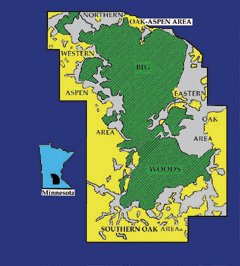
The Bigwoods were a large area of deciduous forest surrounded by prairie
that occupied much of south-central Minnesota (
J. McAndrews in the 1960s and E. Grimm again in the 1980s reconstructed the long-term history of the Bigwoods based on pollen analysis and changes in sedimentation. Both suggested that a reduction in fire frequency coincident with the onset of the 'Little Ice Age' only 300-400 years BP was the trigger for the expansion of the Big Woods; a competing hypothesis is that a reduction in Native American populations due to disease was responsible for a drop in fires but there is very little data to address this hypothesis directly. Grimm showed that the borders of the Bigwoods corresponded with the location of rivers and lakes and other features of the landscape that would have acted as fire breaks.
My students and I are trying to better understand the relationship of fire
to the rise of the Big Woods, examining
I have also been working with Phil Camill (Carleton), Christoph Geiss (Trinity College), and Becky Teed (LRC, University of MInnesota) on cores from two lakes in the Bigwoods both of which have sediment records that extend 10-12000 years. We have a paper in press in Journal of Paleolimnology describing some of this work as well as several manuscripts in review or in preparation. One interesting conclusion is that this area has remained a mix of forest and prairie throughout the past 10000 years -- even at the height of the mid-Holocene dry period (8000 BP).
 Fires have been a historical component of
the ecology of the northern Great Plains for the past 10000 years. The accounts
of 19th and early 20th century settlers and explorers are replete with stories
of these fires but we know very little about the long term history of fire.
I've been looking at charcoal deposited in lake sediments in North and South
Dakota and Montana. Charcoal (+120 microns in length) is abundant (picture to
right). The charcoal record indicates an extended period of increased fires
just before european settlement, possibly due increased ignition sources, and
extended periods of high and low charcoal deposition over the past 10000 years.
Fires have been a historical component of
the ecology of the northern Great Plains for the past 10000 years. The accounts
of 19th and early 20th century settlers and explorers are replete with stories
of these fires but we know very little about the long term history of fire.
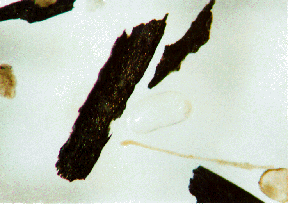
I've been looking at charcoal deposited in lake sediments in North and South
Dakota and Montana. Charcoal (+120 microns in length) is abundant (picture to
right). The charcoal record indicates an extended period of increased fires
just before european settlement, possibly due increased ignition sources, and
extended periods of high and low charcoal deposition over the past 10000 years.
Molly McGrath (St Olaf class of 1997) and I have also been research charcoal
morphology as an indicator of fuel type. We burned known grasses, leaves and
wood and then imaged the resulting charcoal using NIH Image. Grass charcoal
was significantly longer and skinnier (length:width ratio ~4-5) than either
wood or leaf charcoal (L:W 2-3), suggesting that charcoal morphology may in
fact be used as an indicator of vegetation type.