
- St. Olaf News
- Features
- For the Media
- Media Relations
- Kari VanDerVeen
- Alumni Hall
- 507-786-3970 office
- 507-412-1036 cell
- vanderve@stolaf.edu
 RSS Feed
You reached this page through the archive. Click here to return to the archive.
Note: This article is over a year old and information contained in it may no longer be accurate. Please use the contact information in the lower-left corner to verify any information in this article.
St. Olaf strives to be among nation's 'greenest' campuses
September 8, 2004
The 2003-04 academic year marked a resurgence of interest in the environment from all corners of St. Olaf. Plans to compost all food waste, generate energy by wind turbine and use only rain water on fields and flowers are among many ideas put forth by students, faculty and staff, who have joined in a new campus-wide Sustainabilty Task Force.
The goal is nothing less than to become one of the "greenest" campuses in the country.
Until now, the ecology movement at St. Olaf had been steady but quiet. In recent years, Bon Appetit General Manager Hayes Atkins says he had received knocks on his office door from students with earth-friendly suggestions such as serving shade-grown Peace Coffee in the college cafes. (Bon Appetit now does this.)
But recently he has observed widespread unity and support that he says is unique among the colleges Bon Appetit serves nationwide. "The faculty, staff and students are all in sync," Atkins says.
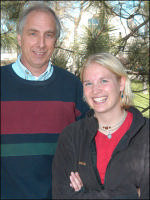 |
| Farrell and Braaten team-taught Campus Ecology last spring. |
"The Campus Ecology class has proven to be a fantastic way for students to see the positive impact they can have on their surroundings," says Farrell. "Our hope is that after the students graduate they will take what they have learned into the organizations and companies they join to help them to become ecological stewards, as well," Farrell says.
The integration of student ecology clubs has given students a stronger voice, as well. The St. Olaf Greens and the Students for Sustainable Development joined together as the Environmental Coalition.
Faculty and Staff Concur
Student environmental advocacy has been matched by staff and faculty advocacy. As a regular part of his job for more than a decade, Director of Facilities Pete Sandberg has made ecologically sound recommendations for campus buildings and grounds, resulting in more energy efficiency and the conversion of once-mowed land tracts into natural prairie, wetland and forest.
In the last comprehensive Association of Higher Education Facilities Offices comparative costs survey, St. Olaf had the lowest energy costs of any college reporting.
Sandberg has been a catalyst for bringing student, faculty and staff environmental concerns together in the Sustainability Task Force, inspired by President Thomforde's strategic plan calling for "economic and ecological sustainability." The task force is co-led by Sandberg and Farrell.
Farrell defines "sustainability" as "the art of assuring that people in the future will have what they need to lead fulfilling lives."
Major initiatives underway include:
Food Service
Energy
Power will be fed directly into St. Olaf's internal electrical system, rather than sold to a utility and re-purchased. The wind turbine will supply one third of all electricity that St. Olaf consumes, and reduce the direct carbon impact of the college on the atmosphere by 24 percent.
Facilities
Green Acres
Meanwhile, the "Campus Ecology" course continues to educate students by incorporating practical research on campus procurement policies, waste disposal, water usage and many other ecological issues. Student research will be followed by recommendations for the "greening" of St. Olaf.
The course has also engaged students in imaginative assignments such as examining the environmental impacts of their own dorm rooms and writing from the perspective of other organisms on campus such as ants, squirrels, flowers and trees.
Facts that Campus Ecology students have collected to raise awareness of "green" issues on campus have been posted, for example, near everyday objects to build awareness of environmental impacts at the college.
Signs near bathroom sinks might read: "This water comes to you courtesy of the Jordan aquifer, which recharges at a very slow rate. Some of Minnesota's groundwater entered the system more than 30,000 years ago and is still moving underground."
And signs on coffee machines at campus eateries say: "The Peace Coffee brewed in the Cage and the cafeteria makes good things happen because it's fair-trade, shade-grown coffee, supporting workers and the environment in countries like Guatemala and Costa Rica."
By adopting and acting on a set of environmental principles developed by the task force, St. Olaf can be among the greenest campuses in the nation, Farrell says.
Recent accomplishments include the restoration of seven wetlands and the hiring of consultants to help with green designs for the new natural sciences and mathematics complex.
Signs of change
During Earth Week in 2004, students posted warning signs about the environmental impact human beings make on campus, including:
* Xcel Energy makes most of its electricity from burning coal, which contributes to global climate change.
* There are 1,623 parking places on campus, which is one of the ways that the college caters to cars.
* For each gallon of gas we use, we put 20 pounds of pollution into the air. Gasoline is about 85 percent carbon, and as the gas burns in the car engine, the carbon is released into the air, where it combines with oxygen to become carbon dioxide, which weighs four times as much as the original carbon. A car may get 20 miles per gallon, but it also emit 20 pounds of carbon dioxide per gallon. This car, and other cars like it, are responsible for about one-third of fossil-fuel carbon dioxide emissions in the United States, and these emissions are the major cause of global climate change.
* A car is a way of breathing. Like people, cars inhale oxygen and exhale carbon dioxide (among other gases and particulates). So when we drive, we basically expand our lungs and increase our environmental impacts exponentially.
* Sleep is a good thing -- for computers. In sleep mode, the average electrical consumption of a personal computer drops by almost 69 percent.
* If you're breathing now, you're inhaling air that's been transformed in the last 100 years. It's not the same as the air that the first students at St. Olaf College breathed. In the 19th century, Oles inhaled air that contained carbon dioxide in concentrations of 280 parts per million. These days, we still suck in carbon dioxide, but we breathe 360 parts per million. Eighty parts per million sounds like no big deal, but it's enough to affect the global climate.
* The big bluestem in front of the Science Center is a native prairie plant. It can grow to heights of three to 10 feet. But even more impressive, its roots can grow to depths of 10 feet.
* Many of us worry about rainforest destruction, but we live in a place where humans have destroyed 99 percent of the original ecosystem -- the tallgrass prairie.
* If St. Olaf gets the grant to build a 1.65 megawatt wind turbine on campus,
* Xcel offers a lower rate to customers who agree to reduce electrical load during peak-use periods. Residential customers get a break, for example, if they agree to let Xcel turn off their air conditioners for short periods on the hottest days of the year. St. Olaf is in an even stronger position than most customers, because we own generators that can supply all our power at any time.
As a result, we save about $150,000 a year on our electric bill. And with our back-up capability, we have 100 percent redundancy in power production. When the lights go out in Northfield, they don't stay out at St. Olaf.


