
- St. Olaf News
- Features
- For the Media
- Media Relations
- Kari VanDerVeen
- Alumni Hall
- 507-786-3970 office
- 507-412-1036 cell
- vanderve@stolaf.edu
 RSS Feed
You reached this page through the archive. Click here to return to the archive.
Note: This article is over a year old and information contained in it may no longer be accurate. Please use the contact information in the lower-left corner to verify any information in this article.
'Body Maps' exhibit traces impact of HIV on South African women
September 22, 2004
An exhibit of art created by black HIV-positive South African women, called "Body Maps," will open in the Flaten Art Museum at St. Olaf College on Friday, Sept. 17, with a special opening program and reception from 4 to 6 p.m. The show, which is free and open to the public, will run through Oct. 19.
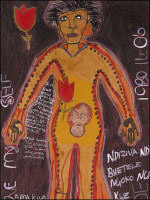 |
| A detail of the life-size self-portrait by Nomonde. |
The life-size Body Maps tell the artistsý own stories through painted representations of wounds, marks and HIV viruses together with textual fragments, areas of emotional significance and symbols of personal power. Shadow outlines of the partners of participants underline the importance of support and encouragement from others.
Body Maps is part of Memory Box Project, a Pan-African community outreach program initiated by the University of Cape Town, South Africa, that works with HIV-positive people to encourage expression and contemplation of their experience through writing, painting and other media.
Two years ago, Memory Box Project teamed with the humanitarian organization Doctors Without Borders to document the lives of a group of HIV-positive women. With the help of Cape-Town-based artist Jane Solomon, the participants created Body Maps, which Memory Box Project uses as research tools and as instruments in therapy and literacy programs.
The show is accompanied by a book, Long Life -- Positive HIV Stories, in which the artists share their stories. The book and prints are for sale, with all proceeds helping the people of South Africa who suffer from AIDS.
The Flaten Art Museum is located in the Dittmann Center on the St. Olaf campus. Visitor parking is available in the adjacent lot. The museum is open Monday, Tuesday, Wednesday and Friday, 10 a.m. to 5 p.m.; Thursday, 10 a.m. to 8 p.m.; and Saturday and Sunday, 2 p.m. to 5 p.m. Admission is free (the museum will be closed Oct. 23ý


