
- St. Olaf News
- Features
- For the Media
- Media Relations
- Kari VanDerVeen
- Alumni Hall
- 507-786-3970 office
- 507-412-1036 cell
- vanderve@stolaf.edu
 RSS Feed
You reached this page through the archive. Click here to return to the archive.
Note: This article is over a year old and information contained in it may no longer be accurate. Please use the contact information in the lower-left corner to verify any information in this article.
Armenian artist uses bread to address ethnic persecution, genocide, immigration
February 14, 2004
Apo Torosyan presents "Hope, Not Hate," his "Bread Series" of paintings on canvas, through March 14 in the Flaten Gallery of Dittmann Center at St. Olaf College. The gallery is open to the public.
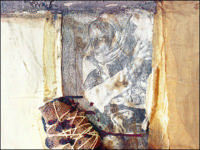 |
| A detail from "Bread #176." Mixed media on canvas, 18x18x1 inches. |
The exhibition, part of the Nobel Peace Prize Forum hosted this year by St. Olaf, is in part autobiographical. It also expresses the horrors of war experienced by several generations of his family.
The Armenian genocide was documented by the international press and neutral observers as it happened, but today the facts surrounding it can be a point of contention between Armenians and Turks. Torosyan says that people can expect quick answers to such issues, but those answers are not always easy. "But that's the beauty of art," he explains. "It gives you wonder and makes you think."
Torosyan's show is appropriate for this year's peace forum, called "Striving for Peace: Roots of Change." "I work to promote social change by talking about my story -- everybody's story," he explains. He will also present the session "Making Art, Making Peace: Arts and Social Change" during the forum.
The variety of bread Torosyan uses includes burned, unburned, whole, broken, sliced and simply crumbs. He notes that no two slices of bread are the same, saying that this "accelerates one's imagination."
The soundtrack accompanying the show is of bare hands making dough. Visual elements include mounds of earth symbolizing obstacles in the immigrants' new life, and newspapers from various countries representing the "tablecloth of the poor," according to Torosyan.
Visitors will also have the opportunity to write about first-hand immigration or new settlement experiences for use in future shows.
Torosyan emigrated to the U.S. from Istanbul in 1968 after receiving his M.F.A. from the Academy of Fine Arts. He sold his visual design company in 1986, allowing him to create many solo and group shows across the U.S. and Europe. His work "My Father's Letter" (1991) was selected for the permanent collection of the Museum of Modern Art on Tonneins, Bordeaux, France. Tarosyan's "Bread Series" is in the permanent collection of the Armenian Library and Museum of America in Watertown, Mass.
The Flaten Art Museum is located in the Dittmann Center for Art and Dance on the St. Olaf campus. Visitor parking is available in the lot adjacent to the Dittmann Center. The Gallery is open Monday, Tuesday, Wednesday and Friday, 10 a.m. to 5 p.m.; Thursday, 10 a.m. to 8 p.m.; and Saturday and Sunday, 2 p.m. to 5 p.m. Admission is free.
In cooperation with the Norwegian Nobel Institute, five Midwestern colleges of the Evangelical Lutheran Church in America sponsor the annual Nobel Peace Prize Forum. This prestigious event is the Norwegian Nobel Institute's only such program or academic affiliation outside Norway. The colleges, all founded by Norwegian immigrants, sponsor the forum to give recognition to Norway's international peace efforts and to offer opportunities for Nobel Peace Prize laureates, diplomats, scholars, students and the general public to engage in dialogue on the dynamics of peacemaking and the underlying causes of conflict and war.
St. Olaf College is a liberal arts institution that fosters the development of mind, body and spirit. It is a residential college in Northfield, Minn., and affiliated with the Evangelical Lutheran Church in America (ELCA). The college provides personalized instruction and diverse learning environments, with nearly two-thirds of its students participating in international studies.


