
- St. Olaf News
- Features
- For the Media
- Media Relations
- Kari VanDerVeen
- Alumni Hall
- 507-786-3970 office
- 507-412-1036 cell
- vanderve@stolaf.edu
 RSS Feed
You reached this page through the archive. Click here to return to the archive.
Note: This article is over a year old and information contained in it may no longer be accurate. Please use the contact information in the lower-left corner to verify any information in this article.
Recent books by St. Olaf professors honored at campus event
May 26, 2003
Publishing is both a pleasure and a requirement of academic life. St. Olaf College recently recognized five humanities faculty authors who have published either academic tomes or more general literature during the past year: Dean of the College James May, English Instructor Mary Winstead, Associate Professor of English James Heynen, Professor of History Michael Fitzgerald and emeritus Professor of German Norman Watt.
All five introduced and read from their recently published works during a reception at St. Olaf on May 13.
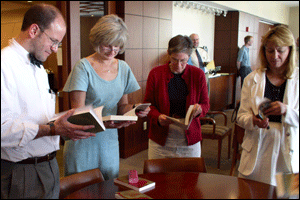 St. Olaf faculty members Jon Bruss, Sylvia Carullo, Mary Cisar and Corliss Swain browse colleagues' books during a May 13 event recognizing St. Olaf faculty published during the past year. Photo by David Gonnerman '90. |
Mary Winstead's Back to Mississippi won a Minnesota Book Award this year in the autobiography, biography, memoir category. Winstead wrote her memoir of her father's family in Neshoba County, Miss., based in part on her father's stories.
Her father, the son of sharecroppers, had a dry sense of humor, she explained. Winstead read a selection that described her father attaching a faucet to his briefcase, the type of antic that sometimes confused Winstead's childhood neighbors in the Linden Hills neighborhood of Minneapolis.
The book details her discovery that her father's cousin was involved in the murders of three civil rights workers in 1964. Unearthing this family secret strains her relationship with extended Mississippi family members.
A professor of classics, Jim May's task as editor of Brill's Companion to Cicero: Oratory and Rhetoric was to line up contributions from 13 of the world's leading Ciceronian scholars. The last three frantic weeks of the task coincided with his first three hectic weeks of his appointment as dean.
"If you've ever edited a volume," he quipped, "you probably don't want to do it again." The 632-page volume took years to assemble, and May is pleased and relieved to see the book finally in print.
Mike Fitzgerald's Urban Emancipation was nominated for the prestigious Lincoln Prize, awarded by Gettysburg College to a scholarly work in English on Abraham Lincoln, the American Civil War soldier or a subject relating to their era. Fitzgerald described his book as an investigation of the conflict among different African American factions in the city of Mobile Alabama immediately after the Civil War. (Click here to read an interview with Fitzgerald.)
"Raise your hand if you're an introvert" is a joke Jim Heynen uses on his classes every year in an effort to highlight the reserved Midwestern rural tradition. "This was the first year," he said, "that not one of my students had been raised on a farm."
While best known for his collection of short-short stories, The Boys' House, Heynen's latest book, Harker's Barns: Visions of an American Icon, are vignettes he wrote in response to photographs of barns taken by Michael Harker. He read passages about a barn's "diary" from 1871 and a debate between two barns about whether a barn should be considered male or female. A thousand barns are torn down annually in Iowa, Heynen said.
Norm Watt's translated from German three stories by Arthur Schnitzler (1862-1931), a contemporary and fellow Viennese of Sigmund Freud. (The two knew each other through correspondence but never met.) Schnitzler wrote 52 short stories, most of them set in turn-of-the-century Vienna. The first story in his collection, "Casanova's Journey Home" (1918), was "intensely personal" for Schnitzler because it deals with "fear of aging and dwindling attractiveness to the opposite sex. Schnitzler," he explained, "was a lifelong Cassanova of sorts."
Watt read from the third story, "Game at Dawn" (1926), about an army officer's compulsive gambling. "The scene around the card table in a café in Baden," said Watt, "is one of the most excruciating that Schnitzler ever created.
"While Schnitzler's characters may often deceive themselves," Watt concluded, "he never deceives us about them. And this is what makes them so believable."


