
- St. Olaf News
- Features
- For the Media
- Media Relations
- Kari VanDerVeen
- Alumni Hall
- 507-786-3970 office
- 507-412-1036 cell
- vanderve@stolaf.edu
 RSS Feed
You reached this page through the archive. Click here to return to the archive.
Note: This article is over a year old and information contained in it may no longer be accurate. Please use the contact information in the lower-left corner to verify any information in this article.
Classics professor, author, renaissance man Jim May named provost and dean at St. Olaf
May 29, 2002
Jim May learned the importance of teamwork at the oar of a 100-foot-long replica of an ancient Greek warship. In 1990 and again in 1993, he was one of 170 rowers (85 on a side) whose efforts had to be perfectly synchronized in order for their oars, which were only a foot apart from each other, to power the trireme Olympias through the waters of the Aegean Sea at speeds of up to nine knots (10-plus mph).
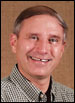 |
| May |
"In Jim May we see great teaching, outstanding scholarship and servant leadership - qualities that are important at St. Olaf College," Thomforde says. "In addition Jim is faithful to St. Olaf's mission as a liberal arts institution and a college of the church."
A member of the faculty since 1977 and a teacher of national distinction, May also has served St. Olaf as a department chair and, from 1997 to 2001, as associate dean for the humanities. He says he is looking forward to his duties as the leader of the college's academic program and its more than 300 full- and part-time faculty members, even though the new job means accelerating the editing of his next book and deferring the sabbatical leave he was due to take in 2002-03.
It will also mean spending less time teaching, something he confesses is a "bittersweet thought."
"I love to be in the classroom," says May, who received the American Philological Association's Award for Excellence in the Teaching of the Classics in 1986 and the prestigious Sears-Roebuck Foundation Teaching Excellence and Campus Leadership Award in 1991. "The president has encouraged me to find ways to teach occasionally, probably a beginning Latin class that meets first thing in the morning."
He will have opportunities to teach (and learn) this summer as well. May is ending the academic year by overseeing a faculty workshop that will prepare the college to apply for a $2 million grant from the Lilly Foundation in support of the "theological exploration of vocation" within the St. Olaf community. On June 16, he will begin his 23rd trip to Greece -- as the leader of a three-week study-travel program for adults sponsored by the college's Center for Lifelong Learning.
May clearly is not afraid of hard work, on the job or off. He is active in his church, the Church of St. Agnes in St. Paul, and sings in two of its music groups. He is also noted as a builder of harpsichords: He has made them for St. Olaf, for Carleton College and for individuals in the Twin Cities area.
He also refurbishes antique John Deere tractors as a hobby, and in 1986 he and his father-in-law constructed the 3,000-square-foot log home in rural Northfield where he lives with his wife, Donna, and their two sons.
May is a summa cum laude graduate of Kent State University, where he earned a bachelor's degree in Latin and English in 1973, and of the University of North Carolina, where he earned his Ph.D. in classical philology.
He is the co-author of Cicero's On the Ideal Orator (De oratore) -- the first translation in 60 years of the Roman orator's classic work -- and the author or co-author of four other books on Cicero, including the forthcoming A Companion to Cicero: Rhetoric and Oratory.
He has twice conducted National Endowment for the Humanities' Seminars on Cicero at St. Olaf and twice received a National Endowment for the Humanities Fellowship for College Teachers. Currently he is director of the national Campus Advisory Service of the American Philological Association.
May succeeds James Pence, who is moving to Tacoma, Wash., to become provost at Pacific Lutheran University. For more information about the St. Olaf announcement, go to the President's web page at www.stolaf.edu/president/events/provost/.
St. Olaf College, a national leader among liberal arts institutions, prepares students to become responsible citizens of the world, fostering the development of mind, body and spirit. It is a residential college affiliated with the Evangelical Lutheran Church in America (ELCA). The college provides personalized instruction and diverse learning environments. More than two-thirds of its students participate in international studies.


