
- St. Olaf News
- Features
- For the Media
- Media Relations
- Kari VanDerVeen
- Alumni Hall
- 507-786-3970 office
- 507-412-1036 cell
- vanderve@stolaf.edu
 RSS Feed
You reached this page through the archive. Click here to return to the archive.
Note: This article is over a year old and information contained in it may no longer be accurate. Please use the contact information in the lower-left corner to verify any information in this article.
Rambachan invited to Vatican to plan improved interreligious dialogue
May 31, 2002
NORTHFIELD, MINN. - Anantanand Rambachan believes that religion can be a constructive partner in the search for peace - but only if followers of the world's major religious traditions engage in dialogue about their shared values and goals, while respecting and honoring differences.
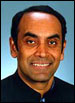 |
| Rambachan |
It is also why Rambachan will travel to the Vatican in June to discuss how the ideal of interreligious cooperation can be translated into action on global problems such as poverty, pollution, AIDS, arms proliferation, and justice and peace for all.
"I do not romanticize interreligious dialogue," Rambachan says, "or suggest that all human problems could be resolved if people of different religions would simply sit and talk. Dialogue is difficult, risky and challenging, but it is a necessity of our times. We are no longer geographically isolated. We either solve our problems together or they will not be solved."
Rambachan (pronounced rom-BACH-on) is one of 10 men and women from seven major religious traditions - Buddhism, Christianity, Hinduism, Islam, Judaism, Sikhism and indigenous religions such as those practiced in Africa and Australia - who have been invited by the Pontifical Council for Interreligious Dialogue (PCID) to gather at the Vatican on June 7 and 8 to help foster cooperation among world religions.
The attendees include Cardinal Francis Arinze, who heads the PCID, and Teny Pirri-Simonian, an executive of the World Council of Churches in Geneva, Switzerland.
In 1999, Rambachan was among more than 200 representatives from 20 different religions that the PCID brought together to reflect on religious collaboration in the new millennium. That gathering resulted in a message of shared concerns and aspirations - which attendees this year will consult as they identify ways to continue the conversations among their faiths.
As a Hindu at a college affiliated with the Evangelical Lutheran Church in America, Rambachan has ample opportunity for dialogue with students and colleagues about how Hinduism, Christianity and other religions are both similar and different - and for nurturing mutual respect. "The United States is now the world's most religiously diverse nation," he says, "and our teaching and learning here must recognize the challenges of this fact."
The importance of such conversations became even clearer after Sept. 11 and the newly fueled conflict in Israel and Palestine. The topic of religion and violence will need to be addressed explicitly and honestly during the Vatican talks, Rambachan says.
"At one time or another, all of our religions have been implicated in acts of violence and injustice," he explains. "Now we must ask what we as individuals can do to cooperatively contribute to world peace, human rights, justice and understanding. We must ask how religion can be a force for life - not violence and death."
Other topics likely to be raised during the Vatican meeting, according to the letter of invitation, include respect for creation, defense of human rights and ways to foster education for dialogue and harmony.
Rambachan is active in the dialogue programs of the World Council of Churches. He has lectured in Germany, India, Kenya, Norway, South Africa and Switzerland, and this summer will make presentations in Canada and Trinidad. He also gives monthly presentations at the Hindu Society of Minnesota.
Rambachan was born in Trinidad. He completed his undergraduate studies at the University of the West Indies, St. Augustine, and then traveled to Britain, where he earned a master's degree and Ph.D. at the University of Leeds. A member of the St. Olaf faculty since 1985, he teaches courses on Hinduism, on major non-Christian religions and on religious pluralism.
His scholarly work includes several books, numerous articles and reviews, 25 lectures on Hinduism broadcast around the world by BBC Radio and contributions to the Encyclopedia of Hinduism, a multi-volume series. Recently, the Ackland Art Museum at the University of North Carolina at Chapel Hill asked him to help explore ways in which its collection of more than 15,000 objects from Asia, Africa, Europe and America could help teach the public about world religions.
The Pontifical Council for Interreligious Dialogue was created in 1964 when Pope Paul VI instituted a special department of the Roman Curia for relations with the people of other religions. The PCID is the central office of the Catholic Church for the promotion of interreligious dialogue.
St. Olaf College, a national leader among liberal arts institutions, fosters the development of mind, body and spirit. It is a residential college in Northfield, Minn., and affiliated with the Evangelical Lutheran Church in America (ELCA). The college provides personalized instruction and diverse learning environments, with more than two-thirds of its students participating in international studies.


