
- St. Olaf News
- Features
- For the Media
- Media Relations
- Kari VanDerVeen
- Alumni Hall
- 507-786-3970 office
- 507-412-1036 cell
- vanderve@stolaf.edu
 RSS Feed
You reached this page through the archive. Click here to return to the archive.
Note: This article is over a year old and information contained in it may no longer be accurate. Please use the contact information in the lower-left corner to verify any information in this article.
American Physical Society honors St. Olaf Professor Jim Cederberg with national award
May 5, 2002
NORTHFIELD, Minn. - Ask St. Olaf College physics students about Jim Cederberg and they invariably smile. "Ask him a question about anything, and he'll give you an answer right off the bat, and it'll be a good one!" says first-year student Justin Von Stroh from Highlands Ranch, Colo.
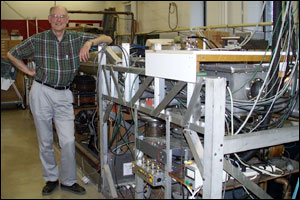 St. Olaf Professor of Physics James Cederberg, who holds the Grace A. Whittier Endowed Chair, recently was presented with the American Physical Society's 2002 Prize for Research in an Undergraduate Institution. He's shown here with his molecular beam spectrometer, a 21-foot vacuum system that is at the heart of his research. Photo by Lindsay VanDelinder '05. |
Cederberg, who holds the Grace Whittier Endowed Chair in Physics at St. Olaf, is known on campus as a likable, insightful guy with a seemingly infinite knowledge base. But he is known nationally for the high-quality research program he offers studying the structure of atoms and molecules.
Cederberg's undergraduate research program earned him the American Physical Society's 2002 Prize for Research in an Undergraduate Institution. He received the award at an APS conference in April in Albuquerque, N.M. The award honors physicists whose research in undergraduate settings has achieved wide recognition and contributed significantly to physics and the professional development of undergraduate physics students.
The molecular beam spectrometer, a 21-foot vacuum system, is at the heart of Cederberg's work. He uses the device - which was donated to St. Olaf by the man who oversaw Cederberg's doctoral studies, 1989 Nobel laureate Norman Ramsey - to study the structure of atoms and molecules.
"I wish I could say it were going to cure cancer or achieve world peace, but it's not going to," Cederberg says of his work.
Maybe not, but these experiments are important from the fundamental perspective of science's attempt to understand atomic and molecular structure. His research gives a glimpse of the atom at the finest level of detail, providing other scientists with a basis for predicting how substances interact with one another, as well as experimental benchmarks to help theoretical physicists and chemists make the best use of quantum mechanics. The results of these experiments have far-reaching implications. Chemists, biologists, doctors, psychologists - even philosophers - make use of the laws of physics. "All of the technology that makes our modern civilization distinct from ancient ones is built on an understanding of these laws of nature," says Cederberg. "Call it physics if you want."
And in all of this research, Cederberg employs the help of St. Olaf physics students, notes David Nitz, chairman of the St. Olaf physics department, providing them with invaluable experience.
"His exemplary research program has afforded generations of students the opportunity to move beyond the curriculum of class and lab work to experience what the 'doing' of science is all about," Nitz says. "Most of Jim's students will not end up with careers in molecular physics, but the things they learn by participating in this high-quality program are among the most valuable lessons of their college experience."
Cederberg, who received his bachelor of arts degree from the University of Kansas, earned his master's and doctorate in physics at Harvard University. A member of the St. Olaf faculty since 1964, he has chaired the physics department several times. He also chaired the Division of Natural Sciences and Mathematics from 1989 to 1995. This is Cederberg's second APS honor. In 2000, the group named him a society fellow, a signal honor bestowed upon APS members who have made advances in knowledge through original research and publication, significant contributions to the teaching of physics, or service and participation in the activities of the society.
Each year, no more than one-half of 1 percent of the current membership of the society receives this honor.
Asked about the significance of this year's APS honor, Cederberg credits his students. "This award really has been earned by them," he says.
St. Olaf College, a national leader among liberal arts institutions, fosters the development of mind, body and spirit. It is a residential college in Northfield, Minn., and affiliated with the Evangelical Lutheran Church in America (ELCA). The college provides personalized instruction and diverse learning environments, with more than two-thirds of its students participating in international studies.


