
- St. Olaf News
- Features
- For the Media
- Media Relations
- Kari VanDerVeen
- Alumni Hall
- 507-786-3970 office
- 507-412-1036 cell
- vanderve@stolaf.edu
 RSS Feed
You reached this page through the archive. Click here to return to the archive.
Note: This article is over a year old and information contained in it may no longer be accurate. Please use the contact information in the lower-left corner to verify any information in this article.
One college, four siblings
April 7, 2009
When Sandy Yang's parents brought their daughter to campus nearly four years ago to begin her first year at St. Olaf College, they had no idea that she was starting a family trend. For each of the next three years, the Yangs made a new addition to the St. Olaf community as Betty '10, Nou '11 and Kong '12 Yang joined Sandy '09 on campus.
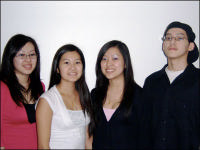 |
| Each of the four Yang siblings -- (from left) Sandy '09, Betty '10, Nou '11 and Kong '12 -- were drawn to St. Olaf for different reasons, but together they created a home away from home. |
The Yang siblings were each drawn to St. Olaf for distinct reasons. For Sandy, it was the strong faculty-student relationships, Betty liked the extensive student support system and Nou was impressed by the college's study-abroad program. "For me, I love the social life here; I feel like there's always something to do," Kong says.
The Yang siblings thrive on the support and encouragement they receive from one another during the school year, and once a week they catch up over dinner. Nou and Betty are even roommates this year. "One of the best things about going to the same college is that we keep each other on track," Nou says. "If someone's slacking off or having trouble with a class, we talk and motivate each other to focus."
Along with the support from their family, the Yangs have learned to rely on St. Olaf's Student Support Services (SSS) for guidance and encouragement. The program's workshops and social activities have helped them succeed in college over the years, both academically and socially. With the added on-campus support, Sandy, Betty and Nou have been able to take steps outside of their comfort zones on study-abroad trips to China, Japan, Korea and Australia, and they hope to continue their travels.
A home away from home
As the first generation of their Hmong family to be born and raised in the United States and the first to leave home to attend college, the four youngest Yang children face high expectations from their parents. The added pressure is one of the reasons why having a strong support network on campus is so important, Nou says.
The first to attend St. Olaf, Sandy says she felt a lot of pressure to do well academically and also to present a good role model for her younger siblings. Moreover, strict traditions in the Hmong culture regarding young women leaving home made the college transition especially challenging for Sandy, Betty and Nou. But after demonstrating what they are capable of accomplishing, the students' relationships with their parents have grown even stronger. "[Our parents'] views and perspectives on Hmong daughters and Hmong women have changed in a positive way," Sandy says.
"They have a lot of hope in us," Nou adds. "They encourage us to support each other and try our best so that we can be successful."
In addition to supporting each other, the Yangs are finding ways to reach out to others. Betty helps foster discussion about issues concerning women like herself as vice president of Hmong Women Dialogue, a support group for Hmong women at St. Olaf that encourages its members to take on leadership roles in the community.
And as Sandy, a family studies and Asian studies major, makes post-graduation plans and Kong prepares to follow in his sisters' footsteps by taking his first opportunity to study abroad, the family is looking forward.
About SSS at St. Olaf
SSS is one of three TRiO programs, originally funded under the Higher Education Act of 1965, whose objective is to help students overcome class, social and cultural barriers in order to complete their college education. With substantial support from the U.S. Department of Education, the Howard Hughes Medical Institute and the Hearst Endowment, the St. Olaf program provides services ranging from tutoring to financial aid advising for up to 160 eligible students each year.


