
- St. Olaf News
- Features
- For the Media
- Media Relations
- Kari VanDerVeen
- Alumni Hall
- 507-786-3970 office
- 507-412-1036 cell
- vanderve@stolaf.edu
 RSS Feed
You reached this page through the archive. Click here to return to the archive.
Note: This article is over a year old and information contained in it may no longer be accurate. Please use the contact information in the lower-left corner to verify any information in this article.
Sociological success
April 2, 2009
Ask any St. Olaf student if they've heard of the expression "ring by spring," a catchy way to describe the commonly held belief that Oles tend to marry other Oles, and they'll almost always respond with a wry smile and a nod. But do most students really expect that they'll meet their spouse on campus?
 |
| Jake Koch '09 discusses research results with Carol Ann Pedersen '09 and other members of their group during Assistant Professor of Sociology Ryan Sheppard's quantitative research class. |
The students' research topics ranged from comparing intimacy in long-distance and geographically close relationships to the effect of gender and level of contact on homophobic attitudes. And the questions they asked Oles often produced interesting results. For instance, the group that set out to examine the "ring by spring" stereotype found that while more than 90 percent of the St. Olaf students interviewed believe that marriages between Oles are "somewhat common or very common," 60 percent doubted they would find their spouse on the Hill.
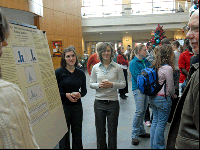 |
| St. Olaf College President David R. Anderson '74 (right) asks questions at a poster session about the research performed by a group of sociology students that included Erin Anderson '09 (center) and Monika Hartsel '09 (left). |
Although studies existed about college students' attitude toward marriage, Pedersen said little data was available about students' expectations toward finding a spouse at college. So while this new research is interesting, especially for Oles, it is also breaking new ground.
The students' research was bolstered by the assistance they received from the Center for Interdisciplinary Research. Each group of researchers was paired with a statistical consultant -- a fellow St. Olaf student pursuing a statistics concentration -- who has been trained by the CIR in guiding researchers on how to best cull and analyze data. This is the first year sociology/anthropology students have worked with the CIR, which is funded by a five-year grant from the National Science Foundation.
The statistical consultants, Elizabeth Zahn '10, Seth Huiras '09 and Kate Virkler '09, helped each group in Sheppard's class plan their survey, analyze the data and determine what to include in the presentation of their research. The experience benefited the statistical consultants as much as it did the sociology students, notes Associate Professor of Statistics and Interim Director of the Center for Interdisciplinary Research Paul Roback, because it sharpened their skills in explaining analytical methods to researchers with less experience in statistics. "They've done a lot of high-level analysis, but here they really have to step back and think about the basics," he says, noting that this is a very similar situation to what they would find as statistical consultants in the business world.
The statistical consultants continued analyzing the data during second semester, using multi-variable models to build upon the initial research results. This enabled the consultants to compare findings between groups and provide a deeper layer of analysis to the research the students will present at the Midwest Sociological Society conference. It also further enriched a research project that Sheppard says provided all of the students involved with valuable experience.
"The hands-on nature of this research really helps prepare students for graduate school and for jobs where they'll need to read research reports to inform their decisions, maybe interpret research for their coworkers, and even conduct research for businesses and non-profit organizations," she says.


