
- St. Olaf News
- Features
- For the Media
- Media Relations
- Kari VanDerVeen
- Alumni Hall
- 507-786-3970 office
- 507-412-1036 cell
- vanderve@stolaf.edu
 RSS Feed
You reached this page through the archive. Click here to return to the archive.
Note: This article is over a year old and information contained in it may no longer be accurate. Please use the contact information in the lower-left corner to verify any information in this article.
Student researchers partner with Minneapolis parenting program
April 22, 2009
Since September psychology major Eva Pesch '09 has been making weekly trips from St. Olaf to Roosevelt/Wellstone High School in Minneapolis to observe, research and videotape the interactions between teen mothers and their children at an in-school daycare program.
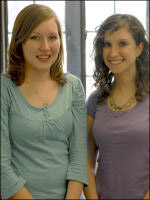 |
| St. Olaf students Betsy Volkman '09 (left) and Eva Pesch '09 partnered with the Minneapolis Teenage Pregnancy and Parenting Program for a psychology research project. |
With the help of Professor of Psychology and Department Chair Dana Gross, St. Olaf students have been working with TAPPP since 2002. At its core, this school-based program offers services for teen moms at various high schools throughout the city. It encourages the development of healthy relationships for its participants, provides public health services, and ultimately gives young mothers a chance to finish their education while raising a child.
In her visits to Roosevelt/Wellstone, Pesch observes the interactions between teen mothers and their children who are participating in TAPPP at an in-school daycare. She videotapes her subjects during times of free play and shared book reading to study the effects of a mother's interaction with her child on the child's verbal development. What she's found in the process of videotaping all 25 mother-child pairs in the TAPPP program and analyzing four of those pairs in a case study is that interactions between mothers and children have been enhanced as their participation in the program has progressed.
"The mother I studied who had been in the program for the longest time seemed to have developed the strongest parenting skills," Pesch says. She explored the results of her research in a senior distinction paper, and she also presented her findings at the Minnesota Undergraduate Psychology Conference at the College of Saint Benedict April 18.
"Community-based research has enabled me to more fully understand both the issues and the people I'm researching on a personal level," Pesch says. "It is a much more effective way to understand complex social issues than simply reading about them in books or research articles."
Without intervention, notes Gross, teen mothers are less likely than older mothers to speak or respond to their infants, and they often have an immature or inaccurate understanding of their child's development and age-specific needs. Comprehensive school-based services have been shown to produce positive outcomes for adolescent parents and their children. TAPPP teaches parenting skills and gives adolescent parents feedback and guidance to help them become more sensitive and responsive, encouraging their young child's learning in a positive and affirming context.
Ultimately, the benefits for both sides have proved worthwhile. St. Olaf students gain the experience of community-based research while providing a service to TAPPP. The program's leaders gain valuable visual aids to assist in guiding young mothers in the care of their children, while the girls themselves receive helpful feedback on how they can be successful parents.


