
- St. Olaf News
- Features
- For the Media
- Media Relations
- Kari VanDerVeen
- Alumni Hall
- 507-786-3970 office
- 507-412-1036 cell
- vanderve@stolaf.edu
 RSS Feed
You reached this page through the archive. Click here to return to the archive.
Note: This article is over a year old and information contained in it may no longer be accurate. Please use the contact information in the lower-left corner to verify any information in this article.
Students tackle crises in Horn of Africa, gain global perspective
November 19, 2008
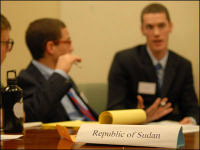
Representatives from six African countries as well as the Office of the United Nations High Commissioner for Refugees and the International Committee of the Red Cross opened a three-day peacekeeping and development conference last Friday at St. Olaf College. Yet as the spokespersons from each of the countries -- which included Eritrea, Ethiopia, Kenya, Egypt, Somalia and Sudan -- began their prefatory remarks by thanking the country of Egypt for hosting the 2008 meeting of the African Union, it quickly became clear that none of them actually hailed from northeast Africa. Rather, these St. Olaf College political science students were learning a thing or two by taking on the roles and many responsibilities of the leaders of some of Africa's most troubled countries.
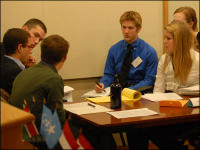 |
| Students in Kathy Tegtmeyer Pak's international relations class discuss issues in the Horn of Africa as they take on the role of leaders from that region. |
In keeping with St. Olaf College's mission to nurture a global perspective, the simulation helped students form cohesive ideas about the contemporary issues facing the Horn of Africa, which include border disputes, refugee crises and drought, and provided them with the resources to become better informed on similar global issues.
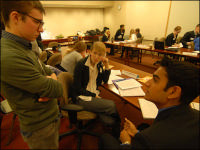 |
| Students (from left to right) Joel Richert '11, Maddy Buck '11 and Akshar Rambachan '12 hold diplomatic discussions during the simulation. |
Tim Wyman '11 and his group spent more than 10 hours researching, writing and revising their opening speech in preparation for the African Union assembly. He says prior to preparing for the simulation, he couldn't understand why the African countries "couldn't just talk and agree."
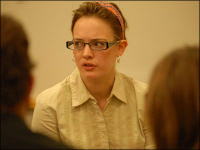 |
| Eliza McDermott '12 voices her thoughts. |
 |


