
- St. Olaf News
- Features
- For the Media
- Media Relations
- Kari VanDerVeen
- Alumni Hall
- 507-786-3970 office
- 507-412-1036 cell
- vanderve@stolaf.edu
 RSS Feed
You reached this page through the archive. Click here to return to the archive.
Note: This article is over a year old and information contained in it may no longer be accurate. Please use the contact information in the lower-left corner to verify any information in this article.
A recipe to save the world
May 6, 2008
For St. Olaf College seniors, meal preparation will soon involve more than locating a student ID and rounding up friends in the Fireside Lounge. And with the increasing awareness of the threat that our current food culture poses to the well-being of our bodies and the environment, two St. Olaf seniors have created a community cookbook that focuses on preparing healthy, locally grown food.
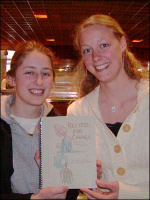 |
| Katie Godfrey '08, left, and Danielle Stoermer '08 hold a copy of the cookbook they've put together titled "Recipes for Change." |
"Everyone needs food, so a cookbook is a great way to disseminate information and create an avenue for change," Stoermer says. "I hope people have a fun time experimenting with the recipes and learning how to cook a variety of foods. Ultimately, though, I hope the cookbook begins a discussion among the community and beyond about the importance of eating local and seasonal foods and how doing so can benefit one's health, the environment, the community and the world."
Cooking up a plan
Last spring, Stoermer hosted a Wellness Center event to teach St. Olaf seniors a few culinary skills. She quickly realized that a half-hour wasn't enough time to prepare them to cook their own meals. After the event, Stoermer jotted down "create a cookbook" in a notebook with ideas for next year.
That fall, Godfrey began work on an independent study class titled "The Ethics of Eating" with Professor of History Jim Farrell. As she learned about the negative effects the dominant American food culture has on the environment, she quickly became concerned. "The average distance our food travels in America is between 1,500 and 2,500 miles," Godfrey says. "Around one-third of our carbon dioxide emissions come from our industrial agricultural system. As a culture, we have forgotten where our food comes from, who our farmers are and how to grow food for ourselves." In her proposal for her final class project, Godfrey suggested creating a community cookbook as an avenue for change.
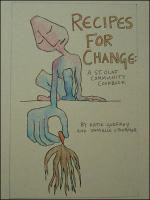 |
| "Recipes for Change" aims to get members of the St. Olaf community eating more locally grown food. |
Putting it all together
The pair received a Finstad Entrepreneurial Grant and funding from the St. Olaf Student Alumni Association. They put out a call for recipes, and each contributor was asked to submit a short introduction to accompany the recipe.
"As I said in my e-mail to them, I wanted the cookbook to act as 'a gustatory link to each senior's favorite faculty and staff member at St. Olaf,'" Stoermer says. "I see this as important because one point of eating locally is to strengthen community, and I think a cookbook composed of recipes entirely from St. Olaf faculty, staff, students and alumni definitely strengthens the St. Olaf community, whether you are on campus or halfway around the world."
The cookbook is organized by season, with each section featuring ingredients that can by purchased locally or grown at that time of year. Interspersed throughout the cookbook are short essays written by Godfrey, including "On Being an Omnivore," "The Dirt on Composting" and "Connecting the Farm and the City: Farmers' Markets."
The cookbook includes recipes for a chicken dish that President David R. Anderson '74 fell in love with while teaching in Italy; a rhubarb pie that Registrar Mary Cisar's mother used to make; a pesto that students Sarah Clarkson '09 and Amanda Rubasch '09 perfected with basil they grew; a blueberry crunch coffee cake that alumni Art '58 and Jan '59 Nelson enjoy; and many more. Sample what the cookbook has to offer with St. Olaf faculty member Judy Kutulas' apple crisp recipe, which is listed below.
Making an impact
Stoermer and Godfrey hope that the recipes and essays will engage community discussions on the benefits of eating local. "Eating local would greatly reduce the amount of distance our food travels, making a big dent in global climate change," Godfrey says. "We would also know our farmers, which would allow us to know more about how our food is actually grown."
Godfrey calls access to quality, healthy food a human rights issue. She hopes that ultimately change will move beyond kitchens and beyond the Hill to collective action in our respective communities. "We could support legislation that would allow farmers to grow fruit, vegetables and wheat, make cheese, and feed their cattle grass," Godfrey says. "We could open up the markets for growing food responsibly, therefore making it easier for people of all backgrounds to afford good food."
Apple Crisp
Judy Kutulas
Professor of History, American Studies and Women's Studies
When I was in college, the house next door to where I lived had an apple tree close to the fence and apples used to fall into our yard. Being thrifty college students, we started looking for apple recipes, but this was the most popular. After a while, we rather artfully arranged to store a ladder conveniently close to the fence to insure an adequate supply of apples.
Ingredients
1 cube butter
1 cup brown sugar
1/2 cup flour
1 cup oatmeal
4-6 apples, depending on size, peeled, cored and sliced
A sprinkle of lemon to make the apples juicy
A sprinkle of white sugar
Cinnamon
Method
Combine the first four ingredients until well-mixed. Meanwhile, mix apples, lemon, white sugar and cinnamon in the bottom of an 8" by 8" or 9" by 9" pan. Distribute evenly. Top with oatmeal mixture, covering apples completely. Bake at 350 degrees until apples are soft, about 25 to 30 minutes.
Also works with a pint of blueberries or four or five ripe, peeled peaches.


