
- St. Olaf News
- Features
- For the Media
- Media Relations
- Kari VanDerVeen
- Alumni Hall
- 507-786-3970 office
- 507-412-1036 cell
- vanderve@stolaf.edu
 RSS Feed
You reached this page through the archive. Click here to return to the archive.
Note: This article is over a year old and information contained in it may no longer be accurate. Please use the contact information in the lower-left corner to verify any information in this article.
St. Olaf students to present research at World Health Organization
November 20, 2007
Three St. Olaf College students will present their research on foodborne disease to experts at the World Health Organization (WHO) in Geneva.
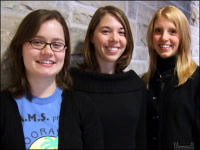 |
From Saturday, Nov. 24, through Thursday, Nov. 29, Sommer Wild '09, Brianna Hirst '08 and Laura Boehm '08 will present their research to the WHO's Foodborne Disease Burden Epidemiology Reference Group (FERG).
Last January the trio began researching the mortality rates of foodborne disease in various nations for their project on the Global Health and Biostatistics Interim course with Professor of Statistics Julie Legler. Legler believes the students' findings will clarify problems in foodborne disease analysis and is an "important project for helping to allocate precious global health dollars."
While St. Olaf students have studied with researchers in Geneva through past Interim classes, this is the first time student work from St. Olaf has not only been solicited by the international public health authority, but the students themselves have been asked to present the information.
"I have been guiding them, but they have done the bulk of the work," Legler says of the group.
Wild says the project has sparked her interest in using research to construct helpful public policy.
"This experience has introduced me to a whole new realm of health issues -- those on a global scale," she says. "Research in this area is essential in informing policy as to what type of need exists and what can potentially be done to help. The impact that can be had based upon this type of research is, I feel, our greatest motivation."
Providing better data
Foodborne disease is common in areas with poor food storage or where food is poorly handled or prepared. Illnesses such as mad cow disease and those caused by E. coli and salmonella result from digested food contaminated with bacteria which incubate in the body for hours, days or even months before showing symptoms.
The WHO created FERG in the fall of 2006 and charged the international group of health experts with developing a framework to assess the global burden of foodborne disease. One of the FERG's central aims is to generate reliable figures that estimate the number of deaths attributable to foodborne disease. Wild, Hirst and Boehm's study explored this objective by developing estimates of the foodborne disease mortality rate for a few nations whose records on the topic were not sufficient for FERG's analysis.
The group worked in conjunction with Dr. Claudia Stein from the WHO Department of Food Safety, Zoonoses and Foodborne Diseases throughout the January Interim. They continued the project through the following spring semester and summer while remaining in contact with Stein, who invited the three researchers and Legler back to Geneva this fall.
"At the end of January, it was evident more work could be done. At that time, we had created rough death estimates for each region; our recent goal has been to create death estimates for each specific cause in each region and also to refine our estimates," Boehm says. "With our continued work, Dr. Stein recommended we return to Geneva for the FERG conference this November."
Wild, Hirst and Boehm's findings will inform the FERG's strategy on how to account for and reduce foodborne disease. Boehm hopes their work will help outline the best approaches to solving the problem.
"Knowing what diseases are prevalent [and] where is very important for preventing illness," she says. "The WHO has data from many National Health Ministries that collect vital registration data, [but] not every country keeps records that are accurate or detailed enough for FERG's purposes."
"I hope that our work can contribute to the international discussion about global estimates of foodborne disease," Hirst adds.


