
- St. Olaf News
- Features
- For the Media
- Media Relations
- Kari VanDerVeen
- Alumni Hall
- 507-786-3970 office
- 507-412-1036 cell
- vanderve@stolaf.edu
 RSS Feed
You reached this page through the archive. Click here to return to the archive.
Note: This article is over a year old and information contained in it may no longer be accurate. Please use the contact information in the lower-left corner to verify any information in this article.
Final 'war' lecture Thursday
November 26, 2007
Karil Kucera, the Luce Assistant Professor of Asian Visual Culture in the St. Olaf departments of Asian Studies and Art/Art History, will present "Preserving Pain, Promoting Peace: Learning from the Memorial Sites at Hiroshima, Nanjing, and My Lai" Thursday, Nov. 29, at 11:30 a.m. in Dittmann Center, room 305. The lecture, which is free and open to the public, will conclude the semester-long series of talks and events that has highlighted this semester's academic theme, "Liberal Arts in Times of War."
 |
| Kucera |
'War is hell'
By examining memorials that Kucera has studied extensively, she will be showing how nations have utilized artifacts and images to promote peace. She also will be looking at how we as a country view war and peace and how we should get past the false ideal of right and wrong. "I'm hoping to move people away from a Hollywood view of war to a more realistic portrayal so that in the future they think twice about going to war."
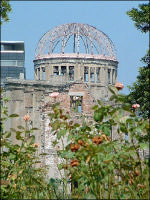 |
| The Hiroshima Peace Memorial (Genbaku Dome) was the only structure left standing in the area where the atomic bomb exploded Aug. 6, 1945. It has been preserved in the same state as immediately after the bombing. |
When asked about how she, as a professor of art history and Asian studies, can identify with the "Liberal Arts in Times of War" theme, she says, "I specialized in Buddhist hell scenes, and as such, the question was 'How does one represent the unimaginable?' How to visually depict to the public something they have never seen or experienced is quite an artistic challenge.
"The same holds true for these three modern sites of catastrophic loss. 'War is hell' is really a very accurate description. How do you bring the viewer to My Lai, Nanjing and Hiroshima into a different time and place and make them understand the horrors of what happened there?"
Liberal Arts in Times of War
Kucera's talk is part of a series of events that have been taking place at St. Olaf throughout the fall as part of the "Liberal Arts in Times of War" theme during the college's two-year academic focus on "Global Citizenship." The purpose of the theme is to encourage college-wide reflection on the contributions of liberal arts to understanding war, terrorism and the war against it, morality in war, and the ideas of "realism," "just war," "holy war" and "non-violence" as competing traditions in the analysis of war.


