
- St. Olaf News
- Features
- For the Media
- Media Relations
- Kari VanDerVeen
- Alumni Hall
- 507-786-3970 office
- 507-412-1036 cell
- vanderve@stolaf.edu
 RSS Feed
You reached this page through the archive. Click here to return to the archive.
Note: This article is over a year old and information contained in it may no longer be accurate. Please use the contact information in the lower-left corner to verify any information in this article.
Taking 'Ideals to Action' to Chinese children
August 27, 2007
I had never taught before I arrived in my host school's airy, second grade classroom in Tunxi, China. When I entered, the teacher asked the children to pull out their English books -- modest, blue texts laden with pictures of seasons and colors -- and then promptly left. Fortunately, I'd gotten used to responding creatively to challenges in and out of the St. Olaf classroom, a skill that proved indispensable while teaching English as a second language. So despite my inexperience I was able to devise an effective lesson plan and help the children learn a useful amount of English.
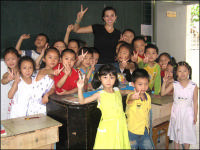 |
| St. Olaf student Lyndel Owens '10 poses with her students. |
A new experience
Tunxi is a relatively small Chinese city nestled in a mountainous region of southern Anhui Province. A five-hour bus ride west of Shanghai, the area is beginning to share in the exponential growth that has characterized East China for years. Chinese, Korean and Japanese tourism wealth sustains much of Tunxi's development, making it an apt microcosm through which to understand China's dynamic transformations.
Few westerners travel to the city and most school children there have never heard a native English speaker. They learn English through rote memorization, with little help from interactive games or props. Teachers are stressed. Many work 13-hour days and hardly see their families since the school is a boarding facility. Couple these conditions with large class sizes and you begin to understand why students even in late middle school struggle to say more than their name and age.
The morning exercise commenced at 8:30. Classes ended at 5:30 in the afternoon. During breaks the other volunteers and I walked to town for lunch or prepared lesson plans for the next class. But if a lesson was not presented clearly and well, classes could become rowdy and time would be wasted trying to regain order. So we moved at a slow pace to ensure that they understood the basics and gradually progressed toward more complex sentences by having them make picture dictionaries and work in groups.
Ideals to action
Due credit must be given to St. Olaf. My first-year experience motivated me to volunteer to teach English to underprivileged children for one month this summer in China. The substantial body of knowledge and wisdom that I acquired during my first year was an excellent framework within which to approach what would be a powerful experience in China. Throughout the year, with my community of classes, professors and friends, I nurtured ideas that were rooted in global citizenship and international responsibility. As nearly all my classes emphasized cross-cultural perspectives, I came to believe with increasing conviction that passivity and indifference were not options.
The wisdom shared at St. Olaf's Globalization Conference last spring particularly clarified these notions. The college community's proactive leadership and emphasis on experiential learning helped me recognize that teaching in China could make real the notion of "Ideals to Action."
The classroom's light attitude encouraged the students to explore English and be comfortable making mistakes. We began and ended each day with songs and games like "Head, Shoulders Knees and Toes," and used similar activities to teach language points in class. Though the first days were difficult, it was apparent after many rounds of hangman and a dozen picture dictionaries later that the children's English progress was immense.
In many ways this experience was a second childhood for me. We played together during breaks, went swimming after class and many of our songs caught on with other classes and Chinese teachers. The school principal especially adored the "Hokey Pokey." Whenever she visited we'd sing and dance it with extra enthusiasm. Occasionally she would bustle in at random, collect children into groups, then have the two groups perform at the same time while asking the other kids to vote which was best. It was the "Hokey Pokey" face-off.
In the afternoon of my last day the students, other volunteer teachers and the principal accompanied me to the local bus station. Our group of children in matching bright orange shirts stood out in the bustling terminal. After hugging, wiping tears and promising to keep in touch the children began to depart. But the principal stopped them. I looked up from zipping my bag to see the kids forming a compact circle in an open area near the station entrance. I walked over, squeezed in and realized that -- as we had sung in our classroom -- this really is what it's all about.


