
- St. Olaf News
- Features
- For the Media
- Media Relations
- Kari VanDerVeen
- Alumni Hall
- 507-786-3970 office
- 507-412-1036 cell
- vanderve@stolaf.edu
 RSS Feed
You reached this page through the archive. Click here to return to the archive.
Note: This article is over a year old and information contained in it may no longer be accurate. Please use the contact information in the lower-left corner to verify any information in this article.
Distinguished Alumnus Kelling discusses crime prevention
June 1, 2007
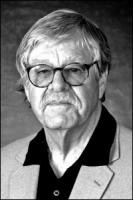 |
| George Kelling '56 |
Q: What is the background story on "broken windows" and your development of the theory?
A: It initially started with the "Kansas City Preventive Patrol Experiment," for which I researched police tactics and foot patrols as part of a study on preventive patrol measures. This was in the 1970s, when there was great demand for police foot patrols in cities. I later did an experiment in Newark, N.J., and my main finding was that where you had foot patrols, the fear of crime dropped. It was the result of police paying attention to minor offences. I found that police riding around in cars have virtually no impact on the deterrence of crime. Police in cars can't pay attention like police on foot can.
James Q. Wilson (former chairman of the White House Task Force on Crime) was familiar with my work, and he eventually asked me if I'd be willing to write an article with him for publication in the Atlantic Monthly. That became the "Broken Windows" article.
Q: Like any well-known theory, "broken windows" has its detractors. What are some of the criticisms of the theory?
A: We hypothesized that in dealing with minor crimes we were at the same time dealing with major crimes. That cut to the heart of conventional thinking at the time that said all you can do about crime is respond to it after it happened. We challenged that.
Cops have always been sympathetic to "broken windows," but some have said, because of limited resources, they aren't able to deal with misdemeanors; they have to deal with serious crime. We turned this on its head and said, "you need to deal with preventive measures and that will decrease your serious crime."
On a policy level, hardly anybody is critical of "broken windows" anymore. It's become part of conventional wisdom, which is both good and bad, because now there are people using the term who don't really understand it.
Q: How do you feel "broken windows" may be misrepresented?
A: "Broken windows" is a powerful tool that -- like any powerful tool -- can be misused. I don't advocate a "lock 'em all up" approach, in which no discretion is practiced. "Broken windows" isn't about zero tolerance. Putting "broken windows" in to practice calls for vigilance among law enforcement managers and overseers. That's because, unfortunately, the practice of paying attention to minor offences has often been used against African Americans and minorities for decades, and in certain places still is.
Q: And yet "broken windows" traditionally has been very well received in minority communities.
A: When New York City citizens were surveyed on "broken windows," the African American community was the strongest supporter. The demand for order is strong in minority communities, where one of the main complaints is under-policing.
Q: What was your role in the crime clean up of New York City?
A: In the 1980s Robert Kiley (then chairman and CEO of the New York City Metropolitan Transportation Authority) asked me to help address the problems of the subway in New York City. At that time, crime on New York subways was entirely out of control. There were those attributing the problem to homelessness, but once I saw it firsthand, I said, "this isn't homelessness. This is lawlessness."
I recommended bringing in William Bratton, who at the time was chief of police for the Massachusetts Bay Transportation Authority, and together -- by addressing the small things -- we cleaned up the subway in a matter of months. Today, it's virtually crime-free. The success was a testimony to "broken windows."
Q: How did you come to be a Senior Fellow at the Manhattan Institute in the Center for Civic Innovation?
A: When I began working on the New York subway cleanup, I was invited to speak at the Manhattan Institute, and I was sort of "adopted" by it. It was a place where I could talk about and spread ideas. I've tended not to publish a lot in academic journals. I've been more interested in ideas getting into the practical world and letting them echo back into the universities. I've always paid more attention to policy-relevant outlets like the Atlantic Monthly.
Q: You also co-founded the Police Institute at Rutgers University-Newark in 2001. How did that come about?
A: I accepted a position in the criminal justice department at Rutgers, where a friend and colleague of mine was the dean. Soon after I started I met with the Newark chief of police, who was having trouble dealing with violence in the community, and he asked for my help. That gave me an opportunity to work on an idea I had had for many years. The question people usually ask is: "Why do people commit crimes?" But I was more interested in how to prevent crime. In addition, I was interested in how a university can be instrumental in dealing with crime as an urban problem, just as it was instrumental in addressing rural problems years ago.
I see the Police Institute working the same way as a teaching hospital works within the medical field. Just as a hospital brings together doctors, nurses and students around medical problems, we bring together doctoral students, social scientists and practitioners around the problem of managing and preventing crime.
This idea caught on, the governor of New Jersey endorsed it, and the gubernatorial decree created the institution.
Q: Before earning your master's at the University of Wisconsin-Milwaukee and your Ph.D. at the University of Wisconsin-Madison, you attended the seminary. How did that fit into your career in crime prevention?
A: I went to Northwestern Lutheran Theological Seminary in Minneapolis, which later merged with the Lutheran Seminary in St. Paul, for two years. While I was there I got a job as childcare supervisor in the Hennepin County detention center (which was where the Metrodome sits today). I later became a probation officer in the Hennepin County court services working with juveniles. That's when I became interested in crime and crime prevention.
Q: How did your time at St. Olaf prepare you for your work in law enforcement?
A: Let me start by saying that leaving the seminary was very traumatic for me. For most of my teen-age years I had envisioned becoming a clergyman. And I wasn't doing badly in the seminary; the fit just wasn't there.
What I gained at St. Olaf was a sense of oughtness. Because of this, I realized that even though I left the seminary I could still do good work and contribute to the public welfare. I found an outlet in working with juveniles. These were among the values I learned at St. Olaf.
Q: You've credited Professor Emeritus of Philosophy Howard Hong '34 and the late Professor of Art Arnold Flaten '22 as being especially influential in your life.
A: I can't tell you how much I was influenced by the thinking of several professors at St. Olaf. The voices of those mentors have always been there throughout my life. Howard Hong taught me that once you understood assumptions you could begin to think critically. When I went in to policing, I soon found that the assumptions of traditional policing -- driving around in squad cars as a crime deterrent, for example -- didn't make sense to me. When I reflected on it, I started questioning those assumptions. I didn't accept them at face value.
It was Arnold Flaten who said: "You swim in the stream of tradition, but often upstream." I have a sculpture that Flaten did called Man Climbing a Rope, that I think captures this quote. I call it my "Existential Man," and it's one of my personal prizes.


