
- St. Olaf News
- Features
- For the Media
- Media Relations
- Kari VanDerVeen
- Alumni Hall
- 507-786-3970 office
- 507-412-1036 cell
- vanderve@stolaf.edu
 RSS Feed
You reached this page through the archive. Click here to return to the archive.
Note: This article is over a year old and information contained in it may no longer be accurate. Please use the contact information in the lower-left corner to verify any information in this article.
Art Barn receives new lease on life
April 23, 2007
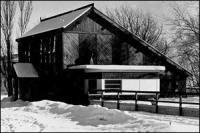
It began life in the summer of 1932, the product of the talented hands of Arnold Flaten '22. It was deconstructed this winter to make room for the college's new Science Complex. If plans come together as anticipated, however, this summer the Art Barn will experience a rebirth.
A campus fixture near Old Main for 75 years, the Art Barn was disassembled in January to facilitate Science Complex construction. As they took it apart, workers painstakingly preserved its woodcarvings, murals, art pieces and other unique components -- which will be incorporated in a reconstructed building elsewhere on the Hill.
 |
"We decided to rebuild, because there was not a lot of internal structure to help a move succeed," says Assistant Vice President for Facilities Pete Sandberg. "A lot of the exterior was in poor condition as well."
Sandberg is working with the campus community and members of the Flaten family to determine a suitable space and use for the facility. Sandberg says that a final site for the reconstructed Art Barn has not been decided on at this time.
A FUNCTIONAL AND ARTISTIC FOUNDATION
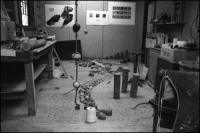 |
| An interior shot of the art barn taken by Assistant Professor of Art/Art History Patrick Kelley '91. He says that following his graduation the art barn served as his studio for a year. |
The studio built in the summer of 1932 was actually only the first phase of a larger plan that never came fully to fruition.
"The blueprints make it clear that Flaten had big plans for the new department," says Associate College Archivist Jeff Sauve. "The rest of the plan provides for lecture rooms, faculty office, studio space and an exhibition area."
Those activities eventually came to be housed in East Hall (later renamed Flaten Hall), built immediately to the west in 1956.
The studio, while utilitarian in some aspects, had a number of distinctive touches of the sort Flaten was noted for. Wooden pillars on the entry porch featured carved faces. On the east pillar, the face of an American Indian looked to the northeast; on the opposite corner was the face of a Viking. On the west pillar, a young man, a symbol of college youth, faced northwest, while the opposite corner depicted the bearded visage of Hans Nielsen Hauge, the layman whose religious movement prompted many Norwegians to immigrate to the Midwest.
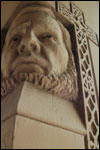 |
| A detail of the bearded visage of Hans Nielsen Hauge, whose religious movement prompted many Norwegians to immigrate to the Midwest. |
The building's wooden pilasters paid tribute to the United States, Egypt, Norway and France -- which was recognized with a carving of the fleur-de-lis and the words "Liberte, Egalite, Fraternite."
A WORK OF HANDS AND HEARTS
Because he actually helped to construct the Art Barn as well as design and decorate it, Arnold Flaten well might appreciate the way the college intends to reconstruct it.
Planners hope to replicate the process by which the Memorial Tower was erected at St. Olaf in 2003. That campus landmark was built by a crew of faculty and staff trained at the North House Folk School in Grand Marais, Minn.
"We're planning to do an actual timber frame," says Sandberg. "That will give the building the structure that its exterior signals it should have, with east/west purlins exposed. We're using photos that were taken before Flaten Hall was constructed to help duplicate the original ridge and the west wall that have been hidden for decades."
Construction is currently slated for late July or early August. To see the up-to-date work on the former Art Barn site, visit the Science Complex webcam, now online.


