
- St. Olaf News
- Features
- For the Media
- Media Relations
- Kari VanDerVeen
- Alumni Hall
- 507-786-3970 office
- 507-412-1036 cell
- vanderve@stolaf.edu
 RSS Feed
You reached this page through the archive. Click here to return to the archive.
Note: This article is over a year old and information contained in it may no longer be accurate. Please use the contact information in the lower-left corner to verify any information in this article.
Bon Appetit certifies St. Olaf food 'Great'
April 29, 2007
Earlier this semester, 20 managers from Bon Appetit, the company that operates St. Olaf's food service, came to the college from as far away as California to learn how to implement the new "Great Expectations" standards that were set recently by the company. After the training Michael Bauccio, chief operating officer of Bon Appetit Management Company, presented St. Olaf with a plaque that certifies St. Olaf College as "Great."
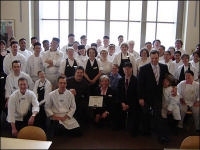 |
| St. Olaf President David R. Anderson '74 (in hat) and the St. Olaf Bon Appetit crew pose with their "Great Expectations" certificate. |
The standards set by the company permeate every aspect of the business, from the purchasing of local food ideas as part of the "Farm to Fork" initiatives, to the types of oils used when cooking omelets on Friday mornings. And the standards are constant for all sites -- whether at the Minnesota Historical Museum, the Guthrie Theatre or a liberal arts college in Northfield.
Choosing the right foods
St. Olaf was chosen as a training site because it already maintains the high standards set through the "Great Expectations" program, including: the use of milk free of artificial growth hormones; making salad dressings with olive and canola oils; using dolphin-safe tuna; making stocks, salsas, pizza and marinara sauces from scratch; mashing fresh potatoes; squeezing fresh lemon juice for cooking; and adding no MSG.
For St. Olaf students the most noticeable program differences this year include the change from spiced French Fries to a rotation of tater tots, sweet potato fries and light yellow fries. The reason, according to general manager Katie McKenna, is Bon Appetit's commitment to reducing trans-fats and hydrogenated oils in the food. "It's important that young adults learn how to eat healthily," she says. "Their college years will dictate their eating habits for the future."
A second change students have noticed is the lack of oranges in Stav Hall. Due to a storm that hit California in January, most of the orange crop was lost. As part of their Market Watch program, Bon Appetit refuses to worsen such situations through over-purchasing.


