
- St. Olaf News
- Features
- For the Media
- Media Relations
- Kari VanDerVeen
- Alumni Hall
- 507-786-3970 office
- 507-412-1036 cell
- vanderve@stolaf.edu
 RSS Feed
You reached this page through the archive. Click here to return to the archive.
Note: This article is over a year old and information contained in it may no longer be accurate. Please use the contact information in the lower-left corner to verify any information in this article.
Go west, young band: tour will mirror 1909 trek
January 11, 2007
In 1909 Abraham Lincoln's profile first appeared on the penny, William Howard Taft succeeded Theodore Roosevelt as president of the United States, the National Association for the Advancement of Colored People was founded and instant coffee was invented. The St. Olaf Choir did not yet exist, and the St. Olaf Band, still in its infancy, was preparing for its first major tour since the ensemble's historic trip to Norway three years earlier.
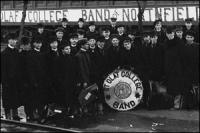 |
| ALL ABOARD -- The St. Olaf Band prepares to embark on its 1909 Alaska-Yukon-Pacific Exposition Tour, during which it would perform more than 100 concerts in 69 towns and cover 5,083 miles. |
The World's Fair, called the Alaska-Yukon-Pacific Exposition, was held in Seattle in 1909 and was promoting the development of the Pacific Northwest. Over the course of 11 weeks the St. Olaf Band, under the conductorship of F. Melius Christiansen, added another highlight to the burgeoning region. Now, nearly a century later, the St. Olaf Band is retracing the footprints of that historic tour.
A modern-day band tour to a different region of the country is a major undertaking. In the early years of the 20th century, it was nothing short of miraculous. During what the college dubbed the 1909 Alaska-Yukon-Pacific Exposition Tour, the St. Olaf Band journeyed from Wadena, Minn., to Seattle, Wash., performing more than 100 concerts in 69 towns and covering 5,083 miles. The tour was among the longest for any collegiate or professional band in the United States at the time and also was considered to be one of the most successful.
Although St. Olaf was founded as a co-educational college, the band -- true to the military tradition of the music and the social mores of the time -- was comprised of 45 men, including current students, alumni and local musicians (the first women joined the band in 1921). The ensemble departed from Northfield on June 21, 1909, after a whirlwind month of preparations. The decision to undertake the Pacific Coast tour was not finalized until late May, which left a mere two and a half weeks to practice a repertoire of nearly 100 pieces. Conductor Christiansen, who later founded the St. Olaf Choir, had pushed his musicians through two and three practices daily to get them prepared.
INTO THE WEST
During the long journey west, band members rode atop freight cars, performed impromptu concerts and challenged local men to baseball games during stops. On one occasion, drummer Ben Rauch, who had been chosen to umpire a game between the band and a local team in Perley, Minn., found himself on the wrong side of the crowd after an unpopular call. He attempted to flee, but soon was overtaken, carried off the field and tossed in a hay field.
Most of the challenges the band encountered related to transportation or weather, including an all-day rainstorm that made travel virtually impossible. The cars scheduled to transport the band to its afternoon performance in Ada, Minn., couldn't navigate the muddy roads, re-quiring most of the musicians to make their way into town via horse-drawn lumber wagons. Because space on the wagons was limited, band manager P.G. Schmidt and 12 musicians had to stay behind. They trudged hours through muddy, mosquito-infested fields, arriving in Ada about 1 a.m. On a brighter note, the band members who had taken the earlier lift arrived in time to perform the concert before a full house.
Things went from bad to worse for Schmidt the following day. En route to Halstad, Minn., he slipped while attempting to dislodge a car stuck in mud, and both of his feet were run over. Although Schmidt was not seriously hurt, the injury forced him to return to Northfield, relinquishing management of the band to J. Jorgen Thompson '09.
A TRADITION BEGINS
As the band rolled west it continued to perform concerts nearly every day in churches, schools and parks. The musicians crossed the Missouri River, marveled at the stark plains and white buttes of the Badlands and set their watches to Mountain time. Upon approaching Big Timber, Mont., the band had its first view of the imposing Rocky Mountains.
Not everyone appreciated the splendor of the Rockies. A number of players were affected by the high altitude while crossing the Continental Divide as the trains climbed up winding tracks at increasingly steeper grades. At one point, three engines were required to pull the 12-car passenger train up a mountain.
Several local Ole alumni gave the band a heroes' welcome as the train pulled into Spokane, Wash. The band stayed a week in Spokane, performing two concerts every day at the Natatorium Amusement Park, including one for the Norwegian Brotherhood. Concert attendance averaged more than 3,000 people per day.
A 14-hour train ride took the band into Seattle and to the 1909 World's Fair. On Aug. 30 the ensemble celebrated Norway Day by leading a parade, in which historical Norwegian costumes were represented, through the exposition grounds. The crowd was estimated at 14,000. The band played five concerts over two days in Seattle before moving on to Tacoma, Wash., Portland, Ore., and back to Spokane.
During a supper at the North Side Church the band was presented with a silver loving cup in commemoration of its tour. The final concert, performed in the town's high school auditorium, concluded with the "Star Spangled Banner." The following day, at 1:30 a.m., the band began the long -- and thankfully uneventful -- trek back to Northfield.
The St. Olaf Band's 1909 tour, lasting more than two and a half months and covering more than twice the distance from New York to Los Angeles, was a momentous accomplishment. The cost of the entire tour was $10,000 (the equivalent of nearly $225,000 today) and the duration was four weeks longer than any previous trip in the college's history.
Over the course of the 20th century the band would travel throughout the United States, as well as to Mexico, the United Kingdom, continental Europe and Norway. As the 2007 St. Olaf Band once again brings its music to the Pacific Northwest, it continues a proud tradition of ambitious musical tours established nearly 100 years ago.


