
- St. Olaf News
- Features
- For the Media
- Media Relations
- Kari VanDerVeen
- Alumni Hall
- 507-786-3970 office
- 507-412-1036 cell
- vanderve@stolaf.edu
 RSS Feed
You reached this page through the archive. Click here to return to the archive.
Note: This article is over a year old and information contained in it may no longer be accurate. Please use the contact information in the lower-left corner to verify any information in this article.
Faculty awarded grant to retrace 1838 Minnesota expedition
January 25, 2007
Three members of the St. Olaf faculty have been awarded a highly competitive grant from the National Conference for Undergraduate Research (NCUR) Lancy Initiative to coordinate and support a student-involved, interdisciplinary research project. The $40,000 grant will allow six students to spend the upcoming summer with faculty to research the physical, environmental and visual changes in the landscape of southern Minnesota since it was first described by Joseph Nicholas Nicollet during his expedition of 1838.
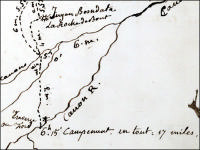 |
| A detail from Nicollet's Sept. 15, 1838, journal entry that shows where the expedition crossed the Canon [sic] River. |
Student researchers participating in the project are Annie Fedorowicz '08, Kate Huber '09, Becky Huncosky '08, Susan Olson '08, Allie Pyan '09 and Amanda Rubasch '09.
Nicollet, a French astronomer, was hired by the United States government to survey the Upper Mississippi drainage. He is noted for his detailed and uniquely sympathetic descriptions of the landscape and its people. In the fall of 1838 he and others in his expedition traveled south from Fort Snelling to present-day Northfield, crossing the Cannon River at what is now Waterford Township, then on to the current location of Faribault. The group stopped in Spirit Lake, Iowa.
"Nicollet plays a prominent role in detailing the landscape of the fairly recent past in this area and, one might argue, setting the stage for future development, " says Jackson. Nicollet's work provided the basis for the first map of the Upper Mississippi region.
The explorer's detailed journals and descriptions also reveal a sensitive environmentalist who found the prairie to be colorful and lively. "He is unique in the expression of his empathy for the Native American inhabitants, curiosity about the language and culture and careful recording of their place names," says Ojala. "The devotion and energy he put into his project will be an inspiration and keep us engaged as we work on ours."
FOLLOWING THE FOOTSTEPS
Over the course of eight weeks Umbanhower, Jackson and Ojala, along with six students, will endeavor to document the path of Nicollet's travels by reconstructing and comparing the landscape of 1838 and today. Their detective work and analysis will involve photographing the current landscape, studying expedition-related documents from the Library of Congress and the Smithsonian Institution, sampling water from various lakes along the route and extracting lake sediments that were deposited in the 1830s and 1840s.
"Nicollet's expedition is a story of science, artistry and humanity, all encapsulated in the experiences of this individual," says Jackson.
The faculty will lead facets of the project relating to their particular disciplines. Umbanhowar will focus on current and historic climate conditions and what insight is offered by studying past events and populations of organisms. Jackson will study historic descriptions of water-land intersections to learn more about how surface water quality is maintained. Ojala will concentrate on making photographs that document specific sites and show changes in the landscape over time.
"We will be thinking about the complexity of the concept of landscape," explains Ojala. "It is a construction of the mind and imagination of the artist or mapmaker and reflects the conventions and tools they use."
Students will be selected through the college's natural sciences and mathematics summer research program. Students and faculty will present their research findings on web pages, at public exhibits, in journal articles and at the 2008 NCUR national meetings.


