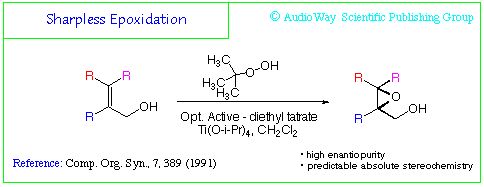
You are hereby offered the opportunity to receive up to 20 points extra credit in Chemistry 247, Section B. Here's how it works:
Any group of 1, 2, or 3 students may submit a review of a literature report published in the year 2000 or 2001
of the total synthesis of a natural product in which the
Sharpless epoxidation is used.
Note that a "total synthesis" is one that starts with available materials and constructs a target compound. A
"natural product" is any substance that is found in nature, such as a natural antibiotic or anticancer compound.
Invariably the title of a report will include the phrase "total synthesis of..." if it is one. Usually the first
paragraph of the report, or possibly the abstract, will indicate whether the substance is a natural product.
Ground rules upon which credit will be dispensed:
- You must notify me of your intent to pursue this goal, clearly indicating who is in your group. In other words, no last-minute additions of personnel.
- All members of your group must certify that they have indeed contributed to the group's work.
- You may use any appropriate means of finding a synthesis. Personally, I recommend using SciFinder Scholar. But there are certainly other ways, including
books and journals in the science library that review organic chemistry. Keywords recommended include Sharpless epoxidation and total synthesis.
Note that we have many of these journals in our library or available
on line at St. Olaf College. Check Sage for what's here or Muse at Carleton.
If you have trouble finding a paper, let me help. But that help will cost you 5 points.
- Once you have found a synthesis that you think is appropriate, clear it with me. I need to see the paper. Please photocopy it or print it in PDF FORMAT (not HTML, if possible, please, because the images then are way too small to read).
No two groups will be allowed to review the same article.
- Your review must be in the form of a single Word document and must include:
- the name of the compound
- the full bibliographic citation (including an HTML link if you found it on line)
- a line beginning with "reviewed by " and including your names
- a drawn structure of the compound (could be clipped right from the on-line version if you know how to do that)
- a brief paragraph indicating the natural source of the compound and its interest to medicine (antibiotic, anti-HIV, anticancer, etc.)
- a retrosynthetic scheme (not necessarily every reaction but at least an overview of how the compound was put together and FOR SURE the epoxidation reaction)
- a brief discussion of the retrosynthesis highlighting the use of the asymmetric epoxidation in the synthesis. What was the overall idea? Why did these researchers use the asymmetric epoxidation reaction?
- a brief honest assessment of what role in this review each participant in your group played.
- The completed report should be submitted as an attachment to an email message to synthesis-ideas@stolaf.edu no later than Tuesday, December 11, 2001.
- Clearly indicate the names of all persons involved (including names and email addresses). If possible, set "reply-to" to include all group participants.
- Don't expect immediate acceptance. The editors will look your report over, and if there are minor corrections to be made, you will be expected to make them prior to final acceptance. If these corrections are not made, you will not receive credit for the submission. No exceptions.
- Submitting a review implicitly releases copyright to St. Olaf College and allows the college to publish that proposal at
http://www.stolaf.edu/people/hansonr/chem247/sharpless.
Extra credit, by the way, means "not part of the curve." Choosing not to do this extra credit will in no way reduce your grade. I will calculate the curve completely "extra-credit blind," then add in extra credit to determine your overall course grade.
Have fun!
Robert M. Hanson
Editor
Synthesis Ideas
synthesis-ideas@stolaf.edu