XML is a markup language, with roots in text
processing. Markup is annotation added to a body of text to
indicate such features as font choice, line breaks, paragraph and
section structure, and inclusion of figures and tables.
See the example of markup for an
illustration.
We will use the term rendition for a body of text
together with description of a desired format. The markup example
(second box above) is an example of a rendition. Software such as
Microsoft Word and Adobe PageMaker also work with renditions
internally.
A presentation is the result of formatting (third box
above). Presentations are intended for human perception. They need
not use visual media, such as paper or an electronic display: for
example, an SGML document might also generate sound through speakers
for the visually impaired.
Word and PageMaker offer a visual interface that shows the
(visual) presentation of the system's document rendition as one creates
the document. These are examples of WYSIWYG systems (What
You See Is What You Get).
The term markup was coined in 1970 by Charles
Goldfarb, the leader of an IBM team that explored the problem of
document content and interchange beginning in the late 1960's. His
team produced GML (Generalized Markup Language) at that time, and
Goldfarb led an ongoing effort to develop the system and concepts
toward SGML (Standard Generalized Markup Language), resulting in the
first ISO standard for SGML in 1986 and the current version of that
standard in 1991.
SGML supports three fundamental goals:
Common data representation. The markup should provide a
universal representation that all systems can use.
Extensibility. It must be possible to define new
markup for new situations in order to represent all forms of information.
Document type rules. Documents of a common type must
adhere to formally verifiable rules for that type.
Few text processing systems adhere to all of these goals. For
example, Microsoft Word is incompatable with other word processors,
which must convert a Word document to their own internal formats.
However, Word is a de facto standard (unofficial, established
through the fact that many users use it) in many organizations,
including St. Olaf. However, different versions of Word offer
different features. A user cannot define his/her own extensions to
Word, and there are no formal rules for document types.
The LaTeX rendition format is frequently used for CS
publications. LaTeX is frequently entered as markup, although WYSIWYG
editors exist. This language has a consistent standard, and is
extensible. LaTeX offers different document types, with presentation
choices governed by those types. However, there is no rule system for
documents of a particular type.
SGML is commonly used in extremely large scale documentation
applications, such as aircraft maintenance information, government
regulation, and power plant documentation. For example, a single
model of a single commercial aircraft might require 4 million
unique pages of documentation that must be revised and republished
quarterly! [Kimber, in Goldfarb] Of course, Boeing or Airbus produce
many such models. As recently as 2000, applications
such as aircraft documentation represented more information than the
entire web.
SGML markup consists of elements indicated by
tags. For example, one element may represent a paragraph,
another a style choice (e.g., emphasized text, perhaps indicated in
this font), and another a graphic image.
Each element has a start tag and an end tag, which allows for nesting
of elements (e.g., a section contains paragraphs; paragraphs contain
regions of emphasized text). The tags
themselves are delimited with angle brackets, now
familiar in HTML. The language was developed over a 20 year period,
and is rich with capabilities including support for hypertext and for
style sheets, which separate rendition decisions from
document content.
SGML has various idiosyncrasies and complexities that support
large-scale use, but
which increase the learning curve and get in the way of ordinary-sized
applications.
Tim Berners-Lee's WWW Consortium developed XML beginning in 1996,
with a standard published in (ca.) 1998, and additional supporting standards
for links (XLink), style sheets (XSL), etc., emerging thereafter.
Jean Paoli of Microsoft and Jon Bosak of Sun Microsystems led the
effort. XML is a subset of SGML, and the accompanying standards are
generally based on corresponding SGML features.
Like SGML and HTML,
markup tags are delimited by angle brackets, and entities are
delimited by ampersands & and semicolons.
Unlike HTML, the XML language achieves all three of the
SGML goals. In particular, XML is fully
extensible---one can define any desired document type---and formal
rules are defined for each document type, against which individual
documents can be checked for validity. SGML's DTD
format provides one way to define document types and describe their
rules; XML Schema constitute an alternate
aproach.
By 1998, it became clear that XML had important applications
beyond text processing. For example, EDI (Electronic Data
Interchange) technology seeks to automate the way large companies buy
and sell from each other. This automation goes beyond the kind of
transaction a consumer has when they buy a book from
amazon.com: for businesses, purchase orders must be
generated and approved, entries must be made in private accounting
systems, etc.; when conducted through the web, one might refer to this
as integrated e-commerce (although it's only called
B2B, Business to Business, in the media).
XML makes it possible to send for documents in one
format between companies, with each organization then transforming
those documents into their own local formats (often also in XML) as
many times as needed, finally making changes in particular (non-XML)
internal systems. The use of XML rather than custom-built
intermediary languages makes this capability available to even small
businesses.
Document structure. Example:
~cs378/xml/Dog.xml,
SD spec for
Dog class.
_____
Balanced tags. Empty elements. _____
Parsing, verification. _____
_____
_____
_____
_____
-
What is a DOM (Document Object Model)?
DOM is a low-level API (Application Programming Interface) which lets
a programmer deal directly with the contents of an XML document.
There is no pre-processing involved with this process. All that is
necessary is the creation of a DOM tree, which is a complete in-memory
representation of the XML document used to create it. After the DOM
is created, there are many methods already written which allow
programmers to efficiently and recursively navigate their way through
a DOM tree, making changes if necessary.
Creating a Document object (DOM tree)
An XML parser or document builder is a code
object for converting an XML
document into a DOM tree (i.e., an object in the class
Document). DOM does not provide a general-purpose
parser object for performing such conversions, because some options for
a parser object can't just be passed as arguments or settings, but
must be incorporated in the construction of that object. Therefore,
DOM provides a factory for constructing custom parser objects.
A DocumentBuilderFactory (in the javax.xml.parsers package)
is a factory API that enables
applications to obtain a parser that produces DOM object trees from
XML documents. A DocumentBuilder defines the API to obtain
Document instances from an XML document. Using this class, a
programmer can obtain a Document from XML. When we say Document, we
mean a DOM tree.
- To create an DocumentBuilderFactory object, simply make
the call
DocumentBuilderFactory dbf =
DocumentBuilderFactory.newInstance();
- A programmer can then specify the way in which the dbf
object parses the XML document. See the Java API for more information
about these options, such as setValidating(true).
- To create a new DocumentBuilder, simply make the call
DocumentBuilder db = dbf.newDocumentBuilder();
- Lastly, to create a DOM tree (or Document object), simply call
DocumentBuilder's parse method, which can take a variety of
input sources. Again, see the Java API for exact specifications.
- So, the final sequence of calls to create a DOM tree is as
follows:
Document document;
DocumentBuilderFactory dbf = DocumentBuilderFactory.newInstance();
dbf.setValidating(true);
.
. (other parse options)
.
DocumentBuilder db = dbf.newDocumentBuilder();
document = db.parse(some input source);
The argument for parse() method of the
DocumentBuilder class can be a File object
or an InputSource object (look this type up in the
org.xml.sax package). For example, if a
String object str holds your XML document
represented as a single string, then
document = db.parse(new InputSource(new StringReader(str)));
creates a DOM tree document from that string str.
Terminology
There are many terms frequently used by programmers when speaking
about XML and DOM trees. In case you aren't familiar with the
terminology, this will be a brief framework of the most commonly used
terms when speaking about XML and DOM.
XML Example:
        <?xml version="1.0"?>
        <!DOCTYPE note SYSTEM "DTD/note.DTD">
	<note>
          <to>
            <name>Agent X</name>
            <building>Langley, CIA Headquarters</building>
	  </to>
          <from>
            <name>Agent Y</name>
          </from>
          <message>Leave the building at 11:00 p.m.</message>
        </note>
- XML declaration -- Every raw XML document must start with
the first line <?xml version="1.0"?>. This simply
declares the version of XML being used.
- Document Type Declaration -- Every XML document must
contain a line specifying the document type. In this XML document, we
are assuming there is a DTD (Document Type Definition) created located
in the local file system with the path DTD/note.DTD.
- Root Element -- In this XML document, the root element is
the note element. There is only one root element for each XML
document. To obtain the root element of a DOM tree simply call
getDocumentElement(), which returns the root element of a DOM
tree. This is a very helpful method, found in the
org.w3c.dom package.
- Node -- A node is the primary datatype for the entire
Document Object Model. There are 12 node types, which are listed in
the Java API in the Node Interface in the org.w3c.dom package.
Every box in the diagram below is a node.
- Parent -- In this XML document, every node is a parent
node with the exception of the text nodes. Namely, the nodes which
contain "Agent X", "Langley", "Agent Y", and "Leave the Building at
11:00 p.m.".
- Children -- In this XML document, every node is a child
note with the exception of the root element note. Notice
that the content of a node (e.g. "Agent X") is a child. The text
nodes are colored blue in the diagram below. The best way to
interpret parent and child is to draw a diagram of the DOM tree. It
then becomes very clear.
- Document -- The Document interface represents the
entire XML document. When we say Document with a capital D,
that is referring to a DOM tree.
- Well-formed -- An XML document is well-formed if it is
syntactically correct.
- Valid -- An XML document is valid if it conforms to a given
DTD or schema. A document can be well-formed but not valid. However,
a document cannot be valid, but not well-formed.
Visual Tree Representation of a DOM
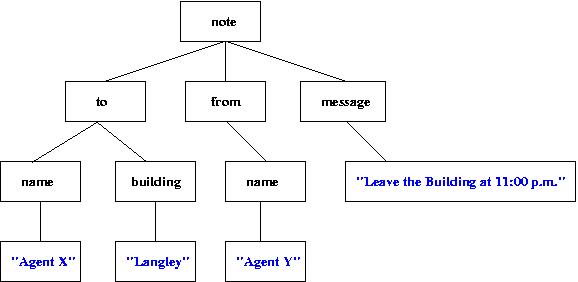
Useful packages for traversing and modifying a DOM tree
For purposes of simplicity, let's assume that rootElement has
been defined to be the root element of this DOM tree. That is,
rootElement represents the DOM tree specified by the diagram
above. To obtain the value "Agent X", this sequence of calls needs to
be made:
- rootElement.getFirstChild().getFirstChild().getFirstChild()
Try running through this sequence of calls
with the diagram. This is the best way to understand these function
calls. Can you write any other function calls to obtain the value of
the name node? Look at the functions defined in the
org.w3c.dom package in the Java API.
Recursion and DOM trees
An excellent way to gain a strong understanding of the recursion
involved with processing an XML document, it is helpful to spend the
time to write a DOM serializer. A DOM serializer is simply a process
to generate a raw XML document from a DOM tree. So, the number of
children must be known at all times and a recursive process must be
called to deal with any number of children and any number of parents.
Remember that a DOM is really nothing more than a data structure
stored in main memory.
Additionally, like mentioned before, there are 12 types of Nodes,
and each type is displayed differently. Writing a Serializer won't be
an assignment here, but will most likely become a task in the team
project later in the semester. The only way to change the contents of
an XML document is to first parse the document into a DOM tree, then
make changes. However, we would like a new raw XML document to
reflect the changes made to the DOM tree. So, we need to write the
DOM tree to a file to accomplish this. Our project is going to
involve a lot of XML defining the structure of a portfolio, and if the
structure needs to be changed then a DOM tree must be created, changes
made to that DOM tree, and the DOM is rewritten as a file and stored
again. There will be many methods to accomplish this task, and if the
methods are written well the first time, it can be reused for any XML
document.
Example of XML processing in Java
The following example shows recursive modification... (append to
<name>s, add a <department>)
Examples:
~cs378/xml/Contract.dtd,
SpecML.dtd
A Document Type Definition (DTD) is used to constrain the content of
an XML document. For example, if you are trying to model the contents
of a music collection you would like a CD to have only one artist and
one album name. DTDs allow a developer to specify exactly these types
of constraints. A DTD is used to define the legal building blocks of
an XML document. A DTD can be declared inline in your XML document or
as an external document.
- DTD Elements:
<!ELEMENT element-name (element-content)>
- Elements with children (sequences):
<!ELEMENT element-name
(child-element-name, child-element-name, ..., child-element-name)>
- Elements with only character data:
<!ELEMENT element-name (#PCDATA)>
- Elements with one or more elements:
<!ELEMENT element-name (child-element+)>
- Elements with zero or more child elements:
<!ELEMENT element-name (child-element*)>
- Elements with either/or content:
<!ELEMENT element-name
(child-element1|child-element2)>
- There are many other ways to constrain the contents of an XML
document. For a good reference of these options, please visit the
following URL: W3 Schools.
_____