
- St. Olaf News
- Features
- For the Media
- Media Relations
- Kari VanDerVeen
- Alumni Hall
- 507-786-3970 office
- 507-412-1036 cell
- vanderve@stolaf.edu
 RSS Feed
You reached this page through the archive. Click here to return to the archive.
Note: This article is over a year old and information contained in it may no longer be accurate. Please use the contact information in the lower-left corner to verify any information in this article.
Former prime minister of Norway to address upcoming Peace Prize Forum
December 1, 2003
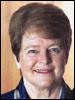 |
| Brundtland |
She will address the conference?s theme "Striving for Peace: Roots of Change" at the opening plenary session, Friday, Feb. 20 at 1 p.m. in the Skoglund Athletic Center auditorium.
Earlier this year, 2002 Nobel Peace Prize Laureate Jimmy Carter, the 39th president of the United States, accepted an invitation to address the conference plenary session on Saturday, Feb. 21.
Each year, the Nobel Peace Prize Forum bases its theme on the accomplishments of the most current laureate.
"We are delighted that Dr. Brundtland has agreed to address the conference,? says Susan Carlson, Nobel Peace Prize Forum 2004 Planning Committee chair and program coordinator for the Center for Integrative Studies and the Center for Innovation in the Liberal Arts at St. Olaf. "This is a rare opportunity to hear her global perspective on the complex web of political, health and environmental issues."
Dr. Brundtland will also speak at a luncheon co-hosted by the Minnesota International Center Nobel Peace Prize Forum on Thursday, Feb. 19, at Windows on Minnesota, in Minneapolis.
The February 2004 event will mark the 16th year of collaboration between the Nobel Peace Prize Forum and the Norwegian Nobel Institute in Oslo. The forum series offers an opportunity for Nobel Peace Prize laureates, diplomats, scholars and the general public to examine the underlying causes and manifestations of conflict and war in modern society, as well as the dynamics of peacemaking.
The two-day event typically is a mix of plenary sessions and small-group seminars. This year, St. Olaf organizers will add peace-skills workshops to the agenda.
The Nobel Peace Prize Forum is hosted on a rotating basis by five colleges of Norwegian heritage and affiliated with the Evangelical Lutheran Church in America in the Upper Midwest: Augsburg (Minneapolis), Augustana (Sioux Falls, S.D.), Concordia (Moorhead, Minn.), Luther (Decorah, Iowa) and St. Olaf College.
Registration information for the general public will be available in December.
Dr. Brundtland spent more than 10 years as a physician and scientist in the Norwegian public health system followed by 20 years in public office.
In 1981, at age 41, she was appointed prime minister of Norway, becoming the youngest person and the first woman to hold the office. She was elected prime minister two more times, serving from 1986 to 1989 and from 1990 to 1996.
In the 1980s, while chair of the World Commission on Environment and Development (the Brundtland Commission), she gained international recognition for championing the principle of sustainable development. In short, sustainable development is defined as satisfying present needs without compromising the ability of future generations to meet their own needs.
The commission published the report "Our Common Future" in April 1987, which led the United Nations to host the international Earth Summit, in Rio de Janeiro.
Dr. Brundtland was elected as director-general of the World Health Organization (WHO) in 1998 and served until July 2003.
In her acceptance speech for the position she summed up WHO's mission as being the "moral voice and the technical leader in improving health of the people of the world." She also said the organization should stand "ready and able to give advice on key issues that can unleash development and alleviate suffering."
"I see our purpose to be combatting disease and ill-health," Dr. Brundtland explained, "promoting sustainable and equitable health systems in all countries." Recently, she published an autobiography: Madame Prime Minister: A Life in Power and Politics.


