
- St. Olaf News
- Features
- For the Media
- Media Relations
- Kari VanDerVeen
- Alumni Hall
- 507-786-3970 office
- 507-412-1036 cell
- vanderve@stolaf.edu
 RSS Feed
You reached this page through the archive. Click here to return to the archive.
Note: This article is over a year old and information contained in it may no longer be accurate. Please use the contact information in the lower-left corner to verify any information in this article.
Examining ethical computing
March 5, 2009
Most of us use computers on a daily basis without even thinking about the ethics involved in the work we do at the keyboard. But privacy, intellectual property, freedom of speech, and the safety of critical systems are just a few of the issues that concern computer professionals. So what's the best way to teach the ethics of computing? And can it be done in a way that actually influences behavior?
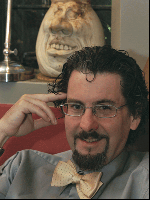 |
| "I hope this research will eventually help faculty in many countries train engineers and scientists so that they can become competent puzzle solvers and actively ethical designers and scientists," Huff says. |
"I hope this research will eventually help faculty in many countries train engineers and scientists so that they can become competent puzzle solvers and actively ethical designers and scientists," Huff says. "The long-term goal is to support good engineering and good science, in both the technical and ethical meanings of the word 'good.'"
Using his third grant from the National Science Foundation (NSF), Huff -- who is completing this research in Munich, Germany, while on sabbatical -- has extensively interviewed 24 people who have proven track records of making ethical decisions in computing. He has examined how these people, dubbed "moral exemplars in computing," arrived at their commitments to ethical practices and what influences in their professional lives may have guided them.
More than a dozen current and former St. Olaf students -- many of whom have gone on to graduate school in psychology, statistics and computer science -- have worked with Huff on this research and will be listed as co-authors on the published research. Fellow faculty members from a variety of disciplines have also collaborated with Huff in thinking about ethics in a variety of different professions.
A panel was established to help choose the two-dozen people studied for this research. Panel members established four criteria that define a moral exemplar, including a willingness to put morals before self-interest and the ability to inspire others to also act morally. They then nominated people who fit these criteria and rejected any nominees to which even one panel member had strong objections. All of the people chosen for the study have had significant experience working in academics, government policy, industry, or a combination of these areas, and hail from either the United Kingdom or Scandinavia.
Huff has found that these moral exemplars have certain personality traits in common, such as higher rates of extroversion, an agreeable nature, and more openness to new experiences than their respective country's norm.
Many ways to be moral
One of the most notable results of the study was that there are many ways to be moral, and it only hinders people to make everyone follow one version of being "good." These findings have already begun to change how Huff teaches his "Ethical Issues in Software Design" class at St. Olaf. The class has become more lab-based than the traditional discussion class, meaning his students are designing software (not just talking about it) with moral ethics in mind. They've been working on projects with the web-registration system at St. Olaf, as well as doing web-based work for nonprofits and databases for local school systems.
The importance of actually being able to apply their moral skill set to create computer software demonstrates another important finding in Huff's research: without the skill set to do anything with good morals, the ethics are basically useless.
"We need the skills to carry out our good intentions," Huff says. "What I have been doing is identifying some of the skills that moral exemplars in computing use to be successful and figuring out how to teach them in the classroom."
Huff plans to use his findings to continue to improve computer ethics classes on campus. "I hope to begin to use some of the life stories of the moral exemplars I have been studying as a way to help students reflect on what moral goals they want to establish for their careers," he says.


