
- St. Olaf News
- Features
- For the Media
- Media Relations
- Kari VanDerVeen
- Alumni Hall
- 507-786-3970 office
- 507-412-1036 cell
- vanderve@stolaf.edu
 RSS Feed
You reached this page through the archive. Click here to return to the archive.
Note: This article is over a year old and information contained in it may no longer be accurate. Please use the contact information in the lower-left corner to verify any information in this article.
Students and faculty member address gap in HIV/AIDS research
March 12, 2009
A rising percentage of the approximately 33 million people worldwide living with HIV/AIDS are age 50 and older. But few scientific studies include this demographic group, which is more likely to risk unprotected sex and progress faster to AIDS than younger groups.
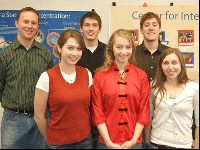 |
| The St. Olaf WHO team: (front, l-r) Emily Segar '09, Monica Southworth '10 and Jocelyn Wacloff '10; (back) Visiting Professor of Statistics Jim Scott, Chris Miller '10 and David Tonyan '10. |
To prepare for their Geneva assignment, Segar (a math major), Miller (a psychology major) and Tonyan (a history major) were granted fellowships in the college's Center for Interdisciplinary Research -- a National Science Foundation-funded enterprise that brings together St. Olaf statistics students and faculty members from multiple disciplines to collaborate on various projects. For three months the group focused on two tasks: 1) documenting risk factors and the prevalence of the disease in adults age 50 and older using demographic health surveys and 2) conducting literature searches to familiarize themselves with the source and development of HIV.
Southworth and Wacloff joined the group for Interim. After surveying close to 5,000 articles from the WHO libraries, the group was surprised to find fewer than 70 articles relevant to their topic. Only one piece reported a controlled study -- the "gold standard" in HIV/AIDS research. "Coming into Geneva, we thought we were going to be doing more statistical work, but we realized that there wasn't enough data," Segar says. "So our work is helping to fill a void."
In their Geneva presentation, the group reported prevalence estimates from both their WHO literature search and their research at St. Olaf, and cited the most common risk factors for people over the age of 50, such as a weakened immune system, the thinning of vaginal mucosa for women, and a decreased use of condoms among older age groups. The group also advocated for further research in the field.
"It's amazing how little this age group has been researched," says Miller, who also has a concentration in statistics. "People over the age of 50 are really at risk. They progress to AIDS and die three to four times faster than 20- to 30-year-olds."
Making the news
Upon completion of their literature search, one of the group's WHO mentors, HIV/AIDS expert George Schmid, wrote an editorial for the WHO Bulletin on the group's results that listed them as co-authors. A number of media outlets reported on the results, and a piece by Reuters was distributed around the globe. "The publicity has demonstrated that people are interested in this topic and what populations are affected by it," Segar says. "HIV is still a fairly new disease, and some parts are being overlooked. We want to contribute to what people know."
During this spring semester the group plans to publish a journal article on the topic that addresses the need for more HIV epidemiological literature on individuals over the age of 50, discuss risk factors based on their fall and Interim research, and report the prevalence and estimating incidence of HIV using mathematical models. They will present their conclusions during the National Conference on Undergraduate Research held at the University of Wisconsin-La Crosse in April.
Tonyan says he's thrilled to contribute to public health research that could save lives. "It's inspiring to feel like I'm doing something that matters even though I'm only an undergraduate," he says.
"Hopefully our project will identify a hole in the literature," adds Southworth, a political science major. "Then in the future, researchers will consider this group to be at risk."


