
- St. Olaf News
- Features
- For the Media
- Media Relations
- Kari VanDerVeen
- Alumni Hall
- 507-786-3970 office
- 507-412-1036 cell
- vanderve@stolaf.edu
 RSS Feed
You reached this page through the archive. Click here to return to the archive.
Note: This article is over a year old and information contained in it may no longer be accurate. Please use the contact information in the lower-left corner to verify any information in this article.
Students unwind, engage at 'game night'
May 18, 2007
With the busy pace of life on a typical college campus, it would be easy for students to overlook the value of playing board games. Some might see it as an idle pastime or just a childhood activity. But a group of St. Olaf students have found "game night" to be the perfect way to unwind and engage -- both mentally and socially.
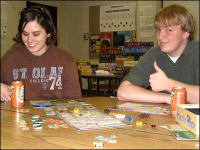 |
| St. Olaf students Emily Klock, a religion major, and Paul Tveite, a mathematics major, play the game "Puerto Rico," a role-playing game set in the early years of the island's development by European settlers. |
In an era when "gaming" conjures up images of a lone player in front of a computer screen in a dimly lit room, these students find low-tech games a satisfying alternative. And while experiencing a "virtual" community suffices for many computer gamers, game night participants create the real thing.
With its origins in the Mathematics Department (which has since been renamed Mathematics, Statistics and Computer Science), game night primarily attracts math and computer science majors, but all are welcome. It began a few years ago, when visiting professor Dave Molnar shared his interest in games (and his impressive game collection) with his math students. But when Molnar moved away from campus to his next teaching job, game night lost momentum.
Hanging out
 |
| Laison |
The group passes over such mainstream games as Monopoly and Yahtzee for more interesting, less common choices. The most popular games with the group are those with simple rules, but that offer the potential for complex strategy. "The games we play are less random," says Laison. "They call for a deeper level of skill." Laison's wife, Stephania Fregosi, who attends game night whenever her schedule allows, adds, "These games aren't difficult to learn. They allow for deep thinking or shallower thinking. A great game can be played by anyone." (Although Laison will be moving to Willamette University next year, he hopes that the game night group will continue by gaining official "student club" status.)
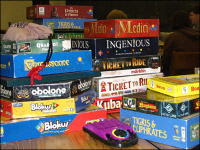 |
| Game night participants choose from a variety of game titles. |
"It's both a mental break and a mental challenge," says mathematics major Paul Tveite '07. "It's a break from thinking about things that matter, but it still engages your mind."
The complexity of the games, combined with the sense of community that is fostered, keeps students returning to game night over and over. "It's more social than watching TV," says Emily Klock '07, a religion major and a game night regular. "And it involves a little more thinking."
--Amy Boxrud '89 is a freelance writer who lives in Northfield.


