
- St. Olaf News
- Features
- For the Media
- Media Relations
- Kari VanDerVeen
- Alumni Hall
- 507-786-3970 office
- 507-412-1036 cell
- vanderve@stolaf.edu
 RSS Feed
You reached this page through the archive. Click here to return to the archive.
Note: This article is over a year old and information contained in it may no longer be accurate. Please use the contact information in the lower-left corner to verify any information in this article.
Culture of Peace exhibit on display through Feb. 25
February 11, 2007
 |
This simple message is at the heart of an exhibit running through February 25 at the concourse of Tostrud Center and Skoglund Athletic Center at St. Olaf. "Building a Culture of Peace for the Children of the World" is free. It is open to the public from 8 a.m. to 8 p.m., Monday through Friday, 9 a.m. to 8 p.m., Saturday and noon to 8 p.m., Sunday.
The exhibit is co-sponsored by the Division of Social Sciences at St. Olaf and Soka Gakkai International-USA. It appears in conjunction with "Another World Is Possible," the 2007 Globalization and Social Responsibility conference being sponsored Feb. 22-24 by the St. Olaf Social Science Faculty, and by the college's 10th annual World Wide Service Fair on Feb. 23.
Causes of conflict
 |
 |
| Stoutland |
The dramatic multimedia display examines barriers to peace, including religious and ethnic intolerance and environmental irresponsibility, and then focuses on eight action areas identified by the United Nations:
* Promoting education for all
* Promoting sustainable economic and social development
* Promoting respect for all human rights
* Ensuring equality between women and men
* Fostering democratic participation
* Promoting dialogue among civilizations that leads to understanding, tolerance and solidarity
* Supporting the free flow of information and knowledge
* Promoting international peace and security
Designed to be enjoyed by people of all ages, the exhibit focuses on the potential of the individual to build peace in today's world and emphasizes concepts such as self-mastery, dialogue and tolerance, community and culture.
A concluding "Peace Builders" section recognizes people, some famous, some average citizens, who have made significant contributions to peace. Among these are Nickole Evans of Kennewick, Wash., and Gerson Andres Florez Perez of Bogota, Columbia. At age 14, Evans created a website to help young people share their feelings about violence. Perez, now 20, is the founder of Children's Movement for Peace in Colombia and an advocate for the abolition of antipersonnel landmines.
Inspiring personal action
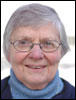
The "Building Peace" exhibit is designed to inspire personal action, notes Stoutland. "As Eleanor Roosevelt put it, if you believe in peace you also have to work at it. You have to do something."
Stoutland's interest and involvement in peace, justice and service was prompted by the creation of the United Nations while she was in high school. It was nurtured at St. Olaf. She studied in Oslo as a student. While teaching ESL (English as a Second Language) at the college, she worked extensively with students from other countries, some fresh from conflict in their homelands.
Co-leading the college's Global Semester and Term in Asia programs brought more international perspective. She also devoted time and energy to ABC (A Better Chance, a program for students of color) and the League of Women Voters.
In 1997 Stoutland retired from teaching -- but not from peace building. In 2002 she helped lobby the Northfield City Council to adopt a resolution in support of the United Nation's International Decade for a Culture of Peace and Nonviolence for the Children of the World (2001-2010).
She has been active in promoting UNESCO's Manifesto 2000, an appeal for non-violence by recipients of the Nobel Peace Prize. She also contributes to school outreach programs when St. Olaf hosts the Nobel Peace Prize Forum, a program that rotates yearly between five Lutheran colleges in the Upper Midwest.
Last September when the Hibakusha, four survivors of the Hiroshima atomic bomb, visited Northfield, she helped organize the community celebration for the International Day of Peace. She convenes a peacemakers group at St. John's Lutheran Church.
At noon on many Saturdays you can find her downtown at Bridge Square, participating in a weekly vigil with other peace advocates.
Peace making is hard work, Stoutland cautions. Your efforts can get you labeled as a dreamer, as a threat, as unpatriotic -- or worse. That was readily apparent as the United States prepared to invade Iraq; opposition to the war was ridiculed and condemned.
When she gets discouraged by that kind of reaction, Stoutland calls to mind the example of A.J. Muste. A minister and the executive secretary of the Fellowship of Reconciliation, a pacifist organization, Muste participated in protests throughout the 1940s, '50s and '60s.
"A reporter asked him if he really thought sitting in solitary vigil in front of the White House would help change the world," says Stoutland. "Muste replied, 'I don't do this to change the world, I do this so that the world won't change me.'"
Learn more about the upcoming exhibition at the Culture of Peace website.


