
- St. Olaf News
- Features
- For the Media
- Media Relations
- Kari VanDerVeen
- Alumni Hall
- 507-786-3970 office
- 507-412-1036 cell
- vanderve@stolaf.edu
 RSS Feed
You reached this page through the archive. Click here to return to the archive.
Note: This article is over a year old and information contained in it may no longer be accurate. Please use the contact information in the lower-left corner to verify any information in this article.
Fourth marks 100th anniversary of band, baseball in Norway
July 4, 2006
Given the plethora of fireworks displays, main street parades and shopping mall sales it's difficult for anyone not to know that it's America's Independence Day this week. What many people -- even Oles -- may not know, however, is that this Fourth of July also marks another historic event: the 100th anniversary of the introduction of baseball to Norway, thanks to the St. Olaf Band.
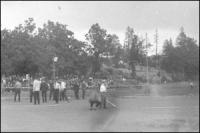 |
| A batter steps to the plate during the first game of baseball played on Norwegian soil. The game took place on July Fourth during the St. Olaf Band's 1906 Norwegian tour. The final score, according to the 1908 Viking yearbook: U.S. 7, Norway 4. |
Most Oles know all about F. Melius Christiansen's famous 1906 trip to his homeland of Norway with the St. Olaf Band, which made it the first American college musical organization to perform a concert tour abroad. The tour celebrated Norway's own independence and set the precedent for a century of interaction between St. Olaf and Norway. But amidst the concerts and the coronation of King Haakon VII, America's pastime made its debut on Norwegian soil.
The tour attracted national attention, even at the time, as evidenced by the July 5, 1906, Washington Post article describing the event. It reads:
Hundreds of Norwegian-Americans who came to visit their native country on the occasion of the coronation of King Haakon and to commemorate the second independence of Norway celebrated the American Independence Day here demonstratively. They assembled in the large hall of the university, where addresses were made in the English and Norwegian languages, expressing their pride in their American citizenship and their admiration of the great republic. To-night the band of Norwegian-born American students of St. Olaf's College, at Northfield, Minn., gave a concert at the Trivoli Garden [est. 6,000 in attendance], where the Stars and Stripes were unfurled and cheered, a most impressive demonstration ensuing.
What is not mentioned in the Post, but is recounted in Herman Roe's recollection of the tour in the 1908 Viking yearbook, is the advent of Norwegian baseball. Roe writes: "After dinner we gave an exhibition of baseball. This was the first game of American baseball played on Norwegian soil! The crowd did not understand the game, but were deeply interested. The score: U.S. 7, Norway 4."
BASEBALL WITH A BANG
George W. Mohn's account of the tour in his publication Were You There? mentions not only the baseball game, but also the American tradition of setting off fireworks. "America's Independence day, must of course, be celebrated by Americans," says Mohn, "and so, a baseball game was arranged between two teams from the band, and this was accompanied by the shooting of what few firecrackers could be obtained on short notice."
As Mohn notes, though, the "purchase of firecrackers in a foreign land is not as simple as it may seem." Mohn describes attempting to procure firecrackers -- a word for which he did not know the Norwegian equivalent -- from a Norwegian salesperson: "So by gestures you proceed to make known to the clerk, in a big department store, that you want to buy something that when a fuse is lighted, explodes with a bang." One can only imagine what the clerk thought the Americans were planning to do.
Another account of the baseball game appears in Manager of Music Organizations P.G. Schmidt's My Years at St. Olaf (published in 1967). "Baseball had never been played in Norway and people were anxious to have an opportunity to see what the great American pastime really was like," Schmidt says. He recalls a "good sized crowd," a ball and a bat "provided by some of the Norwegian singers who had been given them as souvenirs of the previous year when they were in America" and a borrowed fencing mask serving as a makeshift catcher's mask.
Schmidt's observations on the game perhaps explain why baseball never became the Norwegian pastime. "So far as we were able to judge from remarks made after the game, most people in the audience thought the game too dangerous, especially catching high flies," says Schmidt, adding: "Nor did they understand what it was all about."
Fortunately, for both college and country, there was still the music.
[Thanks to Associate College Archivist Jeff Sauve for unearthing the details of this story.]


