
- St. Olaf News
- Features
- For the Media
- Media Relations
- Kari VanDerVeen
- Alumni Hall
- 507-786-3970 office
- 507-412-1036 cell
- vanderve@stolaf.edu
 RSS Feed
You reached this page through the archive. Click here to return to the archive.
Note: This article is over a year old and information contained in it may no longer be accurate. Please use the contact information in the lower-left corner to verify any information in this article.
Ole scientists to participate in International Polar Year
August 29, 2005
 |
| Jacobel |
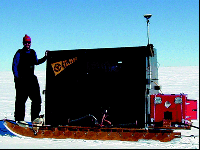 |
| Welch poses with the St. Olaf radar shelter during the U.S. ITASE traverse in 2001. Jacobel and Welch developed the special radar, which penetrates ice and gives information about ice flow and history. |
The grant also will support the participation of St. Olaf physics students. "Our students have played essential roles in all the research we have done in Antarctica and in ice-covered regions such as recent projects in Alaska and Arctic Sweden, where students participated in the field work," says Jacobel. "Several have gone on to do graduate work that has taken them to Antarctica and areas of the Arctic."
ITASE has as its goals a study of climate and global changes recorded in the chemistry of the near-surface ice focused primarily on the past 200 years. "The ice retains an almost perfect record of everything that falls out of the atmosphere," says Jacobel. "This enables scientists to characterize air circulation patterns like El Nino, temperature, pollutants and even the composition of the atmosphere itself."
Modeled after the highly successful International Geophysical Year in 1957 that discovered the Van Allen radiation belts that surround the earth and took scientists (including Carleton's former president Larry Gould) to the polar regions, IPY will be the organizing theme for a range of polar scientific activities in both hemispheres starting in July 2006 and continuing through June 2008.


