New Paradigm in Theatrical Rigging: Packaged Hoists
by Jody Kovalick, ASTC
Traditional theater rigging systems developed primarily during the Renaissance as sailors, who needed work when not out-to-sea, found employment in theatres. During this period, many large new theatres were built with formalized stages. As the use of curtains and large painted drops or scenery became more prevalent, sailing technology was adapted to serve the stage. Theatrical rigging has continued to utilize manufacturing, equipment, and practices from other industries. Although the mechanisms used for manual and counterweight theatrical rigging equipment and the engineering involved has improved over the last century, the systems largely remain the same and their operational practices little changed from the basics employed by those sailors in Renaissance theatres.
The developments in motorized rigging, however, have seen marked improvement in the last decade and a significant increase in the use of motorized rigging in performance venues. There has been a regulatory trend, most prominent in Western Europe, away from manual rigging. These regulatory changes were based on worker safety and injury prevention from the handling of counterweights. The North American markets have not been subjected to this sort of regulatory direction, but the potential safety and labor benefits of motorized rigging may lead them in a similar direction and would be applicable for any performance venue.
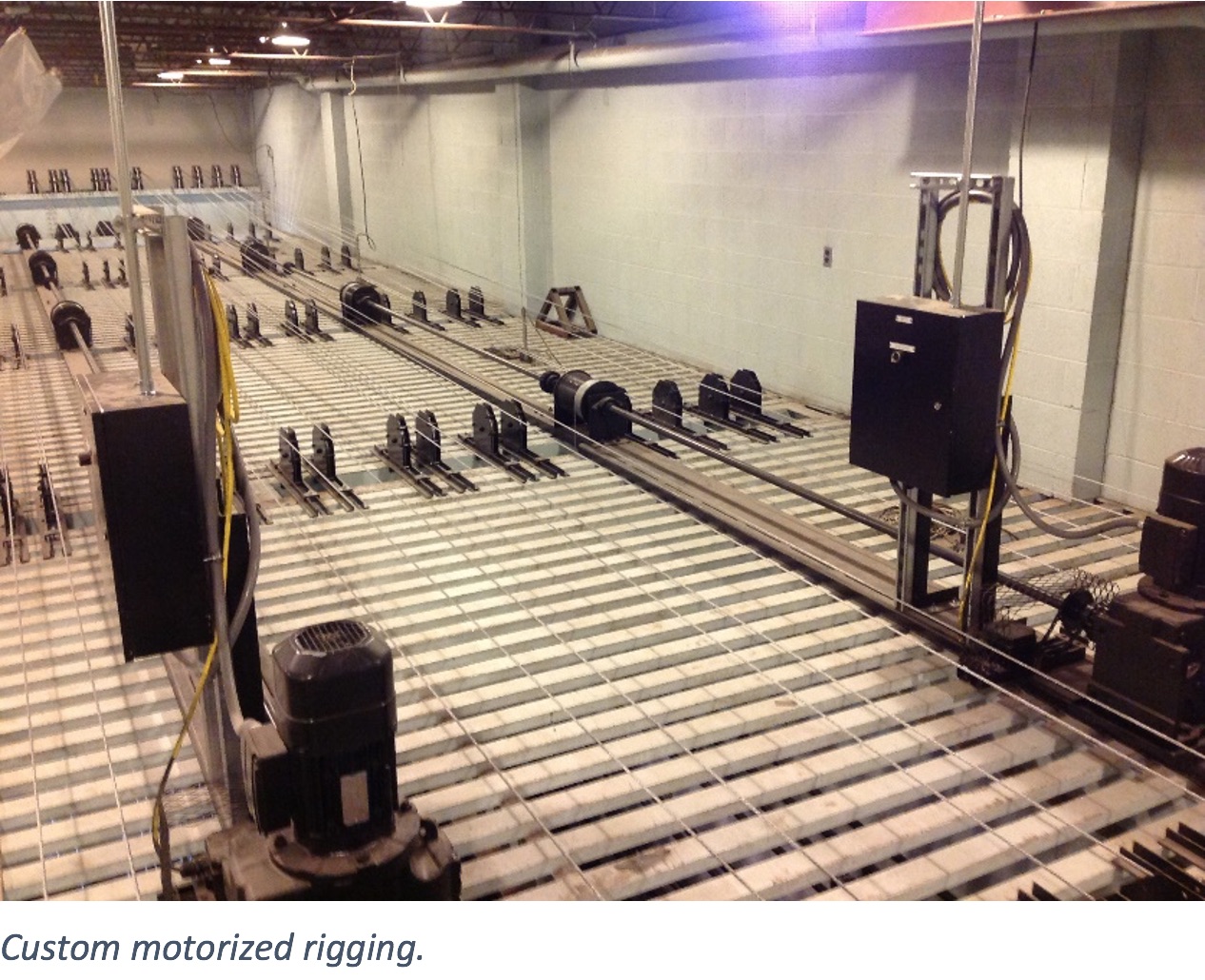 Motorized rigging systems have historically been highly customized and purpose-built machinery for theatrical rigging. They were significantly over-built, complex, and difficult to maintain. Controls were custom and may have required unique wiring. Recent trends have shifted towards a more standardized equipment model based around the concept of a “packaged hoist.” The result is equipment that is engineered to high standards, easy to operate and maintain, and simple to control for basic and complex production needs.
Packaged hoists are built as a single package or unit, with all elements housed within a single device. They can be installed easily (in comparison to custom units) and are designed to augment or replace manual rigging systems. In some ways, the packaged hoist is the theatrical rigging equivalent of the automobile. You have a standardized machine, with a limited set of options, that can be specified, purchased, and put into use. Granted, these are still specialized pieces of equipment, but in comparison to the custom rigging machines built in the past, packaged hoists are a major advancement in the development of motorizing rigging.
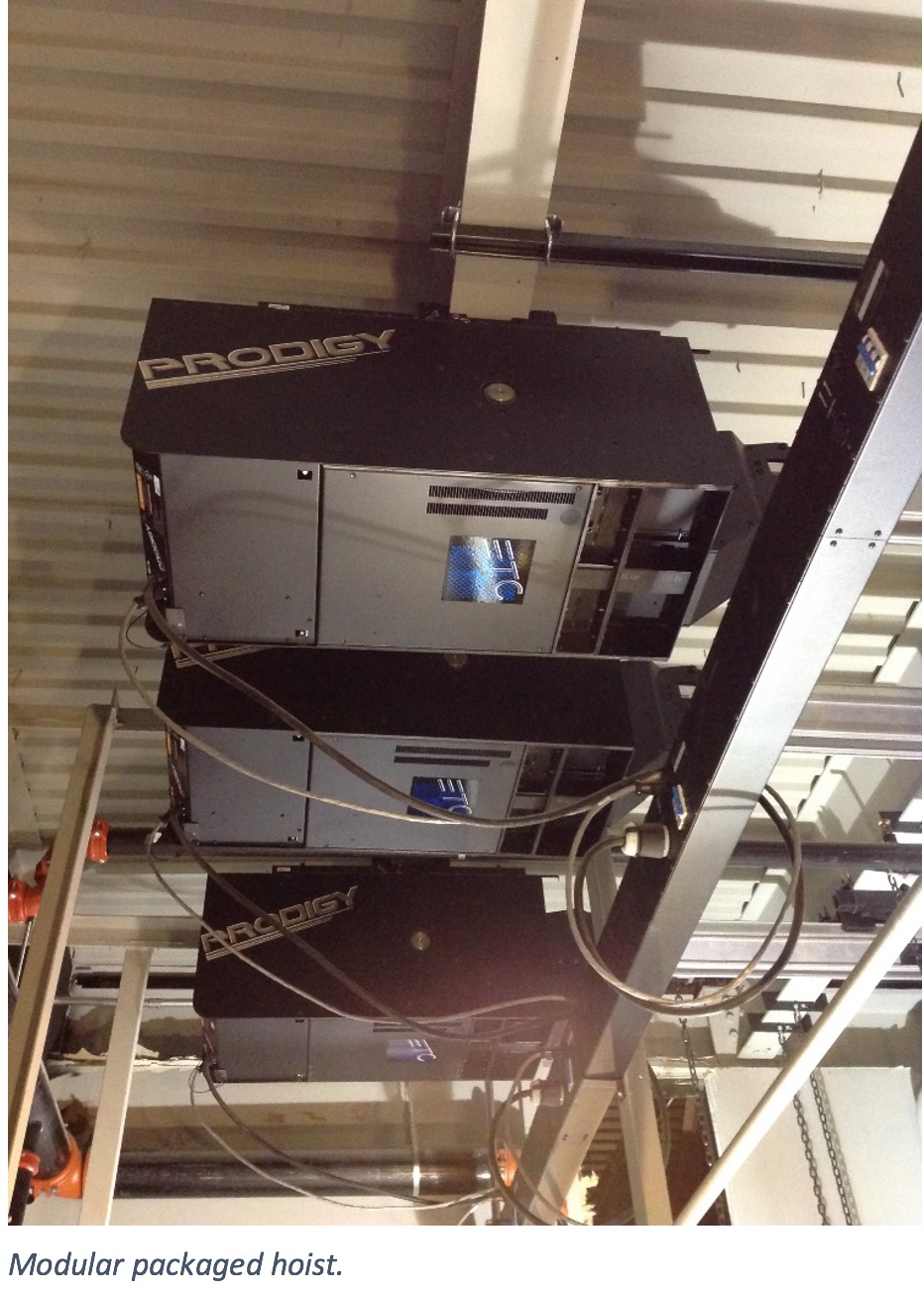 It is relatively common to see a combination of packaged hoists and manual counterweight rigging on stages. The manual counterweight rigging is used for lighter loads that require less counterweight and are easier to operate by manual labor. Manual systems can be upgraded with a counterweight assist style packaged hoist that works with existing counterweight line sets. Multi-line packaged hoists are frequently utilized for larger loads on stages, such as theatrical lighting battens or acoustic shells or production elements that require high-speed production operation. This allows the loads, especially for theatrical lighting, to be changed without the need to moving large amounts of counterweight. Precise trim height settings can be programmed and repeated for theatrical lighting, acoustic shells, or production loads.
Newer packaged hoists are not limited to static or heavy loads moving at fixed slow speeds. Options include a range of load capacities and speed options. Typical capacities range from 500 lbs. to 3,000 lbs. and cover everything from the lightest of scrims to large scenic elements or speaker stacks. Speed options range from 20 fpm (feet per minute) up to 600 fpm or more. With these options, it is entirely possible to design a full automated motorized rigging system capable of production level scene changes. They are not limited to moving the big, fixed elements.
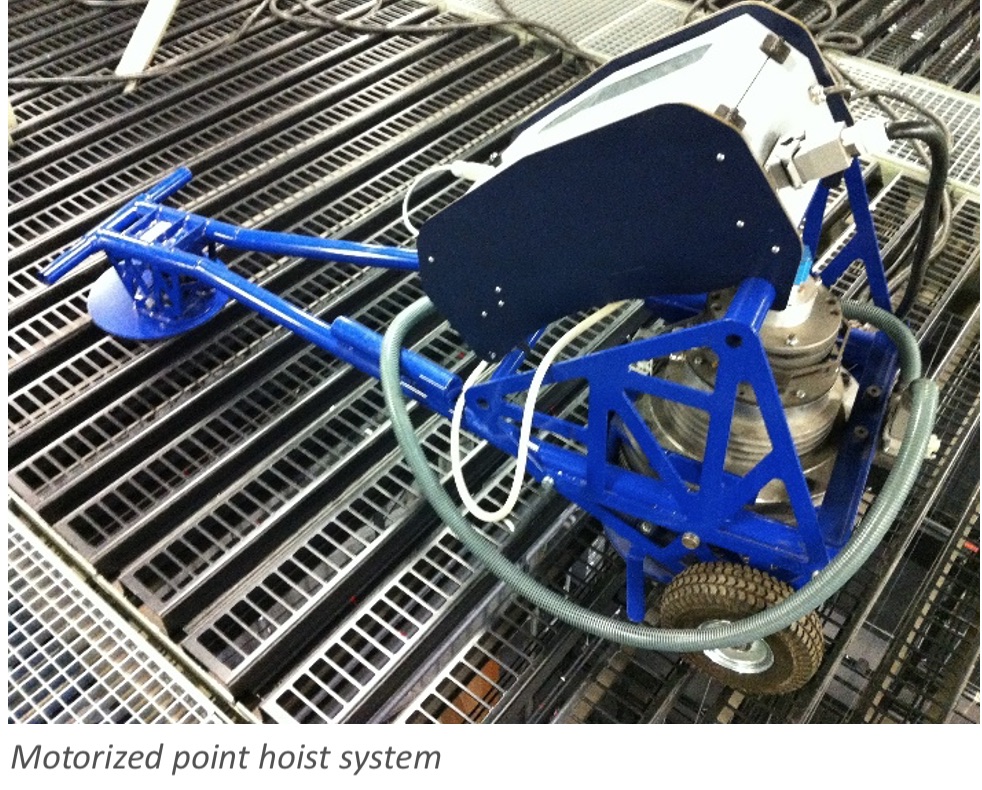 These hoists are not solely for proscenium stage configurations. While many of the above examples are based on multi-line hoists, single line point hoist options have also been developed. These may be of use in a traditional proscenium stage but could be equally of use in more free form venues such as black boxes, event centers, and arenas. The standardized mounting, connectors, and improvements in controls allow for hoist units to be repositioned as needed, easily and quickly, based on the production needs in a venue.
Modern control systems for motorized rigging have also seen significant development in the last decade. In the past, rigging control systems were complex custom builds. Newer rigging controls operate more like a lighting console. They can provide a range of functions, from basic controls for simple up/down moves, to the ability to write “cues” for pre-programmed scenery changes, to complex timed sequences of movement. Controls can be reconfigured if hoists are rearranged—something nearly impossible with purpose-built controls. Many of the newer controllers include 3-Dimensional modeling and pre-visualization of programed moves of scenery or curtains.
Controls are now able to provide a greater level of informational feedback. Faults in the system are readily displayed and pinpointed for the operator. An improved level of safety is possible by this monitoring and robust E-Stop systems located at critical points throughout a facility. A common option with many of the newer packaged hoists is “load monitoring.” The hoist will actively monitor the value of the load applied to it and report this back to the controls for display to the operator. Limits on the load may be set at the controls, a valuable option for controlling who may be able to hang what from a given hoist.
The development of the packaged hoist and associated controls is marked by several key features:
- Standardized components across devices
- Limited options to meet the most common needs of stages
- Standardized controls and wiring within a manufacturer's ecosystem
- Engineered around common power available in most facilities
- Engineered to accommodate to a wide range of structural supports
- Improved manufacturer support for maintenance and repair by standardization
- Flexibility to reconfigure systems as production needs change
- Greater safety features including load monitoring, multiple levels of operator access, and flexibility of control locations
New Choices and New Considerations
Rigging systems are complex systems that are an integral part of any performance venue. Adding or including motorized rigging is a critical decision. A thorough review of a facility’s needs can help to determine the right blend of systems to support the venue's performance program, whether that be packaged hoists, control systems, or any manual equipment. When selecting motorized rigging there are several important considerations:
- Initial Cost – The cost to purchase and install rigging can be significant in both new construction and renovation. The right choices of system and components can result in an economical and sustainable system.
- Ongoing Costs – Manual rigging systems tend towards a “set-it-and-forget-it" mentality. The addition of motorized rigging requires a more systematic approach to ongoing maintenance and annual inspection of motorized systems. This is something that is often omitted when planning around manual rigging only.
- Future Costs – It is not uncommon to see manual rigging systems operating for 30 years with little to no maintenance or component replacement. Motorized rigging requires a planned approach to the upgrade and replacement of system components. Choosing the right system and manufacturer can go a long way to minimizing these future costs and ensuring that these needs can be met.
There are many valuable benefits to including motorized rigging in a facility. These include:
- Increased safety through system fault monitoring, load monitoring, and operator access.
- Flexibility of control locations for improved operator awareness.
- Reduced labor costs.
- Reduced set-up or load-out times.
- Greater flexibility with rigging and potential for reconfiguration of rigging.
The development of the packaged hoist and associated advanced controls has changed rigging, as much the electronic dimmer and networked control console did for theatrical lighting. Venues are no longer limited to highly customized devices for advanced motorized theatrical rigging solutions. Custom rigging will remain a viable option for specific needs, but the majority of theatrical rigging motorization can be served by the modern packaged hoist. [ ]
Jody Kovalick is Principal Theatre Planner with Schuler Shook based in Minneapolis, MN