|
||||||
![]() |
|
|
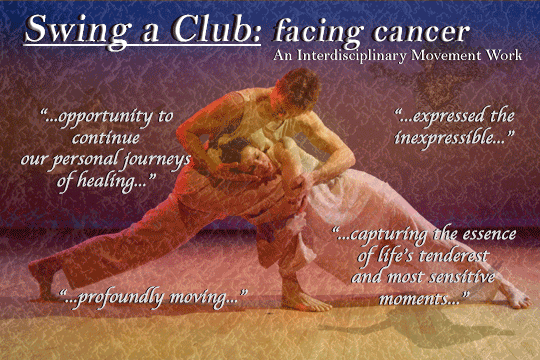
SWING A CLUB: facing cancer
is an interdisciplinary dance piece that brings to light themes of
life and death, hope and grief, support and letting go. Choreographed
by Anthony Roberts, Dance Artist in Residence at St. Olaf College,
this tender work is an intimate response and personal tribute to Roberts'
brother, Tom, who succumbed to cancer in 2001. The title of the piece
stems from Tom’s hope that he could quickly complete his cancer
treatments and take an annual golf trip with a tight knit group of
college friends. The elegant synthesis of movement, video, spoken
word and music, all created by Roberts, facilitates the unfolding
narrative, which seeps through the intellect to viscerally engage
the audience. Conceived and Directed Original Choreography,
Text, Music and Video
Photo credit: David
Gonnerman |
Performance Calendar for Swing a Club: facing cancer
Performances of Swing a Club: facing cancer are not planned beyond the 2005-06 season. If you are interested in having Swing a Club: facing cancer performed in your area, please contact Anthony Roberts: awr@stolaf.edu / 507-786-3622.
2005-2006
2004-2005
2003-2004
Articles on Swing a Club: facing cancer
2004-05
2003-04
2005-06
2004-05
Heather Klopchin |
Anthony Roberts |
|
Katie Balfanz |
Janice Roberts
|
|
Billi Stromseth Faillettaz **
|
Jennifer Nuelk |
|
Melissa Riedesel |
||
Performers listed in italics are also members of the 2005-06 Swing a Club cast. Their current bios can be found under that heading. |
* I would like to extend my deepest thanks to Dona Werner Freeman, who so generously and skillfully played the role of the psychotherapist during the first two seasons of Swing a Club: facing cancer. Dona's friendship, artistry and life experiences made the creation and performance of the work all the more meaningful for me. ** I remember being especially impressed with a certain audience member who attended both the April and November performances and post performance discussions of Swing a Club at St. Olaf College. Her observations, comments and questions was sensitive, incite and engaging. It turns out this audience member was Billi Faillettaz, the newest addition to the cast of Swing a Club. I would like to warmly welcome Billi to the cast as she assumes the role of the psychotherapist for the Spring 2005 tours. Her debut in the work will be during the Bloomington, Minnesota performances March 18-19, 2005. |
2003-04
Carolyn Albert |
Anthony Roberts
|
Dona Werner Freeman |
|
Heather Klopchin
|
Sheila May Slowinski
|
Eliza Larson |
|
Jennifer Nuelk |
Performers listed in italics were also members of the 2004-05 Swing a Club cast. Their current bios can be found under that heading. |
Performer BIOGRAPHIES for Swing a Club: facing cancer
2005-06 BIOGRAPHIES
Katie Balfanz is a junior at St. Olaf College and is pursuing majors in both Dance and English. She has trained in ballet, jazz, tap, lyrical, and hip hop styles and is now directing her focus to modern dance. Katie is now in her third year as a member of Companydance. In addition to her training and performance experience, Katie is an instructor for Universal Dance Association summer dance camps where she teaches high school and college age teams across the Midwest. Most recently, she has been commissioned by a high school team for her choreography. While Katie's future is uncertain, she hopes to pursue a career in the dance field.
Last fall, Katie’s aunt was diagnosed with breast cancer. Her aunt finished her treatment and is now living as a survivor.
Billi Stromseth Faillettaz is a psychotherapist, currently working as a volunteer with the Red Cross Disaster Relief Mental Health Team. She is an active member of the metro Red Cross Stress Team and the Minnesota Rapid Response Team. She has served in responses to disasters in the Midwest and recent hurricanes in the gulf states. In post 9/11 New York, Billi worked with victims of trauma and loss and later assisted the workers at ground zero.
Billi’s career began as a nurse. She worked at the Argonne Cancer Research Hospital at the University of Chicago. She received her BSN from St. Olaf College in 1980. In 1983 she received her MS in Psychiatric-Mental Health Nursing from The University of Minnesota with a thesis topic of “depression in women”. Billi worked at the Wilson Center in Faribault, Minnesota with young adults and on an adult psychiatry unit at the University of Minnesota Hospitals. At St. Olaf College she taught mental health nursing as a leave replacement, started the student wellness program, and helped to start and then advised SARN, the Sexual Assault Response Network. Billi was a therapist in the college counseling center for twelve years. She has worked with mental health projects in the city of Northfield and in Rice County.
Billi is married to Vern Faillettaz, professor emeritus of religion from St. Olaf College, and they have three adult children and one grandson. With Vern she co-led a semester in the Middle East and interims in Rome and Mexico. She has taught “Life Stories” in the St. Olaf Life-Long Learning program.
Early in her career she was a member of a modern dance group among women associated with St. Olaf College. Throughout her life her interest in dance has persisted. She has seen performances by some of the great choreographers of modern dance.
At Argonne, where Kubler Ross did her ground breaking work on the stages of grief and loss, I worked for four years with patients in all stages of cancer, most of them terminal. I led grief and loss groups in the Northfield community and at the counseling center. I experienced not only the loss of my parents, but also of a beloved sister. I shared the grief associated with cancer not only with my clients, but also with close friends and members of my family, including my daughter who recently had treatment for breast cancer. Sharing these performances helps me honor their hope and courage.
Heather Klopchin
Currently, Heather Klopchin is an Assistant Professor of Dance at St. Olaf College where she is teaching Ballet Technique, Dance History, and Senior Career Seminar. Heather holds a BS degree in Management from SUNY Geneseo and an MFA degree in Dance from the University of Illinois at Urbana-Champaign. Heather is passionate about performing, choreographing, researching, and teaching dance. Highlights of her career to date include performing in works by David Dorfman, Doris Humphrey, Mathew Janczewski, Walter Kennedy, Linda Lehovec, Mark Morris, Anthony Roberts, and Renée Wadleigh. Heather has performed with Linda Lehovec & Dancers in various locations throughout the Midwest for the past few years. In May 2005, Heather premiered her work, The Fall of the House of Usher, in the Companydance Spring Concert at St. Olaf College and in May 2006 she will premiere a new group work. She currently performs with a Minneapolis based company, ARENA Dances, and performed in New York with the company in January 2006. Heather will be reprising her role in Anthony Roberts’ Swing A Club: facing cancer in March 2006 at Willamette University in Oregon.
My experience with cancer has included my grandfather dying from cancer, two uncles dying from cancer, and having a close friend living with cancer.
Jennifer Nuelk
I am in my final year at St. Olaf, with the intention of graduating with a degree in Economics and Finance in May 2006. I hope later to enter the investments field as an analyst or financial advisor. I have been dancing since I was three at various schools throughout Minnesota. I studied ballet, jazz, and tap at The Dance Shoppe and Hopkins Dance Center. After studying with Milwaukee School of Ballet, Virginia School of the Arts, and American Ballet Theater over three consecutive summers, I have focused mainly on ballet. Before joining Companydance at St. Olaf, I studied and performed as a student with Minnesota Dance Theatre for two years. I continue to study ballet at St. Olaf, while “testing the waters” of modern dance.
Participating in Swing a Club has helped me grow as both a student and performer of dance, opening my eyes to how expressive dance is and how movement is able to transcend all barriers.
My experience with cancer is somewhat limited. My grandfather passed away from pancreatic cancer when I was much younger. I am able to remember him, but not much about what he went through with his cancer. A friend of mine has, unfortunately, had much more experience with cancer and death in her family and, through this work, has given me some motivation and insight.
Melissa Riedesel
I am currently a Senior at St. Olaf College, majoring in dance and with a concentration in Statistics. I was trained in ballet, jazz, and tap and have expanded my dance experience to include modern dance by attending many summer intensives such as the Interlochen Arts Camp, Milwaukee Ballet School, American Dance Festival, and Zenon Dance School Block E scholarship program. While at Olaf, I have become even more interested in the opportunities that modern dance has to offer. Next year I will be involved in infectious disease research and hope that this opportunity will springboard me into graduate work on infectious disease.
My family has been greatly touched by cancer. My dad's father passed away from laryngeal cancer and my mom's mother seemed to begin a decline in health after the discovery of breast cancer. I was of a young age when my grandparents passed away so have not been as affected by these events. Most of my experience with cancer has been through stories and accounts of hope. My sister is currently in medical school and spent a summer at a children's hospital in Los Angeles where she worked intensively with many young cancer patients and their physicians. Though she told stories of many families and children who were sad, angry, and anxious about the events and future, she was most taken by the amounts of hope and thanksgiving that cancer survivors, including family members who had lost loved ones, had for the patients and physicians who had cared for them.
Anthony Roberts is an Artist is Residence in the Dance Department at St. Olaf College in Northfield, Minnesota. He teaches course work in modern dance technique, dance technology, interdisciplinary fine arts and is co-artistic director of the student modern dance company, Companydance. In addition to choreographing annual works on Companydance, he has created dances for the University of Minnesota, Gustavus Adolphus College and Main Street School for the Performing Arts in Minnesota, and the Mountain Movers Dance Company in Tennessee.
As a dancer, Anthony has performed nationally and internationally with Repertory Dance Theatre and Ririe-Woodbury Dance Company, both located in Salt Lake City, Utah; Sharir Dance Company in Austin, Texas; and the Jacob's Pillow's Men Dancers (a project touring internationally to commemorate the 100th anniversary of Ted Shawn's birth). He has performed historical modern dance works by Ted Shawn, Doris Humphrey, Helen Tamiris, Jose Limón, Charles Weidman and Merce Cunningham. He has also performed the works of many prominent contemporary choreographers, and he is extremely proud of playing one of the mice in Colorado Ballet’s Nutcracker, where he darn near gnawed the nutcracker’s cheesy foot in two.
Anthony has received numerous grants and awards for his artistic work, including support from The Ella and Kaare Nygaard Foundation, the Minnesota State Arts Board, the National Institute for Technology and Liberal Education, St. Olaf College, Arizona State University and East Tennessee State University. He and his wife, Janice, were Sage Cowles Land Grant Artists in Dance at the University of Minnesota. Anthony received a BFA in Ballet Performance from the University of Utah and a Master of Fine Arts in Dance, with an emphasis in Technology, from Arizona State University, Tempe.
I had no exposure to cancer until my brother, Tom Roberts, was diagnosed with melanoma in 1998. He subsequently died on March 31, 2001. Since that time, however, I have tuned my inner antennae to more readily receive news and information related to cancer.
Janice Haws Roberts is an Associate Professor of Dance at St. Olaf College, where she is currently Chair of the Dance Department. She received her BFA from Arizona State University and her MFA from the University of Utah. For eight years she danced with Ririe-Woodbury Dance Company in Salt Lake City, Utah. During her tenure with Ririe-Woodbury, Janice also worked as a solo artist and guest choreographer with several universities and companies. In fact, prior to coming to St. Olaf, Janice was a Minnesota Dance Alliance Visiting Artist in 1989 and again in 1990, teaching master classes at Gustavus Adolphus College in St. Peter, Mankato State University and the Hennepin Center for the Arts in Minneapolis. In January of 1995, she and her husband were Sage Cowles Land Grant Artists in Dance at the University of Minnesota.
Throughout Janice's professional career, she has had the opportunity to perform the works of a multitude of prominent choreographers, including Kei Takei, Alwin Nikolais, Pilobolus, Murray Louis, Joanie Smith and Danny Shapiro, Bill Evans, Jamey Hampton, Tandy Beal, Douglas Nielsen, Jerry Pearson, Alyson Chase, Phyllis Lamhut, Claudia Melrose, Val Caniparoli, Shirley Ririe, Joan Woodbury and Donna White. During Janice's recent sabbatical she was an ongoing guest performer with A. Ludwig Dance Theatre in Arizona.
Janice is excited to be working with her husband on the touring project of Swing a Club this year. She found last year's performances of the work to be profound and moving.
I have had several experiences with cancer. Two of my mother's brothers died from cancer, and my father is currently battling prostate cancer. I, too, was greatly impacted by my brother-in law's battle with and death from cancer. Performing Swing a Club will be a wonderful way to honor those I love and have loved who have been touched by cancer.
Liz Sexe is a junior at St. Olaf College and is a Dance and Biology major with a Biomolecular concentration. She trained in ballet, jazz, tap, lyrical, hip-hop and theatrical styles of dance and currently is involved in Companydance with focuses on improvisation and modern dance. Choreography is one of her passions, and she enjoys teaching at her hometown studio, Studio 3-D in Deerfield, WI. Liz's plans for the future are undecided, but she is deeply interested in a health related profession, volunteering in the Peace Corps and continuing to have dance as an important part of her life.
My grandfather was diagnosed with cancer before I has born and fought for many years. When I was in kindergarten he was taken away. He has lived through the stories told to my sister and me by our dad. A few close friends of mine have had family members who have been diagnosed with various forms of cancer. I am deeply inspired by the strength and love I see through these families.
Sarah Steichen is currently a sophomore at St. Olaf College. She is pursuing a double major in dance and economics with the aspirations of performing and attending graduate school. Her training began in Connecticut and continued at various dance studios around the Twin Cities. Her training has included jazz, ballet, tap, hip-hop, lyrical, and contemporary, with a current focus on modern. She has greatly enjoyed her experience with modern dance as a second year member of Companydance at St. Olaf, and is currently an instructor for Universal Dance Association summer camps taught in the Midwest Region. Her passion for creating and expressing have led her to much success as a free-lance
choreographer for studios and dance teams in the Midwestern states, Arizona, Oklahoma, and Mexico. Although Sarah's future is uncertain, she knows that dancing will forever be a part of her journey.
This project has come at a very opportune time for Sarah. This fall she lost her grandfather, who was a survivor of prostate cancer to a heart attack. In the fall of 2003 she lost her other grandfather to cancer, which also began in the prostate but unfortunately spread to the rest of his body.
Sara Tonsager is a junior at St. Olaf College, majoring in chemistry. She was trained in tap, ballet, jazz, and lyrical before coming to St. Olaf and joining Companydance. Dancing at St. Olaf has given Sara the opportunity to continue with ballet and jazz, while exposing her to modern dance. Modern has proven to be a new outlet for her, and she has enjoyed using modern to explore new movement and emotional expression. This coming summer Sara will be participating in medical research and after St. Olaf, she would like to attend medical school and pursue a dual degree in medicine and public health.
The ravages of cancer have touched the lives of too many of my family and friends, whether it be my Grandma Janet taken by laryngeal cancer, or my uncle's dad, Tom, taken by prostate cancer, or my second cousin Jesse who dealt with a malignant brain tumor for six years before he died at age 19. Others I know are survivors of breast, bone, prostate and ovarian cancers. Many continue their battles with cancer--the afflicted as well as the researchers. I remember those who know and have known cancer personally. I have hope for the future.
2004-05 BIOGRAPHIES
Carolyn Albert is a senior at St. Olaf College, and is honored to be a part of Companydance for a third year. She has been a part of the St. Olaf Improvisation Ensemble, and has worked with both Professors Anthony Roberts and Heather Klopchin in the past. She was trained at Studio 121 in Freeport, IL, in both modern and ballet techniques and was a member of New Expressions Dance Theatre, under the direction of Jill Johnson, for six years, performing in a variety of works with that company. At St. Olaf, she majors in Religion and a self-designed course of study focusing on religion and social justice in the United States.
Carolyn has experienced the sudden illness of a young friend with leukemia and has friends who have survived cancer and others who have lost loved ones. A dear friend is currently battling breast cancer. Her father is a physician and meets with those who fight this disease on nearly a daily basis. More than anything, Carolyn feels a sense of futility when faced with the pain and struggle cancer brings, but finds herself grateful, in the still moments, for the inspiration of those who she has seen fight it. She is performing this work for them.
Katie Balfanz is a sophomore at St. Olaf College and is pursuing majors in both dance and English. She has trained in ballet, jazz, tap, lyrical, and hip hop styles and is now directing her focus to modern dance. Katie is now in her second year as a member of Companydance. In addition to her training and performance experience, Katie is an instructor for Universal Dance Association summer dance camps where she teaches high school and college age teams across the Midwest. Most recently, she has been commissioned by a high school team for her choreography. While Katie's future is uncertain, she hopes to pursue a career in the dance field.
Just this fall, Katie’s aunt was diagnosed with breast cancer. Her aunt is undergoing treatment with courage and optimism.
Billi Stromseth Faillettaz is a psychotherapist, currently working as a volunteer with the Red Cross Disaster Relief Mental Health Team. She is an active member of the metro Red Cross Stress Team and the Minnesota Rapid Response Team. She has served in responses to disasters in the Red River Valley, Wichita, Kansas, southern Minnesota and Florida. In post 9/11 New York, Billi worked with victims of trauma and loss and later assisted the workers at ground zero.
Billi’s career began as a nurse. She worked at the Argonne Cancer Research Hospital at the University of Chicago. As a career mobilist she received her BSN from St. Olaf College in 1980. In 1983 she received her MS in Psychiatric-Mental Health Nursing from The University of Minnesota with a thesis topic of “depression in women”. Billi worked at the Wilson Center in Faribault, Minnesota with young adults and on an adult psychiatry unit at the University of Minnesota Hospitals. At St. Olaf College she taught mental health nursing as a leave replacement, started the student wellness program, helped to initiate and then served as an advisor for SARN, the Sexual Assault Response Network. Billi was a therapist in the college counseling center for twelve years. She has worked with mental health projects in the city of Northfield and in Rice County.
Billi is married to Vern Faillettaz, professor emeritus of religion from St. Olaf College, and they have three adult children and one grandson. With Vern she co-led a semester in the Middle East and interims in Rome and Mexico. She has taught “Life Stories” in the St. Olaf Life-Long Learning program.
Early in her career Billi was a member of a modern dance group among women associated with St. Olaf College. Throughout her life her interest in dance has persisted. She has seen performances by some of the greats of modern dance such as Martha Graham, Merce Cunningham, Alvin Ailey, Murray Lewis and Bill T. Jones.
At Argonne, where Kubler Ross did her ground breaking work on the stages of grief and loss, I worked for four years with patients in all stages of cancer, most of them terminal. I led grief and loss groups in the Northfield community and at the counseling center. I experienced not only the loss of my parents, but also of a beloved sister. I shared the grief associated with cancer not only with my clients, but also with close friends and members of my family. Sharing these performances helps me honor their hope and courage.
Dona Werner Freeman
As an Artist in Residence for St. Olaf Theatre Department, Dona Werner Freeman acts and directs on campus. Last year she played Ruth in the Haugen Theatre production of Collected Stories, and directed Shakespeare's The Winter's Tale for Kelsey Theatre. This year Dona will direct St. Olaf Theatre's Nickel and Dimed, opening in February.
A professional actor for twenty years, Dona's primary focus has been the coaching of other actors. She holds a Master of Fine Arts in Acting from the Unviersity of Minnesota, and furthered her studies in the summer of 2002 as a member of the British Academy of Dramatic Arts Midsummer in Oxford program, an intensive program in classical performance. Dona has taught and acted at the Guthrie Theater, and spent a decade on the faculty of the University of Minnesota. Her work has been seen locally at The Actors' Theatre of St. Paul, Frank Theatre, The Theatre Exchange, and The Hidden Theatre, among others.
My father was diagnosed with cancer at the age of 48, and died two years later of the disease, when I was in the sixth grade. His struggle with the disease remains my foremost memory of him, of his strength, optimism and bravery in the face of cancer's devastation.
Heather Klopchin is an Assistant Professor of Dance at St. Olaf College where she is teaching Ballet Technique, Dance History, and Senior Career Seminar. Heather holds a BS degree in Management from SUNY Geneseo and an MFA degree in Dance from the University of Illinois at Urbana-Champaign. Heather is passionate about performing, choreographing, researching, and teaching dance. Highlights of her career to date include performing in works by David Dorfman, Walter Kennedy, Linda Lehovec, Anthony Roberts, Deborah Thayer, and Renée Wadleigh. Heather has performed with Linda Lehovec & Dancers in Chicago at Links Hall, at the University of Illinois in Champaign, at Beloit College in Wisconsin, at St. Olaf College in Minnesota, at Illinois State University, and at the Harold Washington Library in Chicago. Heather participated this past summer in the Freeman Institute for Incorporating Japan Studies into the Undergraduate Curriculum at Tokai University in Hawaii. In June Heather presented at the CORPS de Ballet International conference held at Columbia College in South Carolina. She also attended the Mark Morris Dance Group workshop in New York. In November Heather will be performing in Eugene, OR in a solo created by Walter Kennedy, former dancer with Bella Lewitzky and Assistant Professor of Dance at the University of Oregon, Eugene. Heather was also a member of the 2003-04 cast of Swing a Club.
My experience with cancer has included my grandfather dying from cancer, an uncle dying from cancer, an uncle living with cancer, and having a close friend living with cancer.
Eliza Larson is currently a senior Dance and English Major at St. Olaf College. She studied ballet and modern dance for several years at Columbus Youth Ballet in Columbus, Ohio and the Marblehead School of Ballet in Marblehead, Massachusettes before coming to St. Olaf. For four years now Eliza has been involved in St. Olaf Companydance, and has also studied Choreography, Dance History, African Dance, and a variety of other dance related subjects. She has performed works by Jan Erkert, Anthony Roberts, and Heather Klopchin and will perform pieces by Janice Roberts and KT Niehoff this spring. After graduation Eliza hopes to keep dance a priority in her life and is considering possible fields and paths that make that a reality. Eliza was also a member of the 2003-04 cast of Swing a Club.
This is the first opportunity for Eliza to deal with cancer in a creative setting. Several members of Eliza's immediate family and circle of friends have had cancer in recent years, and thankfully, all are now in remission. This has been a therapeutic experience for her to explore information and images relating to this disease.
Jennifer Nuelk
I am currently in my third year at St. Olaf, with the intention of graduating with a degree in Economics and Finance in 2006. I hope later to attend law school and enter the field of corporate law. I have been dancing since I was three at various schools throughout Minnesota. I studied ballet, jazz, and tap at The Dance Shoppe and Hopkins Dance Center. After studying with Milwaukee School of Ballet, Virginia School of the Arts, and American Ballet Theater over three consecutive summers, I have focused mainly on ballet. Before joining Companydance at St. Olaf, I studied and performed as a student with Minnesota Dance Theatre for two years. I continue to study ballet at St. Olaf, while “testing the waters” of modern dance.
Participating in Swing a Club last year helped me grow as both a student and performer of dance, opening my eyes to how expressive dance is and how movement is able to transcend all barriers.
My experience with cancer is somewhat limited. My grandfather passed away from pancreas cancer when I was much younger. I am able to remember him, but not much about what he went through with his cancer. A friend of mine has, unfortunately, had much more experience with cancer and death in her family and, through this work, has given me some motivation and insight.
Melissa Riedesel
I am currently a Junior at St. Olaf College majoring in dance and pursuing a concentration in Statistics. I was trained in ballet, jazz, and tap from the Robert Thomas Dancenter in Ames, Iowa. I have expanded my dance experience to include modern dance by attending many summer intensives such as the Interlochen Arts Camp, Milwaukee Ballet School, American Dance Festival, and Zenon Dance School Block E scholarship program. While at Olaf I have become even more interested in the opportunities that modern dance has to offer and hope to be able to dance professionally in the future. Beyond dance I aspire to be a doctor or a biostatistician relating to infectious disease or epidemiology.
My family has been greatly touched by cancer. My dad's father passed away from laryngeal cancer and my mom's mother seemed to begin a decline in health after the discovery of breast cancer. I was of a young age when my grandparents passed away so have not been as affected by these events. Most of my experience with cancer has been through stories and accounts of hope. My sister is currently in medical school and spent a summer at a children's hospital in Los Angeles where she worked intensively with many young cancer patients and their physicians. Though she told stories of many families and children who were sad, angry, and anxious about the events and future, she was most taken by the amounts of hope and thanksgiving that cancer survivors, including family members who had lost loved ones, had for the patients and physicians who had cared for them.
Anthony Roberts is an Artist is Residence in the Dance Department at St. Olaf College in Northfield, Minnesota. He teaches course work in modern dance technique, dance technology, interdisciplinary fine arts and is co-artistic director of the student modern dance company, Companydance. In addition to creating annual works on Companydance, he has choreographed dances for the University of Minnesota, Gustavus Adolphus College in St. Peter, Minnesota, and the Mountain Movers Dance Company in Tennessee.
As a dancer, Anthony has performed nationally and internationally with Repertory Dance Theatre and Ririe-Woodbury Dance Company, both located in Salt Lake City, Utah; Sharir Dance Company in Austin, Texas; and the Jacob's Pillow's Men Dancers (a project touring internationally to commemorate the 100th anniversary of Ted Shawn's birth). He has performed historical modern dance works by Ted Shawn, Doris Humphrey, Helen Tamiris, Jose Limón, Charles Weidman and Merce Cunningham. He has also performed the works of many prominent contemporary choreographers, and he is extremely proud of playing one of the mice in Colorado Ballet’s Nutcracker, where he darn near gnawed the nutcracker’s cheesy foot in two.
Anthony is thrilled to have his lovely and talented wife, Janice, join the cast of Swing a Club for the 2004-05 season. Together, they are blessed to have two amazing daughters, Abby and Naomi.
Anthony is also pursuing a Master of Fine Arts in Dance, with an emphasis in Technology, at Arizona State University, Tempe.
I had no exposure to cancer until my brother, Tom Roberts, was diagnosed with melanoma in 1998. He subsequently died on March 31, 2001. Since that time, however, I have tuned my inner antennae to more readily receive news and information related to cancer.
Janice Haws Roberts is an Associate Professor of Dance at St. Olaf College, where she is currently Chair of the Dance Department. She received her BFA from Arizona State University and her MFA from the University of Utah. For eight years she danced with Ririe-Woodbury Dance Company in Salt Lake City, Utah. During her tenure with Ririe-Woodbury, Janice also worked as a solo artist and guest choreographer with several universities and companies. In fact, prior to coming to St. Olaf, Janice was a Minnesota Dance Alliance Visiting Artist in 1989 and again in 1990, teaching master classes at Gustavus Adolphus College in St. Peter, Mankato State University and the Hennepin Center for the Arts in Minneapolis. In January of 1995, she and her husband were Sage Cowles Land Grant Artists in Dance at the University of Minnesota.
Throughout Janice's professional career, she has had the opportunity to perform the works of a multitude of prominent choreographers, including Kei Takei, Alwin Nikolais, Pilobolus, Murray Louis, Joanie Smith and Danny Shapiro, Bill Evans, Jamey Hampton, Tandy Beal, Douglas Nielsen, Jerry Pearson, Alyson Chase, Phyllis Lamhut, Claudia Melrose, Val Caniparoli, Shirley Ririe, Joan Woodbury and Donna White. During Janice's recent sabbatical she was an ongoing guest performer with A. Ludwig Dance Theatre in Arizona.
Janice is excited to be working with her husband on the touring project of Swing a Club this year. She found last year's performances of the work to be profound and moving.
I have had several experiences with cancer. Two of my mother's brothers died from cancer, and my father is currently battling prostate cancer. I, too, was greatly impacted by my brother-in law's battle with and death from cancer. Performing Swing a Club will be a wonderful way to honor those I love and have loved who have been touched by cancer.
Claire Short (understudy) has been making up dances in her living room since she was born. She studied modern, improvisation, and ballet techniques at Perpich Center for Arts Education with Mary Harding, and at Winona State University with Wynn Fricke. Last year, she performed a solo role in Fricke’s choreography at the American College Dance Festival in Utah. She is currently a first year dance major at St. Olaf.
Claire's experience with cancer includes losing a close family friend, and both her mother and grandmother are cancer survivors.
Sheila May Slowinski (class of 2005)
I started dancing at age seven. My childhood techniques were focused on the genres of tap, ballet and jazz. Through St. Olaf I have gained experience in modern, swing, hip-hop, improvisation, African and a wide array of dances from around the world. This is my fourth year in Veselica, a world dance company, and Companydance, a modern based dance company. I enjoy the variety the two companies give me. Variety keeps me fascinated with the field of dance. I enjoy dancing to release stress as well as to express my emotions. I am a dance and elementary education major with a math concentration, and I am currently in the process of creating my own piece about a personal experience for my senior dance project.
My experience with cancer is through my relatives. My grandpa was diagnosed with prostate cancer and had surgery in 2000. My grandma had cancer when I was little, but I do not remember much about it. My uncle was just diagnosed with skin cancer, but I believe they caught it in time so that it seems to be of little worry to my family. I have experienced many deaths and the sicknesses of those who are close to me this past year. I have come to understand that dealing with loss and hard times is a personal and unique experience, but that the best way for me to get through them is talking and expressing myself to others.
2003-04 BIOGRAPHIES
Emily Schulte is a first-year dance major at St. Olaf College. She has studied ballet, jazz, lyrical, modern and tap for ten years with Sterling Dance Company in her hometown of Grand Marais, MN. Emily is grateful for having the opportunity to work with Ressl Dance!, Christopher Watson Dance Company, Zenon Dance Company, Northwestern Ontario Dance Centre, and the Minnesota Ballet. She looks forward to pursuing her passion for dance at St. Olaf College and hopes to have her own studio someday!
Like many people, Emily has been exposed to the threat, pain, and recovery of cancer through the experiences of family friends. She has witnessed two women win the battle of breast cancer, but has also had to cope with the harsh reality of leukemia. "It is so hard to accept the fact that sometimes there isn't anything doctors can do to cure a person. I empathize with a close friend whose only hope now is time; time to spend with his wife and grandchildren. Because Grand Marais is such a tightly knit community, when one person suffers from the disease, it's as if the whole town has been diagnosed."
**choreographer's note: During the time span of the creation of Swing a Club, the close friend that Emily referred to in her biography expired.
Emily Weninger
I'm a junior at St. Olaf and plan on majoring in math and economics. I've always liked math and recently became intrigued with the history and application of economic policy/theory. After graduation I hope to take some time off to get a job or possibly study abroad. Eventually I would like to go to graduate school and study economics. Career possibilities range from a high school teacher to the chairman of the Federal Reserve Board. I have one older sister who is dancing and singing in Chicago and two great parents who are parenting in Brookings, SD.
My experience with cancer has been limited, but enough to form a general mindset about the disease. Even though my aunt died from colon cancer roughly 10 years ago, I was too young to fully understand what she went through. I was never scared of the disease and don't feel that I am now. It wasn't until recently that I learned what actually happened to my aunt and how horrible her experience was. I feel as though I've been surrounded with survival stories my entire life, and as a result I didn't worry about the disease or perceive it as a threat. While I still don't feel that I worry or fear cancer, my perception has changed slightly as a result of this piece. It's forced me to face the terminal side of the disease more than I have in the past. However, I still don't worry about it enough to get yearly checkups. My attitude toward sickness in general is that eventually my body will repair itself if I just give it time and rest. This is probably the most fatal quality I possess, and probably why I've never been overly afraid of cancer.
Mary Clare Zabinski
Originally from Grand Rapids, Minnesota, I am currently a senior dance major at St. Olaf College. I have been dancing since I was about six years old. I started dancing at the Reif Center Dance Program in Grand Rapids, where I mainly studied ballet and modern, as well as some jazz and tap. While there I danced with their company, which performed works by Bev Wilson, Ellen Schafroth, Mary Pettit, Robin Stiehm, and Doris Ressl. At St. Olaf College I have furthered my interest in modern dance and choreography. I have been dancing with their Companydance since I was a first-year student, performing works by Anthony Roberts, Wynn Fricke, Chris Aiken, and Jan Erkert.
I have had little direct experience with cancer. I have mainly been affected indirectly through the loss of people close to friends and relatives of mine.
Project Title
The title of the work,
Swing a Club: facing cancer, stems
from my brother's desire to overcome his cancer, so he could attend
an annual golf trip with an extremely close-knit group of friends from
college. Was it hope or denial that guided Tom's choices?
Likely it was some combination of the two. Tom did not make the golf
trip.
PROGRAM structure
Swing a Club: facing cancer is approximately 50 minutes in length. It is comprised of:
PROGRAM ORDER
For Tom (Part I): video of Tom Roberts and cancer related text
Water: textual therapy session followed by group movement section
Metastasis: textual therapy session followed by group movement section
Struggle: textual therapy session followed by duet movement section
Swing a Club: music only
section followed by solo movement section
Support:
therapy session and simultaneous group movement section
For Tom (Part II):
video of Tom Roberts and cancer related text
Last Day and For Tom (Part III):
textual therapy session followed by group movement section and video of Tom Roberts and cancer related text
Source Material for Swing a Club: facing cancer
Subject Matter for Movement Sections
Text for "Therapy Sessions"
Water
What is the significance of water in Swing
a Club: facing cancer?
It can represent peace, tranquility and life. It is a life sustaining
compound that comprises the majority of the earth's surface.
The irony of water's role in this journey still gives me pause.
I have always been less than comfortable, let's call it fearful, around the water, bodies of water to be exact. Swimming pools, lakes, the ocean. Viewed from a distance, their beauty and wonder are not lost on me. However, acts of will and a sense of obligation, not pleasure, have been responsible for most of my interractions with water. Stronger pulls still were necessary for me to willingly become enveloped completely in its embrace.
It was in Kauai, in 1998, where my wife, our oldest daughter (our only daughter at the time) and I were vacationing with my immediate family (Tom, mom and my sister Reece--Tom's fiancee, Julie was there as well. The warm pacific water was an unending flow of intermingling hues of blue rippling off shore and cozily lapping at our bodies. It was in this idylic setting that I first saw the mole on my brother's foot. Why?
1998 was also the year that I overcame my fear of the water and, in the process, deepened my relationships with my wife and brother, the water and some of its inhabitants. I learned how to snorkel. The journey was at times excruciating for me, the hydrophobic student, as it must have been for my wife, who bore the burden of being my teacher.
A little knowledge can be a dangerous thing. Having a few guided snorkeling sessions in water that I could stand up in and find myself waist high, I decided it was time to venture further out. I overheard what I thought to be a group of snorkeling veterans talking about a migratory path for green sea turtles that was just a few hundred yards offshore. If I had paid closer attention the the math involved in this problem, I would have realized that the path they were talking about was a few hundred yards further offshore, give or take twenty-five, than I had snorkeled thus far.
Metastasis
Struggle
Solo
Support
last day
I like the depth, texture and shadows these designs provide. Plus, it was another way for me to continue to embrace my brother, Tom, during the creation and performance of Swing a Club: facing cancer. |
The set pieces in Last
Day represent a number of things: hospital beds, coffins
and grave markers, for example. I created the ornate designs in
Photoshop by abstracting the letters of my brother's first name,
T-O-M ("T" in yellow; "O" in red, "M"
in blue).
|
![]() |
Written by Anthony
Roberts
(updated February 2005)
Therapist: Patient: |
Scene 1--Water
In an environment that brings to mind a therapist's
office. Dialogue seems to begin in mid-session.
THERAPIST: OK, then. Where are you now?
PATIENT: I'm in the water. I'm trying to be in the water.
THERAPIST: Why, trying?
PATIENT: I have a fear.
THERAPIST: How long have you been afraid?
PATIENT: Forever.
THERAPIST: What helps?
PATIENT: Staying away.
THERAPIST: Why not go away now?
PATIENT: I don't know. The colors, I guess. The colors are stunning.
THERAPIST: Are you alone?
PATIENT: No.
THERAPIST: Who is with you?
PATIENT: My wife, mom, my brother and sister.
THERAPIST: Are they afraid?
PATIENT: My mom and sister are, worse than I am, and that surprises
me.
THERAPIST: Why?
PATIENT: Mom grew up here, around the water. I thought she would be
more comfortable. And my sister's the risk-taker in the family. But,
not this time.
THERAPIST: What about your father? Is he nearby?
PATIENT: No. No, he's not here. Rarely is. His choice, though. His…that's
another story.
THERAPIST: Shall we get back in the water?
PATIENT: Yeah.
THERAPIST: Do you go under?
PATIENT: Eventually.
THERAPIST: What does that feel like?
PATIENT: Tight, constricting. The sounds bother me. The constant hum.
The muffled and lingering echoes. I try to breath, but I can't move
the air through the tube. I tense up. My heart races. I start to lose
it. I just want to get out of the water.
THERAPIST: Do you, get out?
PATIENT: No.
THERAPIST: Why not?
PATIENT: My wife. I see my wife. Her presence, her touch. She knows…my
anxiety. After a while I calm down and try again.
THERAPIST: Where are your mother and sister, now?
PATIENT: They're on the shore. Too afraid to come even this far.
THERAPIST: What about your brother?
PATIENT: He's never been afraid of the water, that asshole. No, he's
further out, all alone, no care in the world. Where I want to be.
THERAPIST: By yourself?
PATIENT: No, not by myself, just without the fear of going further out.
THERAPIST: And do you get there? Further out?
PATIENT: Not today.
Scene 2—Metastasis
In an environment that brings to mind a therapist's office. Dialogue
seems to begin in mid-session.
PATIENT: I was venting to my doctor about Tom's medical
team. I told him that when my sister read me the results of a CT scan
of one of Tom's kidneys, I got hung up on the phrase, "too numerous
to count." "What the hell does that mean," I asked…too
numerous to count. Since when do doctors stop knowing how to count?"
Well, my sister couldn't tell me what they meant, because she'd been
too stunned to ask. Truth is, she knew what it meant…and so did
I, but we didn't want to believe it—still don't. Anyway, my doctor,
being a scientist, compassionate, but a scientist nonetheless, laid
it out for me. He simply said, "Go outside on a clear, starry night.
Look up at the sky and start counting the stars. You'll soon understand
what they meant by too numerous to count."
THERAPIST: What was at the heart of the pain in that phrase?
PATIENT: Well, for one, it pointed to the extent of disease present
in Tom's kidney—in his whole body, and that was a hard pill to
swallow. It also somehow acknowledged the hopelessness of the situation.
I mean, if you can't even count all the tumors, how do you expect to
get rid of them? But, more than that, hearing "too numerous to
count" rekindled the question that none of us could shake, but
none of us could ask Tom. "How?" "How did he let it get
to this point?" In this day and age of modern medicine and the
notion that, with early detection, you can beat this disease, why was
my brother lying in a hospital room, dying from cancer?
THERAPIST: What kept you from talking to your brother about how you
felt?
PATIENT: It just never seemed like there was a good time to do it. In
the beginning he was so convinced he could beat this, and I kept hearing
that it was vital that Tom maintain a positive attitude during treatment.
I thought bringing it up could make him feel guilty or sorry for his
past decisions, so I kept quiet. After his radiation and first round
of chemo, he wasn't the same man. His strength, his will were gone.
Talking to him about it then would have added insult to injury. And
he never recovered.
THERAPIST: So, where are you now in coming to terms with this?
PATIENT: I realize that getting answers to the whys and what ifs of
Tom's cancer was for my benefit not his. I was looking to ease my pain.
So, I guess I just have to live with not knowing.
THERAPIST: Sort of like trying to count the stars…
Scene 3--Struggle
In an environment that brings to mind a therapist's office. Dialogue
seems to begin in mid-session.
THERAPIST: When do you let him in?
PATIENT: Let him in? It's more like he ambushes me.
THERAPIST: OK then, when does he come to you?
PATIENT: In the shower…wait are you recording this?
THERAPIST: No, why?
PATIENT: Well, taken out of context our last exchange could ruin my
reputation as a straight male dancer. I still don't think my dad's convinced.
THERAPIST: Interesting. (Speaks into lapel) Subject has latent issues
concerning own sexuality and career choice.
PATIENT: Why are you speaking into your lapel?
THERAPIST: That's where I hide my microphone.
PATIENT: Ha ha…very funny.
THERAPIST: So, let's get back to the shower, metaphorically speaking.
Why do you think your brother's presence is most tangible there?
PATIENT: I don't analyze that. I just close my eyes and let him wash
over me. God, it’s good to feel him this close, and he's healthy
again. You know, in these moments, I can believe that everything's back
to normal. But…
THERAPIST: Go on. What happens next?
PATIENT: I know the change is coming, it always does, but I'm never
ready for it. So, I get jolted back into reality.
THERAPIST: Where does that take you?
PATIENT: Different places. Seeing the mole for the first time. Wondering
how long it had looked that way. Sorting through the medical jargon.
Being buried under piles of information, the treatment options, clinical
trials, all the dead ends. The waiting. The frustration of dealing with
his doctor. You know, he was the only physician I encountered who said
that Tom could beat this, should even try to fight it. Tom latched onto
that hope. It was just a safe place to hide his denial. His wife's denial.
THERAPIST: Is it a bad thing to want to fight to live?
PATIENT: No, that's not what I'm saying. You've gotta fight, but there
is time when, well there were other options. He just needed twelve more
days, but he chose the chemo, and he got worse.
THERAPIST: What about "twelve more days."
PATIENT: Tom's daughter. His first, his only child, was born just twelve
days after he passed away.
THERAPIST: How do you feel about that?
PATIENT: Sad, helpless, really pissed off.
Scene 4—Support
In an environment that brings to mind a therapist's office. Dialogue
seems to begin in mid-session.
THERAPIST: How was your reentry back into your own life?
PATIENT: Fine. It was, uh, good.
THERAPIST: No difficulties to speak of?
PATIENT: You mean other than trying to understand the appeal of reality
television?
THERAPIST: Well, who isn't plagued by that one? Anything else, something
less universal, perhaps?
PATIENT: Not really.
THERAPIST: Nothing? Come on, you've got to work with me here!
PATIENT: OK. So I've had some problems. Are you satisfied!
THERAPIST: Not yet.
PATIENT: Look, you know better than most that people have difficulties.
That's life, right? I'm sure I wouldn't have to dig too deep to find
a number of people who are having a hard time coping with, whatever,
so who am I to whine about it? What's the harm in getting on with things?
Just going back to the way things were?
THERAPIST: Like nothing happened?
PATIENT: Stuff happens. Should I expect the whole world to stop rotating,
just because I'm having a few difficulties adjusting?
THERAPIST: Not the whole world, just your world.
PATIENT: What do you mean by that?
THERAPIST: Did you go back to work right away?
PATIENT: Well, yeah. We were already past midterms, and I'd hardly been
there at all. I had my classes to teach; a new work to finish choreographing;
all my other responsibilities to attend to.
THERAPIST: So, you proceeded as though everything was normal? As though
nothing had happened?
PATIENT: I had to.
THERAPIST: Had to or wanted to?
PATIENT: Does that really matter?
THERAPIST: It matters when one considers the aspects of being in control
versus having none.
PATIENT: Is anybody ever really in control?
THERAPIST: Were you? Did you feel in control? Did you feel normal?
PATIENT: Feeling normal is overrated. I'm an artist for God's sake.
Give me the polar extremes over the pale hues of normalcy any day.
THERAPIST: But, wasn't that what you were avoiding? By jumping back
into the swift currents of your preexisting life, weren't you actually
running from the extreme emotions you were experiencing as a result
of your brother's death?
PATIENT: Yes, I tried to get back to normal, to feel normal.
THERAPIST: How did that work for you?
PATIENT: I had a hard time keeping it going. There were too many triggers
that yanked me back…calling my family on the weekends. I can't
remember how many times it took before I stopped dialing his number.
And out of the blue, I would just groan spontaneously. My wife knew
these were signs that I was back in the mire of Tom's disease.
THERAPIST: How did you feel about these moments?
PATIENT: Ambivalent, really. On one hand, I loved feeling so close,
so connected to Tom. But, coming out of them was, a bit unnerving and
embarrassing. I felt self-conscious and I got irritated with myself
for having lost control of the moment.
THERAPIST: Control can be a four-letter word. I believe these brief
deviations from the present reality were really attempts by your subconscious
to try to process the experience you had just endured. Because, your
conscious self refused to make room for this to happen in a more natural
time frame, your subconscious was firing frequent and condensed bursts
of processing moments, which are actually necessary healing opportunities,
into your conscious existence.
PATIENT: What?
THERAPIST: Your subconscious refused to let you get away with ignoring
what you had just experienced.
PATIENT: When will that end?
THERAPIST: You can't put a time limit on healing. But I believe when
you make enough time and space in your normal existence for healing
to occur, your subconscious will no longer need to steal moments from
your conscious self.
PATIENT: Any suggestions?
THERAPIST: You need to let it out somehow. Talk to others with similar
experiences. Share your stories. Offer your support and accept theirs.
Give it time.
Scene 5—The Last Day
In an environment that brings to mind a therapist's office. Dialogue
seems to begin in mid-session.
THERAPIST: What did you expect?
PATIENT: I don't know, something different, certainly something more
than, "I'll see you later." I mean, that was the last time
they would see him alive.
THERAPIST: How could they have known that?
PATIENT: I know that! It's just that, looking back on that day, I know
that.
THERAPIST: What else do you remember about that day?
PATIENT: Trying to salvage my relationship with his wife.
THERAPIST: Why was that important?
PATIENT: Tom would have wanted that, and it felt like the right thing
to do.
THERAPIST: What happened?
PATIENT: Well, I took her hand in mine, and I prayed.
THERAPIST: What did you pray for?
PATIENT: Like it matters, now.
THERAPIST: Does it?
PATIENT: I don't know…I hope so. I prayed for forgiveness for
not handling the whole situation as well as I would have liked. I prayed
for forgiveness.
THERAPIST: Did his wife join you, in prayer?
PATIENT: No.
THERAPIST: How did that feel?
PATIENT: Like saying I love you, and hearing only silence in return.
THERAPIST: How is your relationship now?
PATIENT: Yeah, what relationship?
THERAPIST: I see. What else can you tell me about that day?
PATIENT: I was able to get us all together, our immediate family, a
few hours before he died.
THERAPIST: What was that like?
PATIENT: It was meaningful. We shared stories, laughed, cried, and we
prayed. It had been a long time since I heard my dad pray.
THERAPIST: How did that make you feel?
PATIENT: Hopeful, I guess.
THERAPIST: Hopeful for what?
PATIENT: For my dad, for a better relationship with him. Hopeful that
this could be an opportunity for closure, resolution.
THERAPIST: Was it? Did it give your family the closure you wanted?
PATIENT: No, it didn't. I guess it would have been a bit too tidy.
THERAPIST: Isn't that something that we all want? Coming to acceptable
terms at the end.
PATIENT: Yeah.
THERAPIST: Anything else?
PATIENT: After my family left. It was just Tom and me. I stayed till
the end.
THERAPIST: Was it hard, being there?
PATIENT: Yes. But I couldn't imagine it any other way. Tom was my brother.
I held him close, talked him through it. Told him how desperately I
was going to miss him as he took his last breath, and then he slipped
away. Can we stop, now?
THERAPIST: Yes, that's enough for now.
Watercolor / Oil Paintings: Cancer Through the Lens of the Visual Arts
In cooperation with Wendell Arneson, Professor of Art at St. Olaf College, and the talented students enrolled in Watercolor Painting 222 and Oil/Acrylic Painting 221, works of art that are congruous with themes of cancer were exhibited in conjunction with the April & November 2004 live performances of Swing a Club: facing cancer in Wagner/Bundgaard Studio One in Dittmann Center.
Connect the Dots of Tom Roberts' Life -- Connect the Dots of Tom
My brother’s only child, Bethany, was born just twelve days after he died. I realized there were so many facets of his life that she would never know and I was going to miss.
At the time, my then 5-year old daughter, Abby, loved to "connect-the-dots." Even though her early attempts to connect-the-dots were noteworthy artistic endeavors in her parents’ eyes, they were actually full of unrelated associations and gaps, which left us struggling to identify and appreciate the completed picture. This gave me an idea.
I imagined that Tom’s life on earth was an expansive connect-the-dots picture, with each distinctive dot representing a single relationship established during his lifetime. If the dots were to be connected with thoughtfulness and care, the resulting picture would illuminate the essence of who Tom was: the son, brother, friend, colleague, husband and father.
At Tom's memorial, I made a request of those who were present. I asked them to write down and send me their unique stories of their relationships with Tom, and I would make them available to his daughter, Bethany. To this date (6/15/07), I have received 25 stories. These dots are now online, accessible for all of us, who want to remember Tom and how he touched the lives of others.
Stories of Loss, hope and love (updated June 2006)
"Grief expressed is grief diminished." This quote was offered during one of the post performance discussions of Swing a Club: facing cancer. From my personal experience, I have found this to ring exceedingly true. Below, you will find several stories of life and death, hope and grief, support and letting go. I hope that in reading these stories your healing journey will continue.
Father, Son & Prayer
Submitted by: Jason Keeton (jasonkeeton1@aol.com), June 2006
I was in Minneapolis and was able to see my cousin, Sarah Steichen, perform in Swing a Club a few weeks ago. This was the first time I have attended a modern dance performance. I was very impressed. More so, I was impressed on how well the subject matter was presented and how it really made me think about life. Several times during the performance I found myself reflecting on my own experience with cancer. My father passed away from cancer when I was sixteen years old. I still remember watching him struggle to take his last breath and dying with his eyes wide open. His brother then walked over and closed his eyes with his fingers. I remember my younger sister running out of the hospital room crying and my mother chasing after her. Eighteen years later, I still remember that exact moment. For me, even harder than watching my father pass away, was fourteen years later, when at age of thirty I was diagnosed with a rare form of cancer for which there is no treatment. Medulary Thyroid Cancer. It doesn't respond to radiation or chemo; all they can do is just cut and hope they get it all.
After knowing first hand what I went through as a child and having two young daughters of my own, I could not fathom the thought of my daughters growing up without a dad around.
When faced with such overwhelming odds and having everything so completely out of my control, I did the only thing I could think of. I prayed. Anyone that wants to be skeptical of my course of action I can bet hasn't been in my situation. A situation where the only thing left is prayer. I prayed so hard that I cried.
I know that prayers are not always answered. But mine was that day. Today, almost four years later, I am pretty much cancer free, and I now have three daughters with one more surprise on the way. I am not only healthy, I'm healthy enough to pass a FAA first class medical, and continue my career as a commercial airline captain.
We all tend to get wrapped up in our little troubles in life. Thank you for conceiving and giving a performance that lets us reflect on the things in life that are truly important.
I really enjoyed the performance of Swing a Club.
Gladys*- (Events took place about 12
years ago at Freeport Memorial Hospital)
At our first meeting Gladys was hospitalized for shortness of breath.
She had been admitted by a family doc who ordered a number of tests,
including an abdominal CAT scan, which revealed ovarian cancer.
We took her to surgery and removed most of the cancer we found in
her abdomen. Further therapy was expected, probably chemo. Something
about Gladys…she was the matriarch of a farming family. Her
granddaughter called her “the rock” of the family. Four
days after surgery she had a recurrence of the shortness of breath.
The family doc suspected a blood clot in her leg and put her on
a blood thinner. Partly as a result of this treatment, she began
to suffer from gastrointestinal bleeding. She was still short of
breath, had gotten anemic, and would probably need a blood transfusion.
She was admitted to the ICU, and by the next day appeared very weak
and was only marginally responsive. There was a question about whether
to transfuse her again. I wanted to press on, giver her blood and
maybe transfer her to the University hospital in Madison. The family
doc went to go talk to Gladys’s family, and they decided it
was time to let go. The other doc, Gladys’s husband and I
decided together in the room with Gladys and prayed. We left Gladys
and her husband together, and she died that night.
I suppose I look back most on my early optimism, even after it was
quelled by early frustrations, my desire to not let go. And I will
remember that “angel in my midst,” the family doc who
could say “I know these people and this situation” in
some regard. It taught me my limitations, and the necessity of recognizing
that there are more important things than life. You learn as you
go in the discipline of medicine to deal with loss. I think she
was the first patient I had that died postoperatively.
Sarah*- (Events took place approximately
the same time in Freeport)
Sarah was a widow who lived with her son, who was unmarried…I
would speculate even slightly dependent…but it worked for
them. She had a mass in her pelvis, and an operation found cancer
in her right ovary that had grown down into the
muscle by her pelvic wall and near her urethra. Because of the placement,
not all of the cancer could be removed. In post-op she asked what
almost everyone asks, “What was it?” “A tumor.”
“You mean cancer?” She wanted a prognosis, as people
do. I told her 6 months to a year if she went for treatment,
perhaps at UW. That was the last I saw of her. Until three years
later, when I ran into her in the hall of the hospital. “You
remember me?” “Sarah. Yes. Hello.” “You’re
already three years wrong.” “I’m very grateful
for that.”
That experience taught me that every cancer’s different. Every
patient’s different. Every family’s different. And,
as a consequence, the dynamics of the whole process of a cancer
are always unique.
*names are false to protect confidentiality
Things I've Learned
One of the things that’s always…it
takes a long time I think, to learn how to tell someone distressing
news. I’m very often left in the position that I’m the
first one to know that someone has cancer, and being in the position
to talk to someone about a malignant diagnosis (sometimes in a appt.
after a biopsy or during rounds) there are a few things I’ve
learned.
1. It helps to know them reasonably well; you know how to present
information. Usually I open conversation with a general statement.
“The news I have isn’t the news I’d like to give
you.” Often followed by a “What do you mean?”
Then it becomes an issue of language. The key is making sure someone
truly understands what you’re talking about. You have to give
accurate information without overwhelming them, realizing that denial
is part of human nature. When they’re ready they’ll
ask you if it’s cancer. There are two words that are pivotal
in this conversation: cancer and malignant. They soak in slowly.
After that point you try not to say too much, except “these
are probably the next steps…”
2. You have to keep people empowered. I like people who are in the
midst of struggle to know what they’ve got and to have all
diagnosis and treatment done with their personal knowledge, maintaining
their autonomy. This is important from more than just a medical/
legal standpoint. It’s important from the standpoint of healing;
people need to be involved. There’s a big difference between
curing and healing. You can cure someone completely without ever
healing them. You can live in fear through 20 years of remission
or you can have five years of life even though you may know the
end is coming. It’s hard to feel like you’re “in
control” of your own life when something
else is “in control” of your body.
Cancer is a biological accident. It’s maladapted. When the
sufferer dies, so does the cancer. It’s nothing more than
a tissue that’s quit respecting its borders.
Keith Kriegelstein's Story
Submitted by: Heather Klopchin, September 2003
Keith Kriegelstein is one of my husband's (Mark) best friends,
and he was in our wedding. Keith is also a cancer survivor. He was
diagnosed with Hodgkin’s Lymphoma during his senior year in
high school. Hodgkin’s Lymphoma is one of the groups of cancers
called lymphomas, a general term for cancers that develop in the
lymphatic system. Hodgkin’s accounts for less than 1% of all
cancer cases in this country. It occurs most often in people between
the ages of 15 and 34, and it is more common in men than women.
Keith was a high school athlete playing basketball and football,
when he began to feel out of sorts and extremely tired. He went
to the doctor and through testing they discovered his cancer. Keith
missed half a year of school because of treatment; however, he managed
to graduate on time. It was also a huge loss for him not to be able
to play both basketball and football his last year in high school.
Because of the spread of his cancer, they had to remove half of
his liver and a lymph node in his neck, which left scars both on
his abdomen and his neck. He also had to go through chemotherapy.
For the rest of his life he will have to be tested often to make
sure that the cancer has not come back. He is getting married this
summer (August 2004) to his high school sweet heart. They had actually
broken up in high school before Keith was diagnosed with cancer.
Lampshade
Submitted by: Heather Klopchin, September 2003
In talking to my father, Joseph Klopchin, recently we got on the
subject of what he believed caused the cancer in my grandfather
and two of his four brothers. My father believes the cause lies
in a lampshade factory that all three worked in when he (my father)
was still a young boy. Out of the five brothers, the three who worked
in the lampshade factory all developed cancer and the two who didn’t
work in the factory never developed cancer. My grandfather was initially
diagnosed with bladder cancer, which spread, eventually killing
him. Uncle Joe was diagnosed with lung cancer that spread and killed
him. Uncle Pete had both colon and prostate cancers and is still
living. My father recalls dropping off lunch to my grandfather and
not being able to see the other end of the room because of the smoke
that enveloped the room. The smoke was from the huge welding machines
that they used to weld the various parts of the steel lamp shade
frames together. The steel was coated in oil to prevent rusting
but produced a smoke when the welding machine struck it. My father
also recalls not being allowed in the basement of the lampshade
factory for long periods of time because of the noxious fumes given
off by the vats of aluminum paint that they dipped the frames in.
There was absolutely no ventilation in the building.
The situation surrounding Uncle Joe’s cancer is the most suspicious.
My Uncle Joe was the most "in shape" person you would
ever meet. He was drafted by the NY Yankees out of high school and
still holds many of the track records at Clarkstown high school
in Rockland County, NY to this day. He stayed in shape his entire
life by playing hockey, tennis, baseball, etc. You name the sport
he played it. My young cousins and my husband couldn’t wait
to take on my Uncle Joe in various sports. He was very competitive,
even though they were 40 years younger. My Uncle Joe was the person
who taught me to shoot a basketball. How surprised everyone was
when he was diagnosed with lung cancer. How could this happen to
an extremely in fit person who never smoked? He did what he had
to regarding radiation, chemo, etc. and for a time the cancer seemed
in check, but then he began forgetting things and at times seemed
confused. My father took him to Columbia Presbyterian hospital in
NY to see a cancer specialist, and was then informed that the cancer
had traveled to his brain and that we should make him comfortable.
It took only a few shorts weeks for his body to literally waste
away. We visited him many times during these last few weeks, and
it was amazing to see how he would forget what year it was one moment
and be fine the next. In what seemed like only a week he went from
sitting in a chair to being bedridden. He was taken care of by a
hospice nurse, who stayed with the family and was absolutely wonderful.
Unfortunately, this was all occurring a week before my cousin, Will,
was to be married in Vermont, and my extended family from Vermont
had made a few trips from to visit with my Uncle Joe. During my
extended family’s final trip back to Vermont my Uncle Joe
passed away…the day before my cousin Will’s wedding.
Erling Falck's Story
Submitted by: Eliza Larson, October 2003
My stepfather was going in for his yearly physical in October of
2001 when he discovered he had prostate cancer. His blood test showed
a PSA count to 5.2, just a little over the normal 4., and up from
the 3.7 it had been previously. His physicians suggested that he
have a biopsy of his prostate. The pathology report indicated a
small amount of cancer in one of the six prostate cells. His doctors
told him that he had a mild case and had several options because
of that. He could either a) do nothing and monitor it, b) undergo
on of two types of radiation, or c) go through surgery. He went
through a lot of research before deciding what course of action
to take. Because of his age and the mildness of his particular case
they suggested that surgery wasn’t necessary. Because the
side effects for surgery were greater than for radiation, he decided
to either wait or go through a radiation program. After a bit more
thought he also decided to rule out waiting. He didn’t want
the thought of it on his mind. He wanted to get it over with and
go on and live life, and so radiation seemed the appropriate route.
During his research he became very interested in internal radiation,
or seed implantation. In seed radiation, about 130-150 seeds are
inserted through a needle in a circular fashion around the specific
cancer cells. Unlike external radiation where the radiation takes
place all at once, the seeds go off at different times over the
period of about a month, so the effects are more gradual and side
effects are not as intense. The biggest deciding factor for my stepfather
was convenience. With seed implantation there is just one procedure
and check ups. With external radiation the patient must come in
every day for a designated period of time, for my stepfather it
was estimated about 40 days, and for 10 minutes the patient would
undergo radiation. On Friday, March 13th, 2002, my stepfather went
in for his seed implantation. He went in to the operating room at
10:00 in the morning and was out of the hospital before lunchtime
and was back at work that afternoon.
His side effects were very minimal. He did not experience any of
the expected side effects besides fatigue. The fatigue started exactly
one week after the procedure and lasted about two to three weeks.
He would become tired at around 2 or 3 in the after noon and go
and take a nap.
He described himself as feeling “punky” and “out
of it”. His doctors put him on three drugs. He was prescribed
a mild steroid, antibiotics, and a drug called flomax to help urinary
tract. In addition, he was prescribed viagra for awhile, but has
since stopped all medication besides flomax. The only other effect
of the treatment actually arrived from the anesthesia that was used
to put him under. The day following the operation he woke up with
a case of hiccups, only these hiccups didn’t go away. In the
afternoon they became almost violent. When, at 11:00 that night,
they still hadn’t subsided, they called the doctor. Apparently
hiccups are occasionally a side effect of the anesthesia. He was
prescribed a tablet and they stopped immediately.
Now, almost 18 months later, my stepfather feels normal. “I
never had any doubt I was going to be cured. My case was so mild,
and I went to the best around” he told me. When I asked him
if he had to do it all over again, he replied “I wouldn’t
have changed a thing.”
A Friend's Story
Submitted by: Jenny Nuelk, October 2003
A good friend of mine descends from a long line of relatives with various types of cancer and diseases. Some of these relatives were very close to her and others are just relatives by blood. The following is her long list of relatives and their cancers or diseases:
Early this
past spring, my mother was diagnosed with ovarian cancer. She’s
49. Within weeks of the initial diagnosis, she checked into the
Mayo Clinic, endured a complete battery of tests and ultimately
received a complete hysterectomy. This kept her in Rochester for
about 3 weeks. Both she and my Dad remained fairly upbeat throughout
the process, but were definitely glad to get home.
She’s now into her fifth chemo
treatment, and the battle to produce white blood cells (to ward
off infection) has begun. Each chemo treatment attacks the remaining
cancer cells, but also, unfortunately, kills off some of her white
cells. She’s been receiving injections since the second week,
but has had to postpone a few chemo treatments because her count
is so low. During this time, she is to receive no visitors and cannot
spend any length of time anywhere but her house. A possible return
to work – and to the kids she loves (she’s a school
librarian for grades K-12) – has been put off until at least
Thanksgiving.
All in all, she’s doing OK.
She looks like my grandma did right before she died, but that’s
fine. She puts on a pretty brave face, but I know she’s terrified.
Probably almost as much as my Dad. To be honest, it almost looks
like he’s been diagnosed with cancer, too. He’s aged
30 years in the past 6 months, and I sometimes wonder if this has
almost been harder on him than her.
For me, the most challenging thing is not being there. I live 9
hours away by car, and really am of no help to them whatsoever.
Can’t help with the dishes, can’t mow the lawn, can’t
drive her to the hospital, can’t make dinner, can’t
go to the library to bring her new books or magazines, can’t
putz with the washer to make sure it’s running right, can’t
help either one of them do anything. I can and do pray, but it’s
still not the same as being there.
It’s tough being so removed.
. . easy to pretend everything is OK and she’ll be OK and
life will resume its normal speed and direction once the chemo is
over. I know it’s not that simple, but it’s a comfortable
delusion to entertain.
Diagnosis? Hard to say, exactly. Somewhere along the road a doctor
has made it clear to my folks that she has a definite battle on
her hands, that this is NOT something that will just go away. I
think they both have come to grips with the fact that she may not
be around for another Christmas, birthday, or summer trip to the
Cities. Both of them have been very careful not to say too much
to “the kids,” but I think both my sister and I have
a pretty good idea that this is for real, and this is serious.
**choreographer's note: Each time Chris
and I crossed paths at St. Olaf, I anxiously awaited an update on
his mother, and he always obliged. Chris took a position with another
firm a few years ago, so I lost contact with his situation and his
mother's cancer. We ran into one another again in December 2003,
and I found out that his mother had passed away six months prior
to that. I can't thank Chris enough for his generous and ongoing
sharing of his story. His was the first I received and the one that
I had followed most closely. Through its unfolding, I have also
begun to heal and let go of that which can be.
The primary reason I moved back to Minnesota
when I did was to move in with my grandmother, Nora. She was diagnosed
back in 1993 at the age of 83 with ovarian cancer, which manifested
in her as a "splatter cancer" - countless spots all around
her abdominal cavity. She had surgery and then chemotherapy (Tamoxifen,
I think), which caused her to lose her hair and her energy. Gram
was always a little careless about her appearance (slips peaking
beneath skirts, etc.) but oh so careful to set her hair in pincurls
every night. She had beautiful wispy, pure white hair that she would
put up in a bun every morning with many, many bobby pins. She grieved
the loss of her hair, but gamely tried a ghastly gray wig for some
months, sometimes wearing it backward to the consternation of her
daughters-in-law and delight of her grandchildren.
Before cancer, Gram was the most vibrant person I knew. She wasn't
frenetic, she was just bright, like a clean lake on a breezy summer
day. After her hair started growing back (thicker and curlier this
time around!), she regained a little bit of her energy around the
house, but became reluctant to leave the house except for church
on Sundays. In 1997, it became obvious that she was having a harder
time cooking for herself and taking care of daily living type things.
Her cancer markers (CA-125 blood test results) were going back up.
So I packed up house and cat and moved in with her for the last
sixteen months of her life.
I dealt with the medications, the doctor visits, as well as home
and hearth. I didn't realize how lonely I would be, but that got
to be okay -- cancer and dying is a lonesome thing, I think, even
for the people caring for the person with cancer. The hardest part
of living with a person who was living with cancer was giving up
MY need to control her life, her dying, her illness. I struggled
with her desire to quit eating and my desire to "keep her alive"
(as if I could). I couldn't comfort her as she mourned the loss
of her energy and memory. Once I gave up and let life be life, everything
became simple, in a way. We looked at pictures. I listened to stories.
We sat together in silence. I quilted while she slipped in and out
of consciousness.
I learned more about morphine and cancer and bedpans and stuff that
no one wants to know about, but the thing about being with someone
who is dying isn't the stuff you can do or can't do -- it's in the
being with them, keeping company. And it was beautiful.
Nora Margrethe Ulring Preus Rogness died on October 16, 1998, at
1:45 p.m. surrounded by family, in the music room of her house.
I was lucky enough to be born her granddaughter.
Lynn's story
Submitted by: Kathryn Ananda-Owens, August 2001
I lost a dear friend and mentor to ovarian cancer
in February of 2000. Lynn was a liturgical weaver and the first
woman I ever met who made her living as an artist. A woman my mother's
age, who had known me since I was eight years old, she was a one-woman
cheering section for my graduate studies in piano performance --
the kind of person who would (and did) stick a $20 bill in the mail
every now and then so I would always have a little spare change.
When her cancer was first diagnosed, she successfully fought it
into remission with chemo and radiation, and went back to her work
on a Ph.D. in arts education. The cancer came back quite suddenly
in late autumn of 1999. I'm not sure whether it had metastasized
or not, but it killed her in a matter of weeks. I still cry when
I think about this. Part of the reason her death hit me so hard
was that I was experiencing the worse of my hand injury at the time
-- I couldn't play, couldn't write, couldn't drive, and didn't know
whether I'd ever be able to use my hand again in any way. The sermon
at Lynn's memorial service was about the times when God turns his/her
face away. It seems unbelievably unfair and unjust to me that women
of Lynn’s artistic vision and grace would lose her life in
her early fifties in such a senseless way. I guess until her death
I'd managed to maintain a childhood illusion that God would protect
the good people ("fools and artists," I once heard a person
say).
She was buried wearing a necklace she had made out of pen caps in
the style of Native American silver/turquoise squash blossom jewelry.
I remember this because, although her face was waxen and lifeless,
the pen caps practically glowed with a leftover halo of her energy
and creativity. They remind me that while cancer can take the body
of a loved one, it can never kill his or her legacy and love.
I was diagnosed with breast cancer in late February,
1993. I had gone to my personal doctor in the morning because I
had found a lump in my breast and after he had no success with a
needle biopsy, he made an appointment to see the surgeon at the
clinic that afternoon. When I spoke to the surgeon he scheduled
me for a biopsy first thing the next morning (7:00 a.m.). His parting
words were "I'm sorry, but I'm pretty sure it's cancer."
He asked if I was alone and I answered yes, but that I was OK, not
to worry. And I was OK, until I got in the car and started the motor.
Then I started sobbing and couldn't stop. I sat there, crying in
the parking lot for about 10 minutes, then decided I'd better pull
myself together. I drove as far as my sister's house, only about
five blocks, and stopped there to recover a little. My poor sister
couldn't figure out what was wrong, because I was crying so hard
I couldn't speak. Finally I choked out that the doctor had scheduled
me for a biopsy in the morning and had indicated that he was pretty
sure the lump was cancer.
My sister volunteered to drive me home, but being a stubborn Norwegian
who can take care of herself, thank you, I insisted I could drive.
When I finally left I was in control enough to start thinking about
what was happening. When I got home, I started to cry again and
my husband was wonderful. We'd been married for nine years, a second
marriage for both of us. He held me and let me cry and kept saying
over and over that everything was going to be OK. He never stopped
saying that for the next six months.
The biopsy proved the surgeon was right and I went to a great oncologist
who said we'd fight aggressively and that the outlook was good that
I would make a full recovery. I made the decision to skip the mastectomy
after two days of thinking harder than I have ever thought in my
life - before or since. All the while, my husband kept saying whatever
I decided was fine with him and I could tell he meant it. When my
treatment plan included four weeks of chemotherapy in Northfield,
and 30 radiation treatments at Abbott-Northwest in Minneapolis,
my husband kept saying that it wasn't bad, that we'd handle it.
Like kids waiting for Christmas we crossed off the trips for radiation
and celebrated after ten were gone, then twenty and finally all
thirty.
My husband had recently retired when this happened, so he was happy
to accompany me to every treatment appointment and even made them
fun. I'm convinced that his unfailing optimism, support and understanding
are some of the reasons that I am still cancer-free eight years
later. He never let me feel sorry for myself, insisted that our
life remain as normal as possible and kept me laughing. I'm not
sure how things would have turned out without him, but I'm so happy
that I didn't and don't have to know!
My husband's sister found out she had breast cancer at almost the
same time as I was diagnosed with cancer. She died about two years
later. I think this makes his optimism and hopefulness even more
extraordinary.
I could share at least part of my story related
to cancer, which is ongoing. This has been a roller coaster ride
to be sure, and I have no idea yet when it will end. I have an (x)
girl friend who I never stopped loving and almost married, but after
multiple breakups and living together for a year, we finally decided
this was probably not meant to be. That was about a year and a half
ago, and shortly after she was diagnosed with stage four lung cancer.
At the time they gave her only 11 months, so there is something
to be thankful for, but now it has now spread to additional organs,
including her brain. She has been going everyday for radiation the
past 6 weeks and is about ready to go back to chemo. Our 3-year
relationship was rocky to say the least, but our connection was
equally as strong to have survived through so much trouble. Right
now the steroids have made her feel depressed and bloated, but I
understand she will be able to get off them later this week. Janis.....always
was and still is a beautiful woman. This lung cancer has been particularly
hard for us to explain considering that she was never a smoker and
has lived a reasonably healthy lifestyle. Unfortunately she lost
her long, pretty red hair this summer, but she has dealt with that
reasonably well too, and now wears a wig. Janis is extremely proud,
maybe to a fault, but that also came honestly from a difficult personal
history. In my heart I knew something was not "right"
in the relationship, but I also knew that she loved me like no other-
and still does. Breaking up with her was the hardest thing I ever
had to do. I am now convinced that this evil which has been growing
inside her for some time contributed in some way to our problems
during the relationship. At this point all I can do is to be there
for her and offer any comfort that I can. Her good days are unpredictable,
and I so very much admire the strength which she has been able to
find. I also thank God for the granddaughter who has given her so
much happiness these past two years.
Janis is not a particularly religious person, but I do know that
through this terrible trial she has found a deeper profound side
to her that perhaps she never knew herself. We failed as a couple
and now her body is breaking down, but it was never for a lack of
love. We tired so hard. Over and over again. At this point it probably
is good that we never married, but in our hearts we both feel as
if we had. This is a piece of my life that I doubt I will ever understand.
Janis' Story Update: 12/13/01
A brief follow-up on my story to share the news
that my friend, Janis, passed away yesterday afternoon. Thank you
again for your effort in this project. Somehow it makes the grief
seem less isolated.
My father, Harold Ladd Smith, Jr., was born
and raised in Vermont. For his entire adult life, he worked for
Eastman Kodak in Rochester, New York, first as a research chemist
and then in management where he became a vice-president. He died
in 1977 at age 61 as a result of cancer. Unlike many families who
deal with cancer, our family had only a few days. Dad entered the
hospital on March 12 after experiencing severe internal pains. Exploratory
surgery revealed widespread cancer. Because of the nature and scope
of the cancer, surgery was not possible and other therapies were
not fast enough to do any good. Dad died two days later on March
14. The autopsy revealed that the cancer had begun in the appendix
and then spread to other organs.
We were glad that Dad did not suffer, but had to deal with losing
him so quickly. It was at a definitive time in all of our lives.
Both my sister and I were in our last year of graduate school and
had just accepted jobs. My brother was a senior in college. We have
on many occasions wished that Dad could have been with us during
at least part of our adult, working lives and known his grandchildren.
My mother, then 55, was left a widow. She and Dad had been planning
on what they would do when he retired - dreams that never came to
be.
My mother and mother-in-law are both cancer survivors, so cancer
has had a significant impact on our family.
My husband was the typical, healthy guy - had
been a high school athlete, played league basketball for many years,
then turned avid golfer. No health problems. Then, in early 1995
a general lack of energy, one night woke up drenched in sweat, loss
of weight, persistent cough. Finally, saw his doctor and was diagnosed
with adult onset asthma. As spring turned to summer, condition worsened.
Went back to doctor - night before appointment had blood in urine.
CAT Scan showed tumor in kidney - renal cell cancer. Surgery to
remove kidney was successful. Tumor removed was the size of a nerf
football. Biopsy of surrounding tissues showed no cancer. It was
thought that the cancer had been encapsulated in the kidney and
he appeared to be cancer free. He (Marty) regained his health quickly
after the July surgery. We hiked Harney Peak in the Black Hills
on Labor Day. All was well. Life was good - never better. We actually
appreciated the experience because it made us appreciate life, each
other, etc as never before and certainly put things in perspective
for us. All was well until December of 1996. (We had sold our house
in Eden Prairie and moved to Northfield in June of 1996.) We were
traveling - a driving vacation to Las Vegas (he was meeting relatives
to play golf) and we were seeing country not seen before, skied
in Telluride, toured national parks and monuments. We left home
the day after Thanksgiving and planned to be back about a week before
Christmas. We were on our way home, visiting national parks in Utah
when he had an attack. Doctors in emergency room in Panguitch, Utah
thought kidney stones. We got back to Minnesota and scheduled a
CAT Scan. The cancer was now in his adrenal glands. The prognosis
was not good. Renal cell cancer does not respond to radiation or
chemotherapy. Choices were to do nothing and let the cancer progress
or try to get into a clinical trial. We researched and found the
best clinical trial for this type of cancer to be at the National
Institutes of Health in Bethesda, Maryland. Biological therapy -
make the body fight the cancer cells. We went out to learn more
about the program and Marty was accepted. Once accepted, patients
were randomly put into one of three categories. This was not experimental.
It is proven to work, but researchers are trying to find the best
way to administer dosage and the best dosage. I had read about a
doctor who was having success with biological therapy (Interlukin
2). I met him when he was assigned to my husband's case. I felt
that we had found the best care possible. The doctors in MN will
not administer IL-2 in the dosages needed because they don't know
how to deal with the side effects. We made three (or four, I'm not
sure now) trips total to Bethesda. One for evaluation, the others
for treatment. We were there for a week to 10 days each time. Marty
was in the group that received the highest dosage (most dangerous,
but also best chance for long term cure) administered intravenously.
He spent most of his time there in intensive care. The care there
was wonderful, the nurses caring and compassionate. I met lots of
people with lots of problems - seems that no matter how bad things
are you can find someone else whose troubles are greater.
No room for feeling sorry for yourself. And, I saw many "miracles."
My husband was not one of them, however. His cancer was still there,
by this time in his bones and lungs as well and the treatment had
destroyed his body's ability to produce red blood cells. He became
anemic. We were sent home. There was nothing more to be done. He
had countless transfusions. Home health nurses who did the transfusions
were also excellent. For the most part we were on our own. The doctor
here was very clinical - not always telling us what we needed to
know. The pharmacist was a better resource - good at letting me
know what to expect next, etc. He was one of the very few people
to speak frankly with me.
My husband and I tried to be strong and positive for each other
- never really expressing our fears even after he was bedridden.
I wonder how we kept hoping! So we never really talked the way we
should have, but we did come to appreciate things that we would
normally take for granted. The sun shining in the window to warm
him, a gentle breeze, etc. So there was good mixed with the other.
Well, I am going on and on. I learned to give him shots (me who
had fainted when I got my ears pierced!). He was not able to receive
hospice care because he had been getting blood transfusions. By
this time he was eating next to nothing. Finally the day came in
August, he was coughing up blood. I called the ambulance - not because
of urgency, but I could not transport him without help. He died
the next day in the Northfield Hospital.
Wow, lots of memories. One of the most difficult moments - my daughter,
a recent college graduate had been offered her "dream"
job after a year of looking- pachyderm keeper at the Birmingham
Zoo. She had been living at home and my husband insisted that she
take the job. She packed up her truck with her belongings and her
dog. She said her good-byes to her dad - both of them knowing that
they would not see each other again. This was in mid - July; he
died August 7, 1997. Another of the most difficult was when I had
to call her at the zoo and let her know that her dad had died.
I am very proud of my children. My daughter was 26 at the time and
my son 24. It has been difficult for them. At first I thought nothing
could be worse than losing a spouse; but I have come to believe
that losing a child would be worse yet - and losing a parent at
a young age - or a sibling - all great losses.
So dealing with the cancer, watching a loved one die - and not an
easy death (but thankfully we were able to control the pain pretty
well), grief, loneliness (this was much worse than I could have
imagined). But, life goes on. For months, during my husband's illness
and after his death my first waking thought was "how will I
get through this day." And then one morning, I woke up and
wondered what the day might hold, what nice unexpected surprises
it might bring - perhaps an especially pretty sunrise, or someone
holding a door open for me. The little things were still important
and a delight.
I think those of us who survive such an experience might have a
different outlook on life. One that I am glad to have, but that
was acquired through much pain. I still get caught up in the everyday
hassles of life, earning a living, doing the laundry, etc, etc.
- but I do try to appreciate each day and those I love. We don't
know what tomorrow holds; life is precious - we must cherish it
and one another.
It began with a call, September 30, 1995. We
exchanged the usual salutations. I could tell something was wrong.
When I asked him how he was, he said, “Not good.” (Our
mother used that exact phrase, the exact tone, when she was dying.)
“I’ve been coughing blood.” In my date book, I
wrote down “coughing blood,” under the date, as if I’d
forget it. “I think it’s cancer.”
A week later, he called back. I wrote down, “Inoperable cancer.
No chemo, no radiation, no surgery. Three months.” Beneath
that were words I had written earlier in the day: “rubber
bands.” He started crying. Did I tell him I was sorry? Did
I yell, “That’s what you get for smoking, you asshole!
Didn’t I tell you to quit? Didn’t I tell you what my
wife told me in 1975, when I was considering whether or not to quit?
Carol said, ‘In twenty years, Alvin, you’ll have lung
cancer and you’ll wish to hell you had quit.’”
“I can’t believe it,” he said. “Three months.”
I read Raymond Carver’s poem to him -- “What the Doctor
Said.”
My brother, Tom, was getting radiation treatments
for multiple lesions in his brain and a massive tumor in his spine.
One day, during a follow-up appointment, Tom asked his radiologist
how long it would be before he would be able to swing a golf club.
For the past 25 years Tom had been going on a yearly golf trip with
several of his friends from college, appropriately known as “The
Good Ole Boys”. This year’s trip was only three months
away, and Tom obviously wanted to make sure that his cancer was
not going to get in the way of his walking the links with his buddies.
The radiologist, however, told Tom that the damage to his spine
would more than likely take a year of healing and recovery.
Back at home, after the appointment, I went in to check on Tom with
my sister, Reece, who had arrived with food for lunch. He was lying
on his bed, and he was crying. I couldn’t recall the last
time I had seen him cry. Reece and I took his hands, stroked his
head and asked him if there was anything we could do. Tom shook
his head, and said that he was okay. He said he just didn’t
think it was going to take so long to recover from the cancer, and
that he wanted to be playing golf in three months. I didn’t
tell him that my prayers were not for him to be able to play golf,
but for him to simply be alive in three months. Tom didn’t
make the golf trip with the “The Good Ole Boys”. He
died less than six weeks later.
My father is a retired oncologist, who was among
the early people (1945ish-1975ish) specializing in blood cancer
research & treatment. Most of his patients died from the diseases
he treated. For many years, I could never figure out his stoic personality.
He had a great, achiever's public face but little warmth or close
contact with we, his family members. More years of stories helped
solved this puzzle. He looked at death each day, fought it constantly,
and knew how inevitable but arbitrary it could be. I remember in
particular how one night he came home angry for a change and not
as stoically rational as usual (or full of wisecracks to deflect
real emotions as was his other mode). He had been treating 2 patients
that week.
One was an elderly man had done very well with treatments and had
fought off cancer for a decade but complained bitterly and constantly
about his fate. The other was a young man with a rapidly progressing
fatal form of cancer. He showed tremendously good spirits and acceptance
of his situation despite his youth and marriage and two young children,
whom he deeply loved. My father thought that the 2 men should exchange
dispositions or perhaps circumstances. He was angry at the elderly
man and his attitude and the fickleness of fate that would strike
down a young person in that individual's prime and let an elderly
person live on in bitterness. My father, himself, has survived a
bout of colon cancer and is doing well now at age 84, fighting off
death (I've long suspected) as he did all his life for the sake
of others.
This is the first time I have written about
this experience, though it took place 30 years ago.
The most challenging aspect of dealing with my grandmother’s
cancer was the fact that I could not talk to her about it. She had
colon cancer and surgery for that which was successful. When the
cancer spread to her lungs, her doctor told the family she was not
to be told. Her pain she attributed to a problem with her shoulder.
All other family members descended on her during the weekends, which
took care of their needs. It wore her out. I visited my grandmother
during the week, which satisfied her needs. I do not have memory
now of all the conversations we had then.
Other existing circumstances which affected me at the same time:
My mother told me she was going to tell my dad she wanted a divorce
after his mother died. I am the oldest of five children. I was 7
months pregnant with my first child (first great-grandchild) and
planned on giving it up for adoption at birth. My grandmother said
she wanted me to let her raise “little Johnny or Susie”
for me, even though she was so ill.
I never had the impression that I was a favored grandchild, yet
my grandmother chose to speak with me about personal and serious
topics. An example is her loneliness since my grandfather had died
2 years before.
When my grandmother became unable to care for herself, she called
my dad and asked him to bring me to her house. When we arrived she
was lying on the sofa in a very weak state. She had not eaten for
two days and asked me to make her toast and coffee. As she ate she
told me it was the best toast and coffee she had ever had in her
life. She needed to go to the hospital, but asked me to give her
a bath first. This was a very tender experience.
When we arrived at the hospital my father went with her to get settled
in her hospital room. I stayed in the waiting area. My father came
to me and said my grandmother wanted me to go to her room. She was
settled in her room and seemed relaxed. She wanted me to polish
her nails, so the next time I went up there I did that. She had
never done that in the time I knew her. I visited her during the
week as I usually would be talking to her and putting ice chips
in her mouth for moisture. Her breathing was laborious and through
her mouth only.
About a week later, on the weekend, I decided at the last minute
that I needed to see her.
Her lips and mouth were very dry and she was very weak with her
eyes closed. When I got to her room, her bed was surrounded by family
members. People moved back to let me get next to her and my uncle
told her I was there. I asked her if she wanted me to put some ice
chips in her mouth. I put my right hand on her cheek, leaned in
closer, and asked, “Grandma can you hear me?” and she
stopped breathing. I know that she had been waiting for me.
My father was the only child who was not there. I went to the front
door of the hospital to wait for him because my mother had gone
to get him. I had to tell him she was gone. My father and I were
the ones to go see my great-grandmother and great-aunt and tell
them their sister and daughter-in-law was gone.
I still think about and miss my grandmother, but this experience
is a great comfort to me.
Cancer…..I knew something was wrong so I wasn’t
surprised when the doctor told me I had it. My husband cried, but
I was relieved that it (breast cancer) had finally been detected.
They tell you to look for a lump that feels sort of like a knuckle,
but I’ll tell you to look for anything that wasn’t there
before. “Thickened tissue” is the term used when my
cancer was detected. It was June and time for my annual physical
and I mentioned to my doctor that during a self-exam I found hard
area (not a lump). The mammogram didn’t show anything. Could
the mammogram be wrong? But there was no doubt by the look on his
face that he found what I was talking about. He scheduled a fine
needle aspiration (biopsy).
The biopsy took place in July and the procedure took five samplings.
We waited for the results, the doctor came, he told us the test
did not find any cancer and we were happy. On the way home I thought,
“What if they missed the lump?”
In August, my cousin died of breast cancer. While I was going through
the tests I was also watching her, five years younger than me, die
of breast cancer. She had first been diagnosed when she was 37 years
old and went through therapy – only to have it return five
years later. So I told myself my paranoia was because of her –
two tests said there wasn’t cancer. Why do I think it’s
still there?
Late September, coming home for lunch one lovely, sunny autumn noon,
I parked the car and as I was getting out of the car, looked up
and saw a mirage standing in my garage – you know, like the
wavy lines you see on a highway on a hot summer day. But this mirage
had the shape of my cousin who had died. I don’t know if she
came back to tell me; or if “my” God was telling me;
or if my body/mind was telling me – but there was something
communicating with me and I knew at that moment I had cancer and
I had to do something about it.
In October, during my appointment with the doctor, I told him the
lump had to come out – even if the other two tests showed
nothing. So the end of October a lumpectomy was done, and cancer
was found. In November a mastectomy was performed, followed by chemotherapy
and radiation. I remember the “just get me through”
mode – through this day, through this treatment, through this
cancer.
Cancer and treatment were not pleasant, and at the time I thought
there wouldn’t be a detail I would forget. But time has a
way of putting the ugly things aside. The five-year cancer-free
milestone has passed and through this experience my values, priorities
and faith have become clearer.……….but I still
get angry every time I hear someone has been diagnosed with cancer.
Lorraine's story
Author: Lorraine Tressel
Submitted by: Emily Schulte, September 2003
I’m a Breast Cancer Survivor!--Reflections of Lorraine Tressel
March 1996
Had a second mammogram as requested
by Virginia Piper Breast Cancer Center. Dr. Day did not let me leave
until she showed me mammogram and area of concern. Before I left,
an appointment was set for biopsy. After the biopsy, the surgeon
came to me in recovery area and told me I had cancer.
I thought he must be telling to someone else, but he was talking
to me.
After the surgeon left, I covered
my head with the blanket and bawled. After a while I knew I had
to stop crying and get ready to leave as my dear neighbor, Betty
Hagen, was coming to pick me up.
On the drive home, I told Betty my
terrifying news. Later that evening, I called Betty and told her
I’d gone into my house and cried and screamed and felt so
scared…I’d received a death sentence! She said she’d
done the same.
Betty told me later that her thoughts
were, “Oh gosh, I’ve gotta kee` my mind on my driving.
And with a big lump in my throat, oh this is a lot especially when
it’s a friend.” Later in following months when I’d
come over to her house I looked like I couldn’t go any further.
In fact, I sometimes thought I couldn’t walk back home.
(Before my cancer, my husband Art, Betty’s husband Murt, and Betty’s sister Jeanie had all died from cancer…so Betty and I had been thru the wars together.)
It was necessary to go into the hospital
again to have tissue surrounding the tumor and lymph nodes removed.
The following morning, a doctor on her rounds said what I heard
as “more cancer”. She left and I started to cry. The
young Bethel student nurse didn’t know what to do and then
someone said to get Anita Thompson to come and see me. Anita (forever
to be known as Angel) came and I related the news to her. Wise,
kind Anita said, “we won’t know for sure until tomorrow,
so lets let today be and if it’s more cancer we’ll cry
together tomorrow. I calmed down and agreed I could do that and
we learned the following day that the nodes and tissue were clear.
My great friend, Penny, visited me
in the hospital and brought cookies. It was good to have her there.
The chaplain came then and we held hands and took communion together.
Anita Thompson was there the first day of my radiation and many
treatment days thereafter. She was there at every one of my chemo
treatments. She’s a gift from God and I feel blessed to now
have her as a friend.
During this time, mostly my thoughts
were on the cancer situation…continuing to believe that the
cancer would kill me. My good pal, Carol Miller, accompanied me
to see the surgeon. I understand him to say that my situation was
actually not too bad. Carol interpreted his statistics and I believe
she thought that my odds were better than I thought. Somewhere along
this time of fear, my thinking became, “let’s do what
we can…better to go down fighting than to give up.”
After the surgery recovery, radiation
followed…6 weeks of it. I was asked to attend a class explaining
things that could occur. I asked several dear friends to attend
with me. Penny Kranz and Yvonne Stafford were able to come. Their
loving support was needed and I always need extra ears to hear and
remember and understand.
Starting the radiation at the Virginia
Piper Cancer Center was frightening…however; great care was
taken to identify treatment location and positions. The director,
Dr. Day was excellent and kind and professional. A trio of nurses
were assigned to me so that I always had two who knew me who handled
the actual treatments…again, always kind and respectful.
After completing radiation, Oncologist
Dr. PJ Flynn said I’d need chemotherapy…begin in late
June. While visiting in Grand Marais at a cabin on Lake Superior
along with my good friend, Yvonne Jensvold, I told her that while
combing my hair with the sun behind me, I could see my hair starting
to fall out. She asked how I felt about that and I said it just
didn’t matter…and it didn’t! My hair looked strange
for many months! When chemo was complete in January 1997, Dr. Flynn
said, “There can be many side effects from chemo and you had
most of them.” I recall the mouth and lip sores as being the
most difficult and painful…but it was during this time that
I discovered Blizzards and how good they tasted and how smoothly
they went down without pain.
Chemo treatment was difficult! The
many side effects along with constant exhaustion! Part of my way
of coping was to think of the date when this should be over and
I could surely make it that long. And I did!
I had wonderful, loving support throughout
from friends, and neighbors and relatives. The Lafayette relies
were helpful and supportive always. The Grand Marais community was
amazing: cards, calls, and notes form the McEleveys’ and Schultes’;
a wonderful card from the Bookies; a post-card from the church staff
telling me that I was in their daily prayer; Pastor Sorenson visiting
and praying with me whenever I was up there. I felt that prayers
and healing messages and thoughts were always there for me.
New cancer friends have become an
important part of my life along with the many I already had. Reach
to Recovery is an American Cancer Society program that I now work
with regularly. Renewing Life, a class at Mercy Hospital led by
social worker Marcia Carlson along with Chaplain Alan Grant was
a great experience! I joined it because it sounded like it would
be a help in getting back to a normal life, plus I thought I was
well enough to attend the weekly meetings. Later on, I had an opportunity
to assist in helping with Renewing Life. I’ve made friends
with exceptional people who now are an important part of my life.
As a result of the Renewing Life class,
I now handle the annual daffodil sale (American Cancer Society)
at Mercy & Unity Hospitals. There are many fine people who volunteer
to help sell daffodils and make it run smoothly. Many friends regularly
find or bring vases, which we sell too…to people who’d
like to bring the flowers to a patient’s room. Volunteer musicians
are now a regular important piece of the daffodil sale. It began
with a few musicians playing to simply provide soothing background
music.
The music piece is now an on-going
program at Mercy & Unity Hospitals. We call it “Healing
Harmonies.” I direct and coordinate it with Marcia Carlson.
We have about 75 musicians who all play on a regular basis at both
hospitals: flutists, guitarists, harpists, pianists, vocalists,
cellists, and violinists. It is a magical healing program of music
that the volunteers beautifully provide...and which benefits patients,
families, friends, staff. It’s a joy to be part of and provide
music to heal the soul.
So I’m still Lorraine Tressel…now with a broadened horizon, a revised attitude, a strong faith, a constant attitude of gratitude, an enlarged family of friends, a life where volunteerism is essential, joy and fun are expected, dear people are often told I love them . . .Life is good.
Duane and Shirley's story
Submitted by: Shelia Slowinski, September 2003
Memorable moments/thoughts/impacts on his life:
Aunt Patty
Submitted by: Emily Weninger, September 2003
Ten years ago my aunt Patty died of colon cancer. She was
my dad’s younger sister, one of 11 children in the family.
While I was old enough to remember the major events, I remember
little about the feelings or conditions of my relatives. Talking
to my parents was tough, but very necessary in terms of discovering
what they went through. After talking to them, I realized how in
the dark I was at the time. Whether they told me and I’d forgotten,
or whether they never told me, there were many events and stories
that I’d never heard.
My aunt’s experience was similar to Tom’s in that she
suffered a lot of pain, but was too strong or reluctant to go to
the hospital until the pain became overly unbearable. After missing
a softball game due to hospitalization for abdominal pains, the
doctors discovered that she had colon cancer. By this time the colon
had ruptured and the cancer had spread to the cavity and other organs.
Patty found out about the cancer in May of 1993. She went through
a few surgeries and radiation treatment, but by December the doctors
told her that the cancer was terminal. She went to a support group
with other patients who had been diagnosed with a terminal disease.
These meetings were among the few places where she could admit/discuss
the fact that she was going to die. She couldn’t talk to the
family about her dying – whether it was because she didn’t
want to hurt everyone, their lack of belief, or their constant positive
outlook on the situation. After a point, I would rather admit to
and prepare for my inevitable death than live in a façade.
I wonder if this was the case with Patty.
While Patty was in the hospital, the entire family rallied together.
The waiting rooms were frequently filled with her grown siblings
and their children. I’m sure the doctors felt overwhelmed
by the constant questions and suggestions. My entire family was
very active in knowing and understanding the condition and what
the future would mean.
After the cancer was labeled terminal, Patty moved back to my grandparents’
house to enjoy her last time with family. The cancer took over her
organs, including her digestive system. Eventually she was unable
to eat anything, and essentially starved to death. She died in mid
June of 1994.
My entire family talks about Patty’s spirit throughout the
episode. She was a tough but patient person who never wanted to
burden anyone. A few of the stories people remember include Patty
insisting that she wear her seatbelt in the car, (after learning
of her inevitable death) savoring a piece of watermelon, and mentioning
that she should have her teeth cleaned (to avoid cavities). There
was always a lighthearted humor underlying her disease.
I wish I remembered more about the little stories and events surrounding
the actual disease and death. Most of my memories include visiting
her in her apartment for the last time, hearing of her death, and
the funeral.
I’m very appreciative of this experience to relive or relearn
of the situation from a different perspective. It’s somehow
comforting.
A Friend's story
Submitted by: Mary Clare Zabinski, September 2003
After enduring a period of intense chemotherapy
a woman was successfully treated for cancer about seventeen years
ago. Her church had been praying for her and then gave thanks for
her recovery, which is how she met my friend’s uncle. They
started seeing each other while she had cancer and they were married
shortly after her remission. Her health had largely improved, except
occasional periods of jaundice. Her liver was still reacting to
the chemotherapy.
The newly married couple had tried to have children of their own,
but after years of trying decided they couldn’t. Her body
had gone through too much trauma during the treatment process. They
decided to instead adopt a boy from Korea. After the long process
of adoption papers and interviews their son arrived. The couple
was excited to have a family and three years later they decided
to adopt another boy from Korea.
The second son had just arrived when the woman’s health began
to decline again. This had been happening over the period of sixteen
years since she had finished her chemotherapy. This time was worse
than the others. She couldn’t seem to get healthy again. The
family knew that there was not much time. After a year of being
in and out of the hospital, the woman died of liver complications
due to the chemotherapy her body had gone through roughly seventeen
years before.
Their oldest son was five years old and the younger son was two.
The younger son still hasn’t learned to speak yet because
he hadn’t attached to the mother or father. The father had
been so busy taking care of the mother and the mother had been so
sick that it was difficult to spend enough time with her baby.
Support for Swing a Club: facing cancer
Sincere thanks are offered to the following agencies and individuals for their financial and in kind support of Swing a Club: facing cancer. Their generous and passionate support has allowed a broader audience to experience the power and poignancy of Swing a Club: facing cancer.
Anonymous Donor
The Ella and Kaare Nygaard Foundation
The W. M.
Keck Foundation
St. Olaf College
Bloomington Center for the Arts
The University of Iowa
Scottsdale Community College
The University of Minnesota
Willamette University
The Center for Medical Humanities at the University of Minnesota Academic Health Center
Midwest Instructional Technology Center
Stanford Johnson
Dr. Lisa Tillmann
Peta Torrens / Kawana Waters State High School
Maricopa Colleges Television